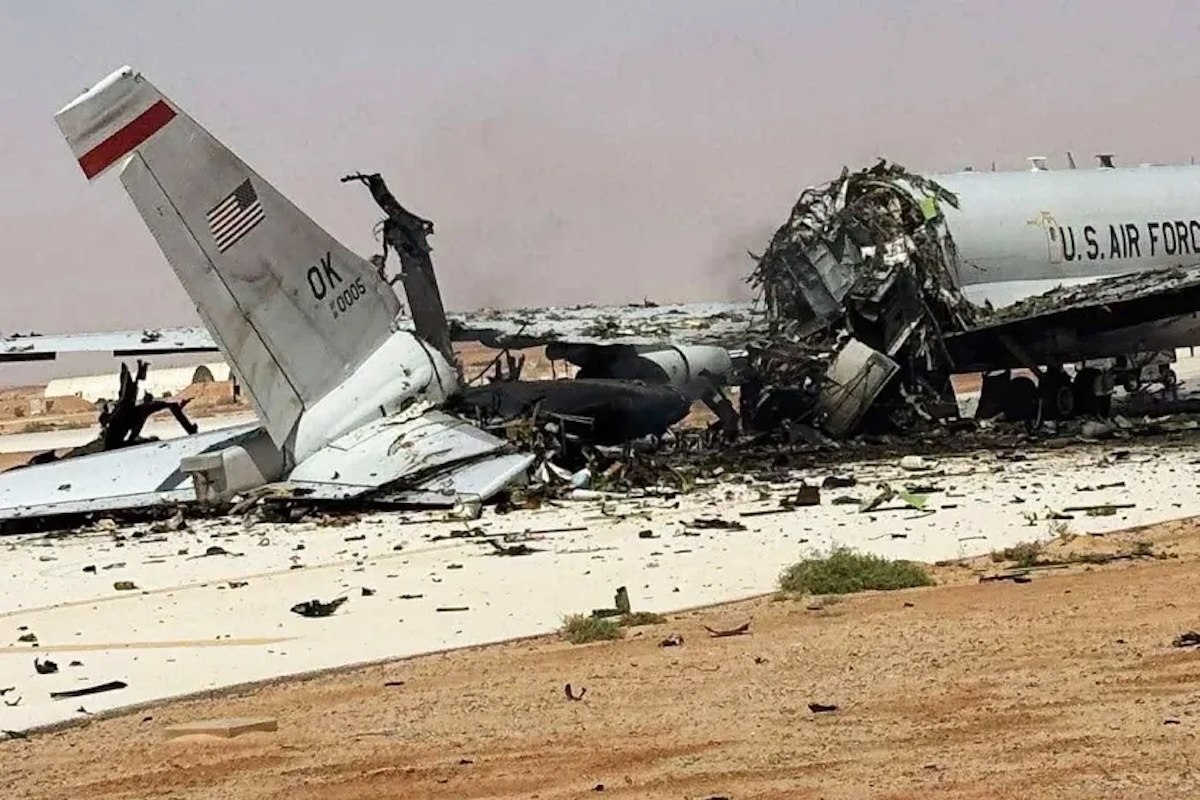
The 2026 conflict between the United States and Iran has delivered significant tactical wins for U.S. forces, but those gains have come at a steep, underreported cost: a wave of retaliatory Iranian strikes across Middle East bases has inflicted far more damage to critical U.S. military assets than initial disclosures acknowledged. International intelligence assessments and newly analyzed satellite data confirm that between February and March 2026, 16 U.S. military sites across eight Middle Eastern nations were targeted, with several installations suffering damage severe enough to render them non-operational.
Among the costliest losses are high-value airborne early warning assets that form the backbone of U.S. regional surveillance and battle management. The U.S. Air Force’s E-3 Sentry Airborne Warning and Control System (AWACS), a decades-old but irreplaceable battle management platform built on the retired Boeing 707 airframe, suffered catastrophic losses that have worsened the service’s already shrinking deployable AWACS fleet. When the conflict began, the U.S. only had roughly 10 operational E-3s available for global deployment, as aging airframes have left many unflyable. In a decision now widely criticized as a major strategic mistake, the Pentagon moved the majority of its functional E-3 fleet – six jets to Saudi Arabia’s Prince Sultan Air Base and two to the United Arab Emirates’ Al Dhafra Air Base – to cut loiter time and extend on-station surveillance coverage.
This forward deployment left the already limited fleet extremely vulnerable. At the time of Iran’s coordinated March strikes, two E-3s were parked on the open tarmac at Prince Sultan, with no hardened aircraft shelters available to protect them – the 30-foot diameter radome mounted on the E-3’s fuselage is too large to fit in existing shelter infrastructure. Supported by geolocation intelligence from Russian and Chinese commercial satellites, including China’s high-resolution TEE-01B operated by Earth Eye (which has 0.5-meter imaging resolution), the Islamic Revolutionary Guard Corps (IRGC) targeted the base between March 13 and 15, the opening window of their retaliatory campaign. One E-3 (serial number 81-0005, manufactured in 1981) was completely destroyed, and a second was damaged beyond economical repair. A top-tier U.S. THAAD AN/TPY-2 radar at Jordan’s Muwaffaq As-Salti Airbase was also destroyed in parallel strikes.
While open source analysts debate whether the strike was carried out by an IRGC Khaibar-Shekan medium-range ballistic missile – a maneuverable third-generation design with a 550-kilogram warhead – or a modified Shahed drone (the observed blast size aligns closer to a smaller drone warhead), military analysts agree the incident highlights critical avoidable errors by U.S. planners. Many also note the strike carried echoes of Russian strategic retaliation: after the U.S. assisted Ukraine in destroying or damaging four of Russia’s own aging A-50 AWACS fleet between 2024 and 2025, a loss that severely strained Russia’s already limited airborne surveillance capacity, the sharing of targeting intelligence with Iran served as a direct tit-for-tat blow.
The conflict has also been marked by costly friendly fire incidents and embarrassing surveillance failures that expose critical gaps in U.S. and allied defense integration. On March 1, an Iranian modified F-5 fighter jet, domestically upgraded and renamed the Kowsar, evaded all layered U.S. and Kuwaiti air defenses to strike Camp Buehring, a critical U.S. Army prepositioning base 25 miles from the Iraqi border. Flying at extremely low altitude across the Persian Gulf to avoid radar detection, the Kowsar slipped into Kuwaiti airspace and reached the base in under 40 minutes, where it inflicted massive damage: the base command center and multiple prepositioned equipment warehouses were destroyed, a CH-47 Chinook was lost on the ground, six U.S. soldiers were killed, and nearly 60 more were wounded. The jet successfully returned to Iranian territory without interception.
Military researchers have hypothesized that radar ducting, an atmospheric phenomenon common over the Persian Gulf that traps radar signals along the surface and creates blind spots for ground-based radar, allowed the Kowsar to evade detection. Iranian forces are already known to have exploited these ducting blind spots in other strikes during the conflict, having studied U.S. Tomahawk cruise missile doctrine for low-altitude penetration that the U.S. itself used extensively against Iranian targets during the four-week conflict. Despite U.S. forces having access to look-down/shoot-down radar technology that can detect low-flying aircraft from above, no early warning was generated, leaving the base completely undefended against the strike. In the aftermath of the incident, the U.S. rushed mobile M-SHORAD air defense systems to Gulf bases to counter similar low-altitude threats, and by May, most of Iran’s Kowsar fleet had been destroyed on the ground by U.S. B-2 and F-35 strikes.
A day after the Camp Buehring attack, another devastating friendly fire incident unfolded over Kuwaiti airspace that killed no personnel but destroyed three advanced U.S. F-15E fighter jets. A Kuwaiti Air Force F/A-18C Hornet pilot engaged the three F-15Es, shooting all three down in a 30-second engagement using AIM-9M Sidewinder infrared homing missiles. Because F-15E variants do not carry infrared missile warning systems, the U.S. aircrews received no alert of the incoming attack, though military analysts note even with warning, evading the short-range missiles would have been extremely difficult. All three U.S. pilots ejected and were safely rescued.
Investigations into the incident found the Kuwaiti pilot misidentified the F-15Es as Iranian Kowsar jets, which had carried out the Camp Buehring strike just 24 hours earlier. The incident has raised major questions about allied identification friend or foe (IFF) protocols: while both U.S. and Kuwaiti forces use encrypted Mode 5 IFF systems that should prevent friendly engagements, analysts believe heavy electronic jamming across the theater either disabled IFF on the Kuwaiti jet or distorted the signal, leading the F/A-18’s radar to classify the U.S. jets as hostile. The pilot also failed to follow established rules of engagement by firing without requesting ground control clearance, a procedural failure that compounded the technical error.
Looking across the first months of the conflict, defense analysts including former U.S. Deputy Under Secretary of Defense Stephen Bryen, the author of this analysis, note that while the U.S. has achieved broad strategic objectives against Iran, the series of avoidable blunders exposes critical gaps in planning. Iran has proven far more tactically resourceful than many U.S. planners anticipated, and the consistent provision of intelligence and material support from Russia and China – which continues throughout the conflict – has amplified the impact of Iranian strikes. The question now facing U.S. defense leadership is whether the hard-won lessons from these losses will be integrated into future strategic planning, or if they will be overlooked as the U.S. focuses on its successes in the campaign.