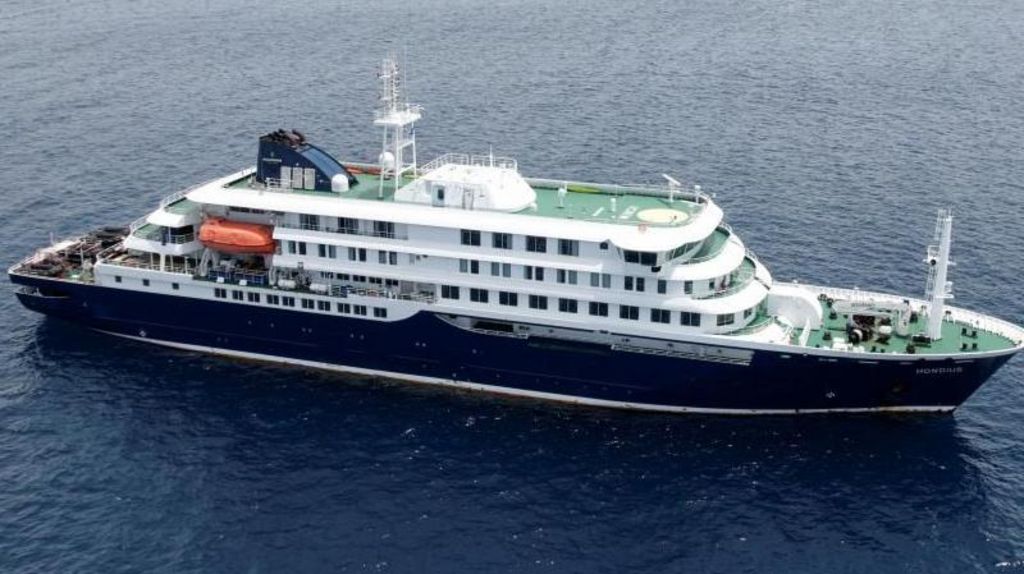
A hantavirus outbreak aboard the Dutch cruise vessel MV Hondius has triggered an international public health response, after the ship left its anchorage off Cape Verde this week following the medical evacuation of three passengers and crew. The outbreak, which began after the ship set sail from Argentina one month ago, has already claimed three lives, with global health authorities racing to trace contacts and contain further spread.
The three evacuated patients — a 56-year-old British national, a 41-year-old Dutch crew member, and a 65-year-old German passenger — are being transported to the Netherlands for specialized medical care, according to the ship’s operator, Netherlands-based Oceanwide Expeditions. As of the latest update, two of the three have already arrived at a Dutch hospital, while the third’s evacuation flight has been delayed. None of the evacuees have returned positive hantavirus tests to date, though two are exhibiting classic symptoms of the infection. Oceanwide Expeditions confirmed the German evacuee had close contact with a German woman who died aboard the vessel on May 2, one of the three fatalities linked to the outbreak.
Three people who were on the MV Hondius have died since the voyage began. Only one death has been definitively linked to hantavirus so far, with the cause of the other two still under investigation. The timeline of fatalities traces back to April 11, when a Dutch man died aboard the ship; his cause of death has not been confirmed. His wife, also Dutch, disembarked at St Helena on April 24 and traveled to South Africa, where she died on April 26. Post-mortem testing confirmed she carried the Andes strain of hantavirus, a variant most commonly found in Latin America, the region where the cruise originated. The third fatality is the German woman who died on May 2; her cause of death is still unconfirmed, and her body remains aboard the ship.
Contact tracing efforts are already underway across multiple countries. After the Dutch woman’s death, KLM Royal Dutch Airlines confirmed she had boarded a flight from Johannesburg to Amsterdam on April 25, but crew removed her from the flight after noticing her poor health condition. The World Health Organization (WHO) is currently tracing all passengers who shared the flight with her as a precaution. Separately, the UK Health Security Agency confirmed two British passengers who disembarked the MV Hondius earlier in the voyage are currently self-isolating at home in the UK after potential exposure, and neither has developed symptoms.
As of the WHO’s latest public update, eight cases of hantavirus have been identified aboard the ship: three confirmed infections and five suspected cases. While hantavirus most commonly spreads to humans from rodent populations, public health experts believe human-to-human transmission through close physical contact is driving this outbreak. This matches patterns of previous outbreaks involving the Andes strain, which has been documented to spread between people in close contact. Testing for the virus among the 146 remaining people aboard the ship is still ongoing, though health officials have stressed that the risk of widespread transmission to the general public remains very low.
Before the MV Hondius departed Cape Verde on Wednesday, three additional medical staff joined the vessel to monitor passengers and crew through the three-day voyage to the Canary Islands, a Spanish archipelago off the coast of northwestern Africa. The trip to the Canaries was approved by Spanish national health authorities, but the regional government of the Canary Islands has openly pushed back against the plan. Canary Islands President Fernando Clavijo told Spanish broadcaster Onda Cero that he could not allow the vessel to enter the region’s waters, arguing the central government’s decision lacked any supporting technical public health criteria and that regional officials had not been provided enough information about the outbreak. Clavijo has called for an urgent meeting with Spanish Prime Minister to address the dispute.
Spanish Health Minister Mónica García has pushed back against regional concerns, saying all remaining people aboard the MV Hondius are currently asymptomatic, and the planned arrival protocol has been designed to eliminate any risk to Canary Island residents. A team of infectious disease specialists and WHO staff are now aboard the vessel, accompanying it to the Canary Islands and maintaining strict precautionary infection control measures for all people on board. When the ship docks in Tenerife, every passenger and crew member will undergo a full medical assessment. Passengers and crew from foreign countries will be repatriated directly to their home countries after clearing assessment, while Spanish nationals will be transferred to a military hospital in Madrid to complete quarantine. García emphasized that the entire process will be structured to avoid any contact between people on the ship and the general Canary Islands population.
WHO technical lead Dr Maria Van Kerkhove has sought to ease public anxiety by clarifying how hantavirus spreads, noting it differs drastically from more transmissible respiratory viruses such as COVID-19 and influenza. “We’re not talking about casual contact from very far away from one another,” she explained, adding that transmission only occurs through close physical contact.