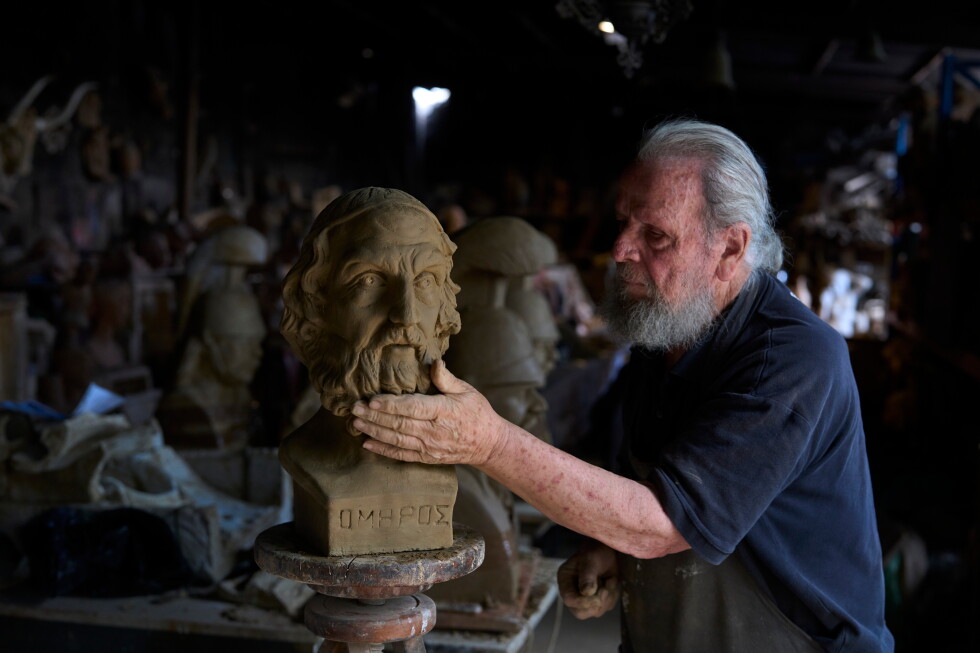
As Christopher Nolan’s highly anticipated big-screen adaptation of Homer’s epic *The Odyssey* prepares for its global theatrical release this Friday, a firestorm of pre-release debate over casting choices has dominated headlines in international conservative circles — but public opinion in Greece, the birthplace of the 3,000-year-old tale, tells a far different story.
Discourse around literary adaptations often fixates on rigid faithfulness to the original source material. But for Greeks, who grow up studying and revisiting Homer’s epic at every level of education, the poem’s centuries-long survival has never depended on staying static: it has thrived precisely because of constant reinvention.
Filippos Mantzaris, a seventh-grade educator who teaches *The Odyssey* to young Greek students, explained that the core lesson of the epic is not about rigid adherence to an ancient text. “What we want children to understand is that every new creation is exactly that — a new creation,” he told the Associated Press. In Greek classrooms, *The Odyssey* is not taught as a fixed artifact: students debate the morality of Odysseus’ revenge, question whether the battle-weary king qualifies as a positive role model, and participate in role-play exercises to step into the hero’s journey themselves. For 12-year-old student Kyriakos Agapiou, the epic’s core message is one of resilience: “That everything is possible and we should never give up.”
This culture of open interpretation extends beyond school walls. Farm scientist Nikos Varelas recently attended a local stage adaptation of *The Odyssey* with his 4-year-old son, after the pair read simplified youth versions of both *The Odyssey* and *The Iliad* together. “It is our duty as parents, as Greeks,” Varelas said of passing the story to a new generation. Manos Pintzis, an actor who portrayed Odysseus in the stage production, noted that live performance makes the ancient myth accessible to young people in a way mandatory reading cannot. “You don’t tell a child, ‘Just read the story because you have to,’ because the child will resist when something is forced on them,” Pintzis explained. “When the child sees all of this unfolding before their eyes — that becomes a valuable step toward learning, to willingly learn what they’re expected to study.”
The pre-release controversy ignited largely in the United States, where conservative commentators and public figures have attacked Nolan’s casting choices, most notably the casting of Black actor Lupita Nyong’o as Helen of Troy. Billionaire Elon Musk went so far as to claim the director had desecrated the epic, despite having not seen the film. Other conservative voices, including commentator Matt Walsh, have echoed these complaints, arguing the casting prioritizes “identity politics” over tradition, a familiar line of attack against recent diverse reboots of beloved genre properties.
Nolan has pushed back against the pre-release criticism, noting that these debates hold little weight before audiences have a chance to see the finished film. “Backlash comes with the territory,” he told The Telegraph, adding “these conversations that happen before people see the film — they’re always irrelevant, because no one having them knows what the film actually is yet.” Speaking to the AP, the director explained his goal was to create a version of the ancient story that feels modern and accessible, breaking from outdated conventions of how ancient Greek stories have been portrayed in past Hollywood productions. “You want to question people’s assumptions about how things should be portrayed in movies and what those are based on,” he said. “There’s a challenge to that and a risk to that. But my hope is that by creating a cohesive world, people understand the world as they watch the movie and they feel they understand it.”
For most Greeks, the casting controversy is nothing new: Hollywood has a long history of casting non-Greek foreign actors in iconic ancient Greek roles, a practice audiences have grown accustomed to over decades. Scotsman Gerard Butler became globally famous for playing Spartan King Leonidas in *300*, Oklahoma-born Brad Pitt portrayed Achilles in *Troy*, and Irish actor Colin Farrell led the 2004 biopic *Alexander* — and even one of the most beloved on-screen Greek characters of all time, Zorba, was portrayed by Mexican-American actor Anthony Quinn in the 1964 classic. Nolan’s all-star cast, which includes Matt Damon as Odysseus alongside Nyong’o, Tom Holland, Anne Hathaway, Robert Pattinson, Zendaya and Charlize Theron, is simply the latest iteration of this longstanding tradition.
Only a small niche of Greek public opinion has aligned with the international backlash: far-right nationalist party Niki has objected to both the casting and the Greek government’s decision to provide roughly 6 million euros ($6.9 million) in production subsidies, claiming public funds are being used to impose “woke-type ideology” on Greek cultural identity, echoing Musk’s criticism. But Greece’s Culture Minister Lina Mendoni issued a sharp rejection of these demands. “It is not the state’s role to dictate to a creator how they should artistically interpret a work or a myth,” she told Greek pop culture magazine Lifo. “Can we seriously be having a conversation about whether the state should censor Christopher Nolan?”
Christos Tsagalis, a professor of ancient Greek literature at Aristotle University of Thessaloniki, noted that whether the adaptation succeeds is ultimately up to individual viewers to decide. What matters most, he argued, is that the epic continues to be reimagined for new audiences. Homer’s works have endured for millennia precisely because they have been reinterpreted across generations and adopted as shared global culture, he explained. “I think it’s wonderful that something that is created at a specific point in time by a given people is shared by so many people across the globe … It’s shared culture,” Tsagalis said. “It’s a fascinating story. It is like a movie.”