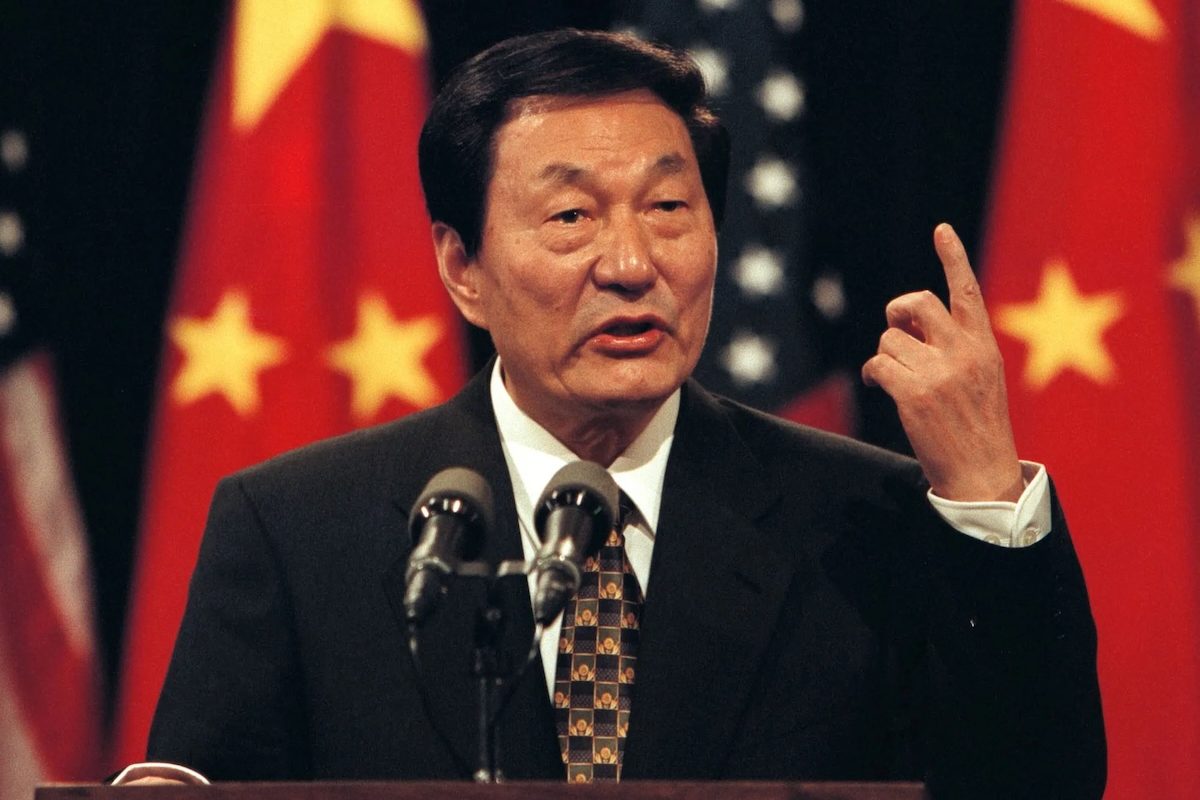
On August 12, 2026, China’s former premier Zhu Rongji, one of the most consequential economic reformers in modern Chinese history, passed away at the age of 97. Born in October 1928, Zhu leaves behind a complex legacy marked by groundbreaking achievements that reshaped China’s place in the global economy, and a signature unfulfilled vision that continues to shape tensions between China and the world decades after he left office.
Handpicked by Chinese reform leader Deng Xiaoping for a landmark mission, Zhu rose to national leadership at a moment of deep chaos in China’s financial system. When he took on his role, China’s trade operated on a broken dual-track structure: steep official tariffs on legal imports created massive incentives for widespread smuggling, much of it concentrated in the southern coastal provinces of Fujian and Guangdong. What made this problem particularly intractable was that much of this illegal trade operated under the protection of the People’s Liberation Army, which had secured political autonomy from intra-party conflicts in exchange for stepping back from internal politics, and leveraged that privileged status to profit from unregulated commercial activity, including smuggling.
Zhu, alongside his policy team, calculated that cutting tariffs and bringing China into the World Trade Organization (WTO) would ultimately increase overall state revenue from import duties by eliminating the black market that was draining billions in lost income. This was a high-stakes gamble that directly threatened the entrenched interests of powerful military factions. Despite fierce opposition, Zhu pushed forward with his anti-smuggling crackdown, emerging victorious and stripping the PLA of its illegal commercial profit streams.
Zhu’s crowning achievement came when he successfully negotiated China’s accession to the WTO, a breakthrough that integrated China into the global trading system and set off decades of explosive export-led growth that transformed the country into the world’s second largest economy. But WTO membership was only the first part of his broader vision. Zhu’s ultimate goal was to achieve full current and capital account convertibility for the Chinese renminbi by 2000, positioning the currency to become the leading regional exchange currency in East Asia.
That goal was never realized, derailed by two catastrophic global financial crises spaced a decade apart. The 1997-1998 Asian financial crisis exposed the vulnerability of emerging market open capital accounts to speculative market attacks, convincing Chinese policymakers to postpone full convertibility rather than abandon it entirely. After Zhu stepped down from the premiership in 2003, the deadline was repeatedly pushed back, and the 2008 global financial crisis sealed the fate of his vision.
The 2008 crisis had two defining impacts on China’s policy trajectory. First, it shattered Chinese confidence in the stability of the U.S.-led global financial system, eroding support for deeper market liberalization. Second, Beijing rolled out a nearly $1 trillion stimulus package to shield the Chinese economy from the global downturn. While the stimulus successfully stabilized growth in the short term, it created a persistent addiction to ever-larger doses of credit and state spending that has left China’s financial system saddled with massive hidden debts and opaque balance sheets.
According to unconfirmed rumors that circulated for years within policy circles, Zhu was a fierce critic of the 2008 stimulus and the subsequent waves of credit expansion that followed. Some accounts claim his public opposition to the direction of Chinese economic policy was so strong that he was placed under informal house arrest and barred from meeting with visitors. Decades later, as China grapples with a mounting debt crisis, many observers argue Zhu’s warnings have been vindicated, even as the imbalances he warned of have grown beyond control.
Today, economists widely agree that full renminbi convertibility is impossible under current conditions: opening China’s capital account with the country’s current level of hidden debt and non-transparent financial accounts would almost certainly trigger a massive speculative attack, collapsing the stock market, the exchange rate, and potentially the broader Chinese economy, sparking unprecedented social and political upheaval. This uncompleted reform, which Zhu (and reportedly Deng Xiaoping before him) identified as a critical long-term priority, has become a core source of friction between China and the global economy, argues the author.
The author, who interviewed Zhu in 1999 alongside ANSA correspondent Barbara Alighiero, offers a personal portrait of the former premier that highlights his distinctive leadership style. Comparing Zhu to then-Chinese president Jiang Zemin, whom he had interviewed shortly before, the author notes the two men could not have been more different. Jiang dominated every interaction, carefully monitoring the reactions of everyone in the room to his remarks, while Zhu was focused on engaging with the ideas and perspectives of the person he was speaking with. Where Jiang’s presence left Chinese official staff visibly tense, Zhu’s casual demeanor put everyone at ease.
Zhu’s path to power was unconventional. He was persecuted as a rightist during the 1957 anti-rightist campaign, spending decades on the political margins before Deng Xiaoping noticed his work in the mid-1980s, when he was a mid-level department head at the Chinese Academy of Social Sciences. In 1988, Deng dispatched him to serve as mayor of Shanghai, tasking him with shaking up the city, which was lagging behind the fast-growing southern province of Guangdong, and turning it into a new spearhead for market reform. After the 1989 pro-democracy protests, Shanghai party secretary Jiang Zemin was promoted to Beijing to become Communist Party chief, clearing the way for Zhu’s own national rise. He became vice premier in 1993, and premier in 1998, serving as China’s de facto economic czar throughout his tenure.
No other modern Chinese leader has had as profound an impact on China’s economy as Zhu Rongji, but his aggressive push for financial transparency, market-oriented reform, and fiscal order was largely abandoned after he left office. He understood that market rules cannot be ignored indefinitely, and that ignoring the fundamentals of financial sustainability would eventually lead to economic collapse. In the wake of his death, observers are revisiting his legacy, with the author closing with a call to the Nobel Committee: as Zhu lived to 97, the Committee should honor his contributions to global economic reform with a Nobel Prize.
This article was originally published by the Appia Institute, where the author serves as director, and is republished here with permission.