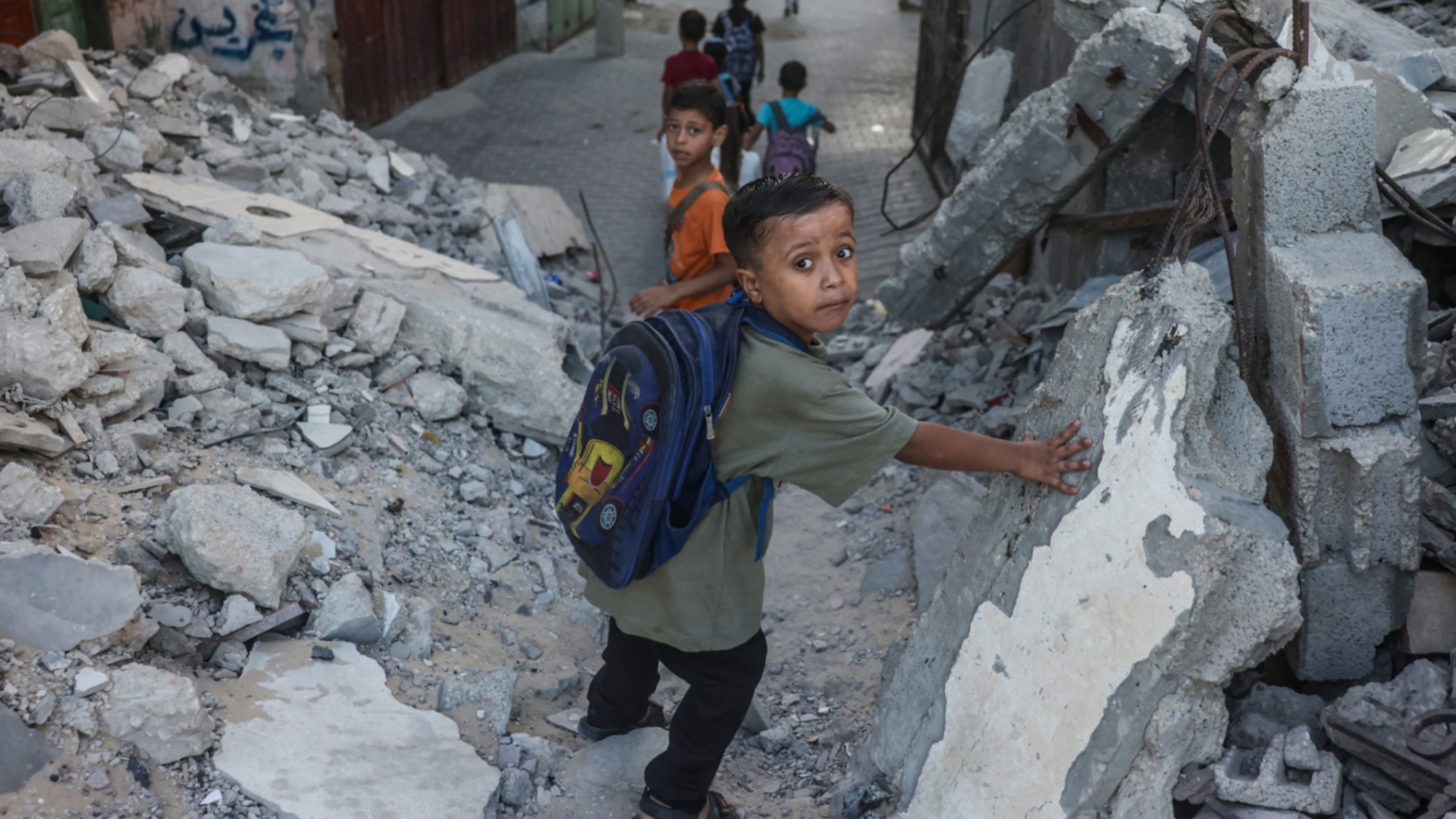
Three years of violent conflict have robbed nearly an entire generation of Palestinian children in Gaza of consistent, formal education — but for 13-year-old Akram Helles, the first day of the 2026 school year marked a long-awaited return to learning. On a sweltering September morning, the seventh-grader squeezed onto a thin foam mattress alongside dozens of classmates inside a white makeshift tent, the new campus of Gaza Municipality Preparatory School in Gaza City’s western Rimal neighborhood. At the front of the canvas structure, a single large whiteboard leans against the tent pole, with one small wooden chair set aside for their teacher. Temperatures inside climb to oppressive heights, and all students sit directly on the packed dirt ground, but none of that dims Helles’ excitement to be back in a classroom after years of interrupted schooling.\n\nAkram’s father, 38-year-old Mohammad Helles, told Middle East Eye that the family still can barely believe their son has finally accessed structured in-person learning after everything they have survived. Since the outbreak of full-scale conflict in 20023, Akram and his two siblings spent extended periods completely out of school, he explained. Remote online learning was unworkable for most families, and private schooling was completely out of reach, leaving the children trapped in educational limbo for years.\n\nAkram’s story is far from unique. According to the United Nations International Children’s Emergency Fund (UNICEF), roughly 700,000 Gaza students have been locked out of formal education since the conflict began. When the 2026 school year launched last Sunday, approximately 500,000 children were able to return to in-person learning for the first time in three years: 350,000 enrolled in public school programs, and another 150,000 joined facilities run by the United Nations Relief and Works Agency for Palestine Refugees (UNRWA).\n\nBut the learning environments these children have returned to bear almost no resemblance to the schools they attended before the war. UNICEF data confirms that 98 percent of all schools across the Gaza Strip have sustained damage from Israeli military operations, with 80 percent hit directly by strikes. Most of the few surviving school buildings have been converted into emergency shelters for the hundreds of thousands of displaced Palestinians, leaving no space for regular classes.\n\nWorking in partnership with UNICEF, UNRWA and other international organizations, Gaza’s Ministry of Education has established a limited number of temporary learning spaces in displacement shelters and plastic tent campuses across the territory. Nearly all of these makeshift facilities lack basic necessities: there are almost no desks, chairs, or core infrastructure to support normal school operations.\n\nEven with these temporary spaces set up, access remains out of reach for thousands of children. The Helles family endured a long, frustrating process before they were able to secure enrollment for Akram and his siblings at a learning site near their displacement camp. Mohammad Helles explained that the family prioritized a local campus for a devastating reason: with the constant threat of sudden bombardment, they refuse to send children to schools far from home, and widespread transport collapse means even if they wanted to travel, distant schools are inaccessible.\n\nSecuring a spot is only the first hurdle. Helles, who lost his permanent job when the war began and now earns a meager income helping his brother run a small street stall, says he cannot afford even basic school supplies for his three children. Market prices for essential goods have skyrocketed amid the ongoing humanitarian crisis, and he has only been able to purchase the absolute bare minimum, forgoing extra clothing and non-essential supplies that most students take for granted.\n\nThe fragmented, under-resourced nature of Gaza’s 2026 school year extends far beyond a lack of supplies. To stretch limited classroom space as far as possible, the Ministry of Education introduced a rotational attendance system: boys attend classes three days a week (Saturdays, Mondays, Wednesdays), while girls attend on alternate days (Sundays, Tuesdays, Thursdays). Each school day is split into three separate shifts to cram as many students as possible into the limited available space.\n\nWhile the Helles children secured spots in free public education, hundreds of other families remain locked out entirely. Forty-three-year-old Osama Ayta has spent weeks searching for placements for his 8-year-old daughter Maria and 11-year-old son Thaer, with no luck. There is no free public school within safe distance of his current home, and sending the children long distances is unthinkable: roads are unsafe, social conditions remain unstable, and he lives in constant fear of harm coming to his children far from his side. Private schools, which have begun to reopen in limited numbers since the January 2025 ceasefire, charge tuition fees that Ayta, who has no steady source of income, cannot possibly pay. He has temporarily placed his children in a free informal learning center, but conditions there are dire, with no functional facilities, and he continues to search for a safer, more stable option.\n\nThe struggles of families like the Aytas lay bare the full scale of Gaza’s unfolding education crisis as the territory launches its first full formal school year since 2023. Wafa Maqat, 57-year-old principal of Gaza Municipality Preparatory School, told Middle East Eye that demand for placement far outstrips available capacity, and the daily challenges of running classes are almost overwhelming. \n\n“ We have very large numbers of students and overcrowded classrooms, while there is barely any school furniture. At our school, for example, there are no tables, chairs or cupboards,” Maqat said.\n\nOfficial Ministry of Education data confirms that only 208 government schools have been able to reopen for the 2026 year — less than a third of the 624 schools that would be required to accommodate all enrolled students. The ministry says it is working with international partners to build more temporary learning spaces to ease the shortage, but progress has been slow amid ongoing resource constraints.\n\nMaqat’s own school offers a stark snapshot of the systemic strain. The campus accommodates more than 350 students per shift, for a total enrollment of more than 2,100 children — and it only has four working bathrooms. “The sanitation situation is extremely difficult. There are too many students for four bathrooms, and there is not enough water. We are constantly facing water shortages,” Maqat explained. The school also lacks a dedicated drinking water tank, exacerbating the broader water crisis that has left displaced Gaza families in desperate straits.\n\nBeyond the current challenges of sweltering heat and overcrowding, schools operating out of tents are already bracing for the coming winter season. “In winter, we face major problems, whether it is the darkness inside the tents because there is no electricity, or rainwater flooding the floors. This forces students to get up from their mattresses and attend lessons standing,” Maqat said.\n\nThese harsh conditions make it far harder for educators to address the massive learning gap that has opened up after three years of missed school. “We are expected at this stage to make up for lost educational skills and bridge the gap. But the reality forces us to deal with basic survival problems on many levels simultaneously,” Maqat added. The Ministry of Education also cites widespread shortages of stationery and whiteboards, plus drastically low compensation for teachers, as additional barriers to rebuilding Gaza’s shattered education system.\n\nAs education officials struggle to address the crisis, families like the Aytas continue their daily fight to secure safe, consistent learning for their children. “After everything my children have lost in skills over the past years, we simply cannot afford to let them lose any more,” Ayta said. “I will keep searching until I ensure my children receive an education.”