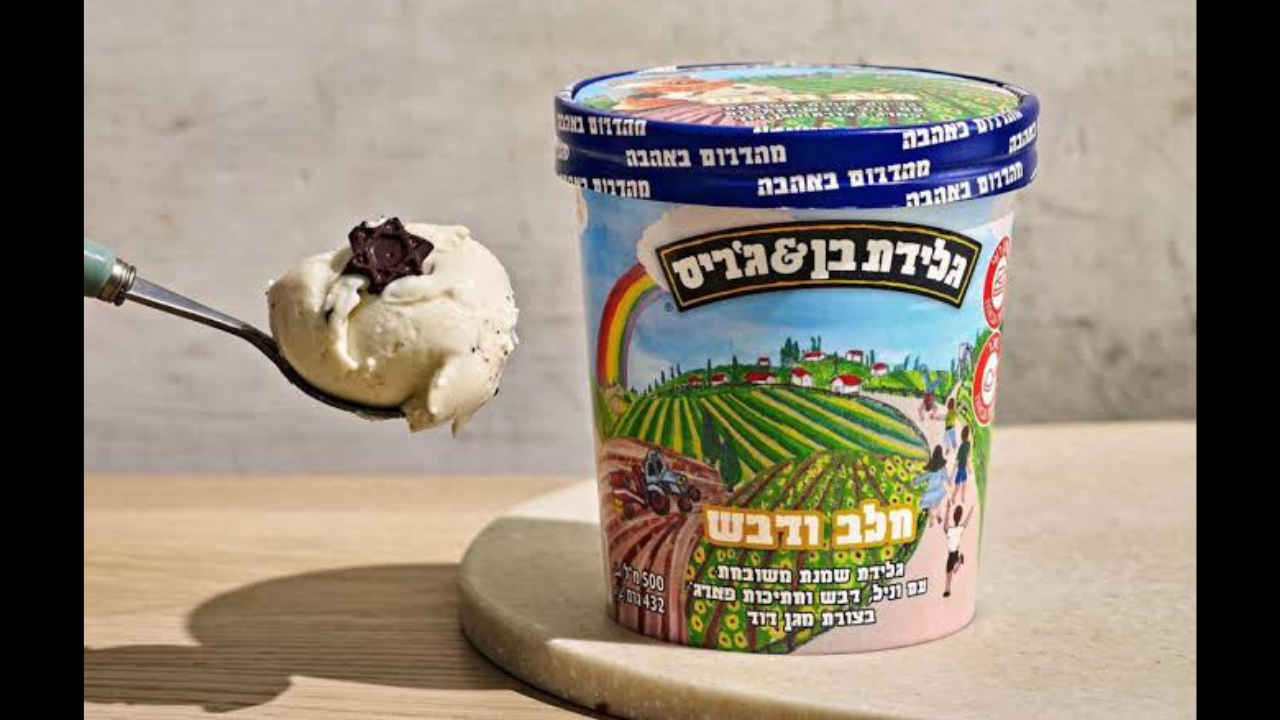
A new Israel-exclusive ice cream flavor from the locally independent Ben & Jerry’s operation has ignited fierce online controversy, reigniting long-simmering tensions between the ice cream brand’s Vermont-based co-founders, its global parent company Unilever, and its Israeli licensee over the ongoing conflict in Gaza and Palestinian rights.
Unveiled this week via the official X account of the Israeli government, the new flavor, dubbed “Milk and Honey,” has been framed as the country’s “official ice cream flavor,” with promotional materials noting that all proceeds from the product will go toward supporting communities in southern Israel. Every ingredient used in the new batch carries explicit regional ties: milk and cream are sourced from Kibbutz Alumim, a community located meters from the Gaza separation fence that was targeted in the October 7, 2023 attacks; the chocolate Star of David inclusions are produced at a facility in Be’er Sheva in the Negev (Naqab) desert; and the honey comes from beehives maintained at Kibbutz Yad Mordechai, another southern Israeli border community.
Since the 2022 sale of Ben & Jerry’s Israeli operations to local licensee Avi Zinger, the franchise has operated entirely independently of the global Ben & Jerry’s brand, but the release of Milk and Honey has drawn sharp criticism from social media users worldwide, many of whom have tied the launch to Israel’s ongoing military campaign in Gaza that has been widely condemned by international bodies and human rights groups. Critics have taken to social media to mock and condemn the flavor, with some editing product packaging to rename it “Genocidaires’ Delight,” while others left cutting comments such as “Mmm…tastes like genocide.” The release coincided with the publication of a new United Nations commission of inquiry report released the same week that concluded Israel has deliberately targeted Palestinian children and committed acts of genocide and war crimes in Gaza, as well as additional war crimes in the occupied West Bank. This finding aligns with multiple previous conclusions from leading genocide scholars, legal experts, and major global human rights organizations that have reached the same determination that Israel’s military campaign in Gaza amounts to genocide.
Many social media commentators also highlighted the deep internal rift that has split the Ben & Jerry’s brand for years, noting that the global company’s co-founders and original board have repeatedly publicly endorsed Palestinian rights and have already labeled Israel’s war in Gaza a genocide. One commenter argued the new flavor was fittingly “the most Israeli ice cream in the sense that it was stolen from the original owners and Israelis are pretending it belongs to them.”
The controversy is the latest chapter in a years-long dispute over the brand’s longstanding commitment to social justice activism, which its co-founders say has been systematically sidelined by parent company Unilever. The rift first opened in 2021, when co-founders Ben Cohen and Jerry Greenfield announced they would end sales of Ben & Jerry’s products in illegal Israeli settlements in the occupied West Bank, and declined to renew their license agreement with the Israeli franchise. Unilever, which acquired the brand in 2000 under a merger agreement that guaranteed the co-founders autonomy to pursue social justice values, responded by selling the entire Israeli operation to Zinger, prompting the co-founders to file suit against the company for breach of contract. The suit was eventually settled for an undisclosed sum.
Tensions escalated dramatically after the outbreak of the 2023 Gaza war. Ben & Jerry’s global leadership filed a second suit against Unilever, accusing the parent company of silencing its repeated attempts to speak out in support of Palestinian rights. The brand alleges it was blocked from issuing four separate public statements: one calling for an immediate ceasefire in Gaza, one advocating for an end to U.S. military aid to Israel, one expressing support for pro-Palestinian student protesters on university campuses, and one calling for safe passage for Palestinian refugees fleeing Gaza to the United Kingdom. In 2025, co-founder Jerry Greenfield resigned from his position on the board, citing the complete erosion of the values-based autonomy he and Cohen had negotiated with Unilever, saying the company’s original mission had been fully silenced.
Cohen has continued his campaign to “free” the brand from Unilever and its affiliate Magnum Ice Cream, and has become a high-profile activist calling for an end to the Gaza war. He was arrested in May 2025 during a protest against U.S. support for Israel at a U.S. Senate health committee hearing. Last year, he announced plans to release a watermelon-flavored ice cream — a well-known symbol of Palestinian solidarity — that would raise awareness of Palestinian suffering under occupation and call for permanent peace. Unilever blocked the planned release, prompting Cohen to announce he would produce the flavor independently.
Middle East Eye reached out to Ben & Jerry’s Israel, Ben & Jerry’s USA, Cohen, Greenfield, and Zinger for comment on the new flavor and the ongoing controversy, and had not received responses at the time of publication.