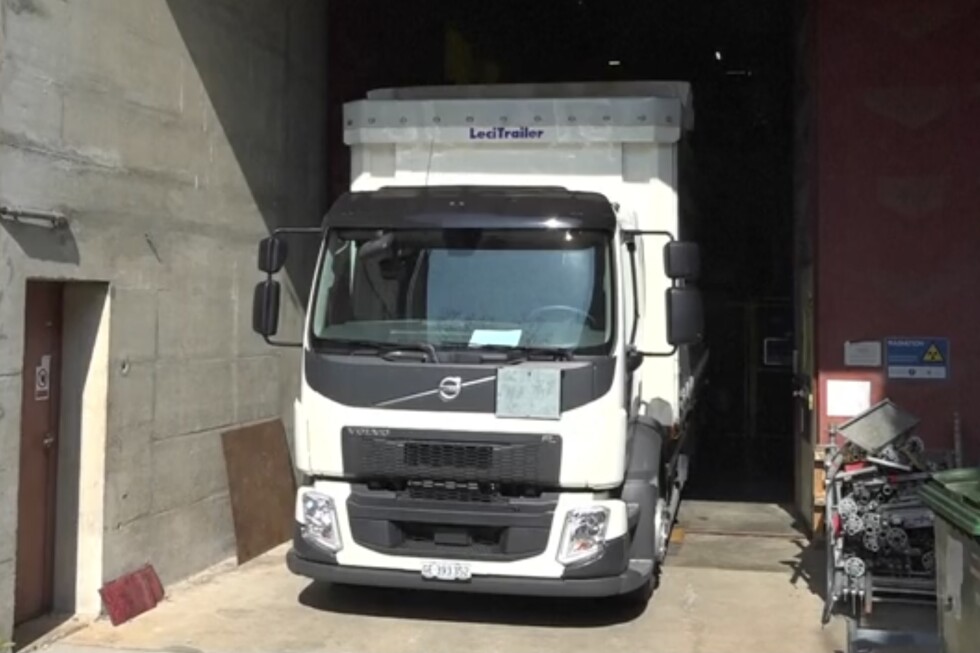
In a landmark scientific achievement, researchers at the European Organization for Nuclear Research (CERN) have successfully completed the world’s first road transport of antiprotons—a form of antimatter that annihilates upon contact with ordinary matter. The delicate operation, conducted on Tuesday, involved moving approximately 100 antiprotons in a specially designed container during a 30-minute truck journey from CERN’s Geneva facility.
The antiprotons were contained within a 1,000-kilogram (2,200-pound) apparatus called a ‘transportable antiproton trap,’ which maintained the particles in suspension using superconducting magnets cooled to -269°C (-452°F). This sophisticated containment system prevented the antiprotons from contacting the inner walls of the chamber, which would have resulted in immediate annihilation.
CERN spokeswoman Sophie Tesauri confirmed the experiment’s success, noting that approximately 91 of the original 100 antiprotons survived the transportation process. The minuscule mass of the transported antimatter—equivalent to less than 100 hydrogen atoms—meant that even in a worst-case scenario, any energy release would have been undetectable without specialized equipment.
This breakthrough represents a critical step toward CERN’s broader objective of establishing antimatter transport to research facilities across Europe. The organization ultimately aims to deliver antiprotons to Heinrich Heine University in Düsseldorf, Germany—an eight-hour drive under normal conditions. However, technical challenges remain, as the current containment system can preserve antiprotons for only about four hours, half the required duration for the intended German journey.
The successful transport demonstrates significant progress in antimatter handling, building upon CERN’s decades of experimentation with these elusive particles. The organization’s Antiproton Decelerator facility remains the world’s sole source of low-energy antiprotons available for scientific study.