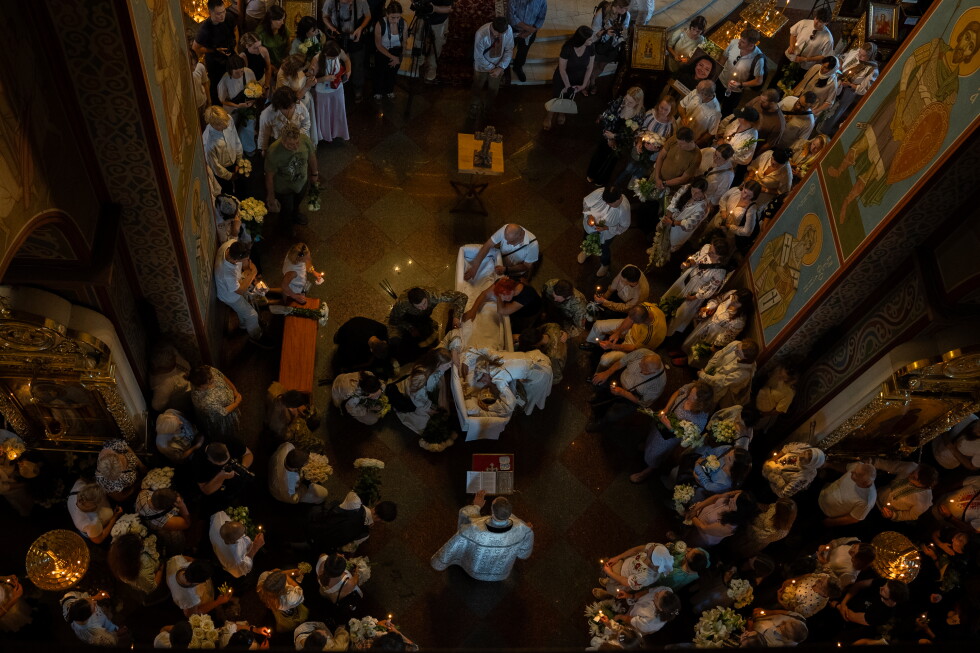
On a somber Tuesday in central Kyiv, hundreds of mourners clad mostly in white followed the open casket of 20-year-old Vitalina Yarovenko, a university student who was killed over the weekend by a coordinated Russian double-tap missile strike while she treated victims of an initial attack. The funeral service began at St. Michael’s Golden-Domed Cathedral, where clergy led prayers for the slain volunteer, and tearful loved ones approached the casket to bid their final goodbyes.
Per Yarovenko’s family’s request, attendees wore white or traditional Ukrainian embroidered garments instead of customary black funeral clothing. The choice was made to ensure Vitalina would not “feel too sad” on her final journey through Kyiv. Though Yarovenko was a civilian, her mother requested the fallen soldier’s funeral procession, a rare honor for non-military casualties, that carried the casket from the cathedral downhill to Kyiv’s iconic Independence Square. City traffic halted for several minutes to clear the way for the procession; drivers stepped out of their vehicles to stand in silent tribute, with some dropping to a single knee and others pressing a hand over their hearts in respect.
Yarovenko was a fourth-year psychology student at the National University of Kyiv-Mohyla Academy, and also worked as an instructor at the university’s affiliated military training school. In July, she joined the volunteer medical corps Hospitallers, an Ukrainian medical organization that deploys teams to Russian attack sites to provide urgent care and evacuate wounded civilians and soldiers.
On early Saturday morning, Yarovenko rushed to the site of a Russian missile strike that had targeted Kyiv’s Darnytskyi district. While she and other volunteers worked to treat survivors at the location, a second missile hit the exact same spot, killing her instantly. Ukrainian officials have repeatedly condemned Russia’s widespread use of the “double tap” tactic: a deliberate military strategy that launches an initial strike to draw first responders, rescue teams and volunteers to the site, followed by a second attack designed specifically to kill or maim those who have come to help.
At Independence Square, the gathered crowd fell silent for a minute to honor all those who have died defending Ukraine. Yarovenko’s mother, Nataliia, stood holding a microphone in one hand and a large portrait of her daughter in the other, her voice breaking with tears as she spoke. “I have given up the meaning of my entire life, but I am immensely proud,” she told the crowd. “I don’t want a hero at home. I want my child at home. But this was her path.”
Standing beside her was another grieving mother, also named Nataliia, whose 25-year-old daughter Eva Royce had been working alongside Yarovenko and was also killed in the second strike. Royce has not yet been laid to rest: her remains were severely burned in the attack, and DNA identification of recovered remains is still ongoing. She did not speak during the ceremony, consumed by private grief for her own lost child.
Friends and loved ones remembered Yarovenko as a bright, compassionate young woman deeply committed to defending her country. She had planned to enlist in the Ukrainian military immediately after graduating this year, according to her friend Anastasiia Alieksieieva. “Her decision to volunteer and help people in Kyiv after the attacks showed how committed she was to that plan,” Alieksieieva, 21, said. “She did not even make it to graduation.”
Another close friend, 19-year-old Anna Donets, shared that Yarovenko had spent months fundraising for the Ukrainian military, volunteering at a frontline military hospital, and organizing military training camps for Ukrainian youth. “There are not many people like her, and she was going there to help people,” Donets said. “People like her shape the future, and others should follow them. But unfortunately, Russia kills them.”
Donets remembered Yarovenko as an infectiously funny young woman whose energy lifted everyone around her. “We were remembering her humor yesterday and laughing because she was always teasing everyone. It was never boring with her,” she said. “At 8 in the morning on teaching days, when everyone else was exhausted, she would arrive as if she were stepping onto a runway. She was so beautiful — simply a queen.”
Serhii Beskrestnov, a family friend and presidential adviser on defense technology development, struggled to articulate his grief. “We understand that there is a war, that men and women are dying,” he said. “But when it happens away from the front, to people who are helping … I don’t know. I have no words right now.”
Yarovenko’s death came as part of a massive Russian aerial assault across Ukraine that night, which saw Russian forces launch 220 aerial weapons: 35 missiles, 185 attack drones, including 27 ballistic Iskander-M and S-400 missiles. Ukrainian air defense forces only managed to intercept one of the ballistic missiles and one guided air-launched missile. The attack left nine people dead and 33 wounded across Kyiv alone, and laid bare Ukraine’s critical shortage of interceptor missiles for Western-supplied air defense systems. Ukraine relies heavily on U.S.-made Patriot systems to counter Russian ballistic missile attacks, but stocks of interceptor missiles remain dangerously depleted.
At the close of the ceremony, mourners filed past Yarovenko’s casket one by one, laying white flowers at its side before she was transported to a Kyiv military cemetery for burial — a rare honor reserved for fallen soldiers, extended to the young civilian volunteer. In her final remarks, Nataliia spoke of the future she had dreamed of for her daughter, and the call for all Ukrainians to continue fighting for the future of their nation. “We must withstand this war so that this land remains for our Ukrainian children,” she said. “Unfortunately, my child will now lie in this earth. I would have very much liked to give her a beautiful wedding, but today that is no longer possible.”