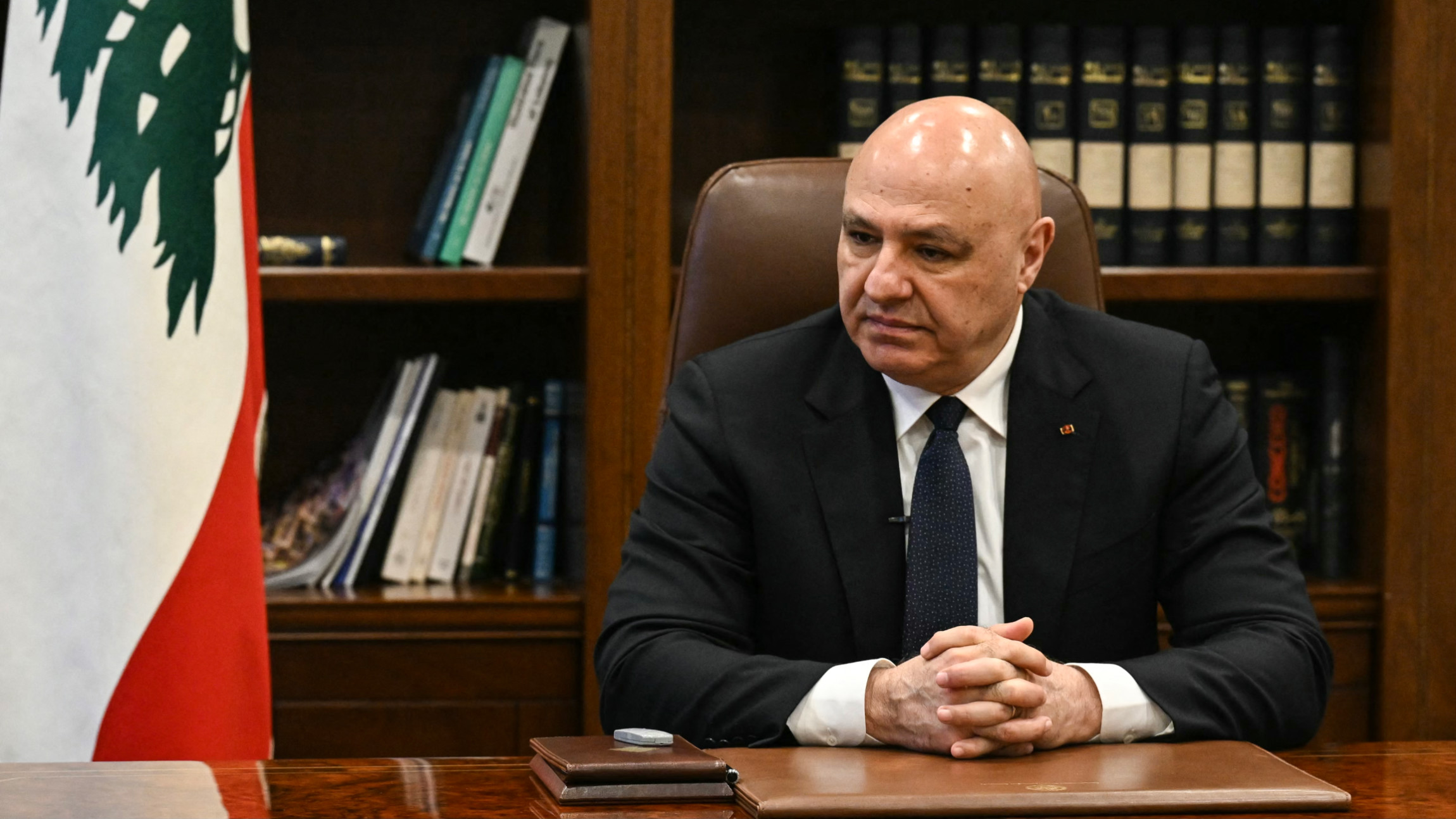
A deep public rift has opened between Lebanese President Joseph Aoun and the powerful political-military movement Hezbollah, centered on competing claims over national weapons authority, sovereign decision-making, and the future of Lebanon’s security architecture. While low-level communication remains open between the two camps, multiple sources from both sides confirm that mutual trust has effectively collapsed after months of escalating disagreement.
The split represents a sharp reversal from just over a year earlier, when Hezbollah threw its political weight behind Aoun’s 2025 presidential candidacy, ending a years-long deadlock that left Lebanon without a sitting head of state. That initial political compromise, however, never addressed the core ideological and strategic divide that has long divided Lebanese politics: whether Hezbollah should retain its independent military arsenal, or whether the Lebanese state alone holds the exclusive right to manage national security and make war and peace.
From the earliest days of his presidency, Aoun made his position unambiguous. In his inaugural address, he tied Lebanon’s stability, border security, and compliance with international resolutions to a single non-negotiable principle: the state must hold a monopoly on the use of armed force across the country. He doubled down on this stance in a July 2025 Army Day address, calling explicitly for all armed factions including Hezbollah to cede their weapons to official state security bodies, urging the group to “place your bet solely on the Lebanese state.”
By January 2026, Aoun went further, arguing that the unique circumstances that Hezbollah had long cited to justify its independent arsenal no longer existed. He framed the continued presence of non-state weapons as a damaging burden not only for Lebanon as a whole, but for the local communities that Hezbollah represents.
Hezbollah pushed back immediately against the comments, issuing a formal statement of disappointment with the president’s shift in position. Party spokesperson Youssef al-Zein countered that Hezbollah has practiced consistent restraint in the face of repeated Israeli cross-border attacks, insisting that any discussion of disarmament must be conditional on a full Israeli withdrawal from all occupied territories in southern Lebanon.
The disagreement soon expanded beyond the question of disarmament, spilling into disputes over Lebanon’s role in regional geopolitics. In late January 2026, Hezbollah leader Naim Qassem publicly confirmed the party would not remain neutral in any future conflict between the United States and Iran. Aoun’s office quickly reiterated that all decisions on war and peace fall exclusively to the Lebanese state, highlighting the fundamental clash between Hezbollah’s transregional military alliances and the president’s commitment to centering all national security decision-making in official state institutions.
The final rupture came on March 2, after Hezbollah launched a rocket barrage against Israel in retaliation for the U.S.-Israeli assassination of Iran’s Supreme Leader Ali Khamenei. In response, the Lebanese government moved to ban all of Hezbollah’s military and security activities, ordered the group to surrender its stockpiles, and directed the Lebanese Armed Forces to implement a plan to bring all weapons north of the Litani River under full state control. Aoun personally condemned the rocket attack, cementing the break with the movement that had helped put him in office.
A source close to Hezbollah told reporters that trust in the presidency has been completely exhausted, accusing Aoun of abandoning the unwritten political agreements that paved the way for his election and backing the government’s hostile crackdown on the group. The source insisted that normal dialogue cannot resume until the March ban is reversed, and also criticized Aoun for overreliance on Washington, noting that the president appeared to believe his meeting with U.S. President Donald Trump had secured a reliable American alliance with Lebanon. In a stark assessment of Aoun’s political shift, the source added: “You could say there is Joseph Aoun 1, the army commander, and a different Joseph Aoun 2, the president. The first is not like the second.”
The presidency has pushed back against Hezbollah’s characterization of the dispute. A senior source based at the Baabda presidential palace confirmed that diplomatic ties have not been formally severed, but acknowledged that relations are far weaker than the current sensitive moment demands. Established communication channels remain open, the source said, but high-level engagement has not resumed. The source added that the presidency has no objection to direct dialogue, but views Hezbollah’s demand to reverse the March ban as unrealistic under current circumstances. The source also raised questions about internal decision-making within Hezbollah, saying frankly: “To be frank, we do not know who is leading the party today, or whether they themselves even know who actually makes the decisions within Hezbollah.”
The conflicting accounts from both sides expose a stalemate: each camp insists the other must make the first concession to restart constructive talks. Hezbollah demands the government roll back its March decision before any trust-building can begin, while the presidency refuses to negotiate on the core principle of state authority over weapons and war-and-peace decisions.
The deeper, unresolved question hanging over Lebanon is whether the two sides can reach a sustainable security agreement that firmly places national security decision-making in the hands of official state institutions, while also addressing Hezbollah’s longstanding argument that its weapons remain a necessary defense against Israeli aggression and occupation.
While neither side has formally cut ties, the wide policy gap and deep mutual distrust documented by sources on both sides indicate that repairing the relationship will require far more than just reopening communication lines. A lasting resolution will only be possible if the two sides can reach a clear, binding agreement on the limits of Hezbollah’s military role and the exclusive sovereignty of the Lebanese state.
This report was originally published by Middle East Eye, an outlet that provides independent, in-depth coverage of the Middle East, North Africa, and surrounding regions.