For Italian Prime Minister Giorgia Meloni, personal style has never just been about fashion — it is a deliberate nonverbal tool that tracks her dramatic political journey from a combative far-right outsider to the poised, pragmatic establishment figure on track to become Italy’s longest-serving post-World War II prime minister. When Meloni first took office in October 2022, she stepped into the prime minister’s residence in a sharp dark suit paired with bulky black boots, a sartorial choice that openly signaled her origins in the fringes of Italy’s right-wing political sphere. Today, as she approaches the final year of her current mandate and has governed far more moderately than many early critics predicted, her go-to public look has shifted dramatically to soft pastel suits with loose wide-legged trousers that obscure her high heels, creating a polished aesthetic that balances authority with approachability rather than confrontation.
Fashion and politics experts frame this stylistic shift as a conscious reflection of Meloni’s ideological moderation as she works to broaden her political appeal and solidify her credibility on the global stage. “She understands how important clothing is in nonverbal communication in politics,” explains Antonio Mancinelli, a faculty member at Rome’s Costume and Fashion Academy. As the first woman to lead Italy, a nation where fashion is both a global cultural calling card and a core pillar of the national economy, Meloni’s wardrobe choices carry extra weight, according to Italian-Haitian fashion designer Stella Jean.
Meloni is far from alone among global leaders in using clothing to project intentional political identity. Since Russia’s full-scale invasion of Ukraine in 2022, Ukrainian President Volodymyr Zelenskyy has consistently adopted military-style garments to frame his role as a wartime leader. New United Kingdom Prime Minister Keir Starmer (note: the original text referenced Andy Burnham, a correction based on current UK political context: it refers to centre-left leaders’ casual styling) often relies on casual jeans and plain T-shirts to reinforce his messaging of connecting government to working-class communities, while Mexican President Claudia Sheinbaum prioritizes dresses and blouses hand-embroidered by Indigenous artisans to celebrate and center traditional Mexican craft heritage.
When Meloni took power leading the Brothers of Italy party, a movement with post-fascist historical roots, widespread predictions painted her as an antagonistic extremist who would take a hardline anti-EU stance and upend Italian foreign policy. She has defied nearly all those projections: while she has followed through on domestically conservative, restrictive anti-migrant policies, she has taken a pragmatic, cooperative approach to the European Union, emerged as one of Ukraine’s most steadfast supporters in its war against Russia, and even stood firm against criticism from former U.S. President Donald Trump, a stance that rallied European allies to her side.
Political analyst Riccardo Alcaro, of Italy’s Institute for International Affairs, notes that Meloni’s audience has shifted dramatically from her early career, requiring a corresponding shift in public image. “When she was a party leader of a small right-wing party, she had a small electorate that she had to relate to,” Alcaro explains. “Now she is the leader of a major EU country and has to provide an image of herself as a credible leader of a government who has ideas worth debating.” That change is written into every layer of her daily attire.
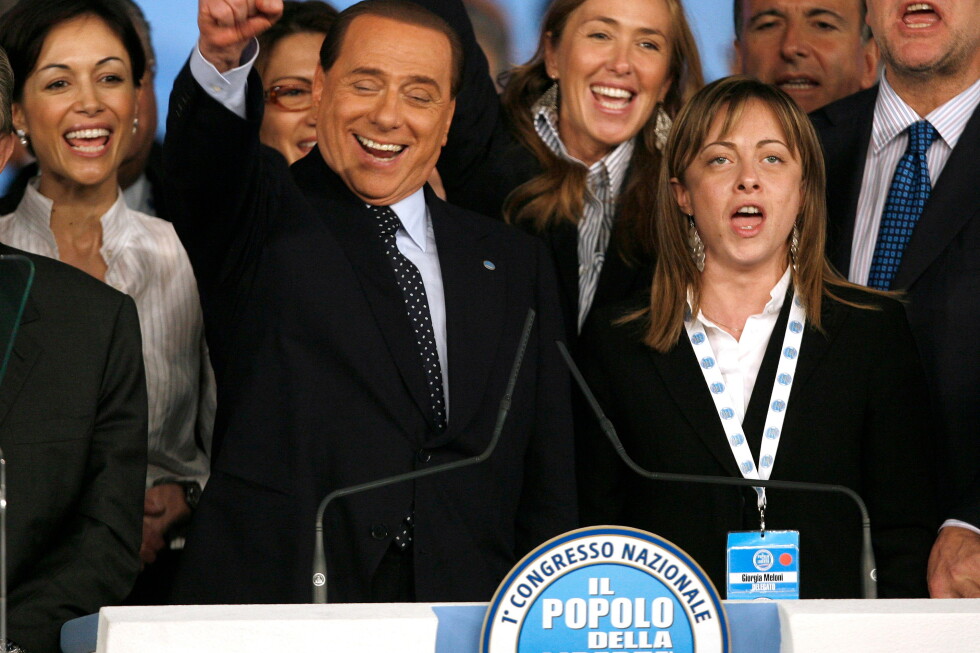
This stylistic evolution has been unfolding for decades, tracking Meloni’s gradual rise through Italian politics. As a 19-year-old right-wing youth activist in 1996, she was filmed by a French television crew dressed almost head-to-toe in black, an aesthetic that matched the hardline extremism of her early political profile, when she made widely condemned comments defending fascist dictator Benito Mussolini that have followed her throughout her career. Since that early period, she has worked systematically to distance herself from the extremist ties that have long shadowed Italian right-wing politics. When then-Prime Minister Silvio Berlusconi appointed Meloni as Italy’s youth minister in 2008, she began adopting more formal, serious attire, leaning almost exclusively on dark suits paired with white blouses.
By the 2022 general election campaign, Meloni had already begun building broad appeal among conservative centrist voters, a shift that showed in both her messaging and her style. Her campaign speech framing herself as “a woman, a mother, a Christian” went viral as a remix and cemented her mainstream conservative credibility, and by the time she took office, she had already begun softening her public look. Soon after assuming the premiership, she shifted to tailored suits in muted, lighter tones, a look fashion critics praised as elegant, conveying both seriousness and approachability as she made more frequent appearances on the global stage; she even lightened her hair to complement the new aesthetic. Michela Bonafoni, a fashion instructor at Florence’s Unicollege, explains the messaging behind softer hues: “Lighter colors suggest a loyalty, tenderness and gentleness. With light colors, you’re more welcoming.” Meloni’s office has declined to comment on her wardrobe choices or any fashion advisors she may work with.
In Italy, all-black dressing carries specific historical baggage beyond its common associations with sophistication and mourning: it has long been tied to Italian fascism, a connection Meloni has been careful to avoid as she distances herself from her early extremist ties. Today, she almost never appears in public in all-black ensembles, favors trousers over skirts, avoids bold eye-catching patterns, and consistently sticks to pastels and neutral tones, with high heels almost always hidden beneath her loose wide-cut trousers. Alcaro points out that this intentional rebranding has aligned with spectacular electoral growth for her party: Brothers of Italy rose from winning just 4% of the national vote in 2018 to nearly 26% in 2022. “She cannot clash visually with the image she wants to project,” Alcaro says.
A defining moment in Meloni’s public visual transformation came during the 2024 G7 summit hosted in Italy’s Puglia region. Fresh off a strong performance for her party in European Parliament elections, Meloni welcomed global leaders in a flowing tailored pastel pink suit and loose palazzo trousers, a look that reflected her growing political security and comfort on the international stage. That confidence was on display again at the 2025 G7 summit in Evian-les-Bains, France, where she appeared in a tailored beige suit paired with a matching necktie, drawing a playful comment from German Chancellor Friedrich Merz that was captured by open microphones. “You’re wearing a tie today,” Merz observed. Meloni’s quick reply captured her evolved public persona: “Yeah, so you can consider me a fighter.”