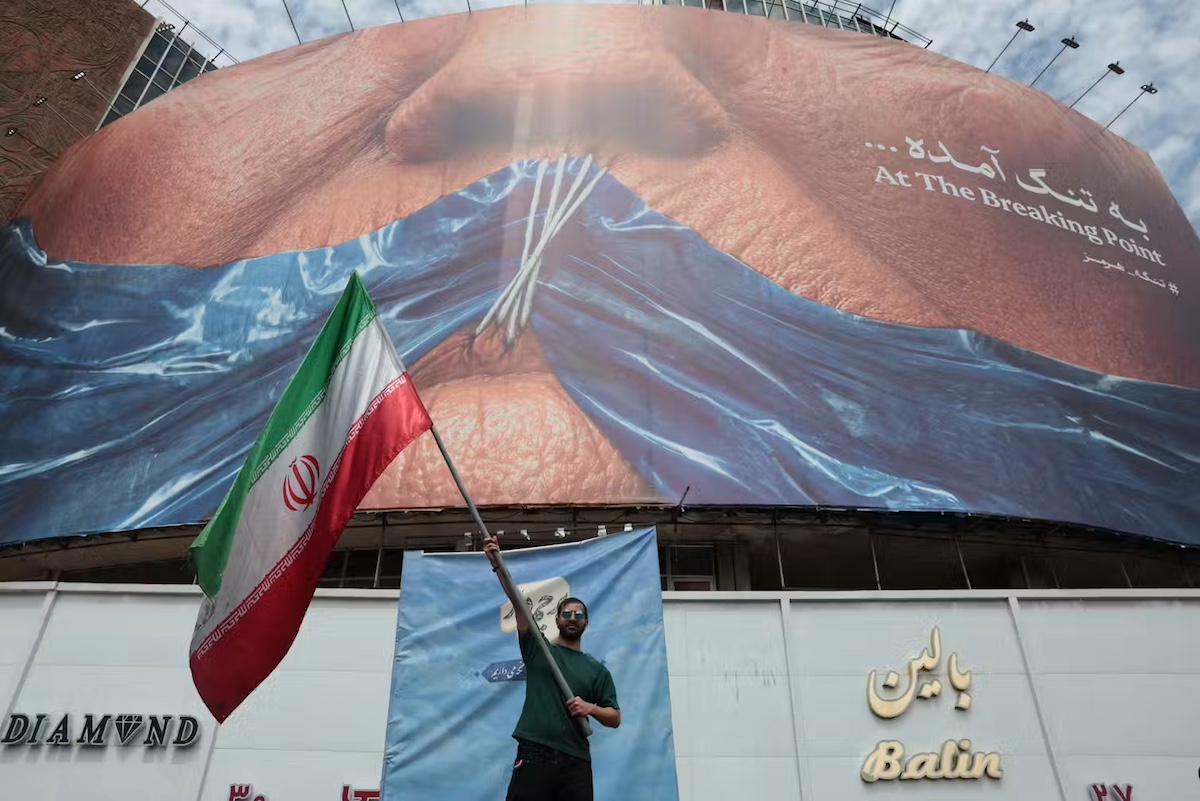
In the months since the US-Israel military campaign against Iran launched in late February 2026, large, strategically placed billboards across Tehran’s busiest public corridors have flooded both traditional media and global social platforms. Constantly refreshed to align with shifting on-the-ground events, these outdoor installations are far more than urban decor: they represent a decades-long evolution of Iran’s state-led visual political communication, adapted for a modern digital age.
Iran’s deployment of public space for ideological messaging traces back to the 1979 Islamic Revolution, and expanded dramatically during the 1980s Iran-Iraq War, when murals and billboards were used to display revolutionary iconography, war memorials, and core ideological tenets to domestic audiences. Today, that model has been reimagined for global circulation. Designed from inception to be photographed, shared, and amplified online even amid Iran’s months-long national internet blackout, these contemporary billboards serve a clear dual purpose: to shore up collective national identity and unity during a period of open conflict, and to project the Iranian state’s narrative of power and resistance directly to international audiences. To reach these global targets, many now incorporate Hebrew and English text alongside native Farsi, a deliberate break from the purely domestic focus of past messaging.
Researchers frame these installations as a core component of Iran’s broader state-led visual communications strategy, crafted specifically for viral spread across social media. To unpack the messaging and layered symbolism behind this campaign, we analyze five of the most widely circulated examples from Tehran’s urban landscape:
### 1. The Epstein Missile
One of the most viral billboards in recent months, displayed at Tehran’s Valiasr Square in March 2026, features a cluster of Iranian missiles covered in handwritten symbolic inscriptions. The most prominent message, rendered in bold red Farsi, reads “To the girls of Minab” — a reference to a strike on a Minab girls’ school in the opening days of the war that Iranian authorities confirm killed 175 students and educators, with independent assessments pointing to U.S. forces as the likely perpetrators.
Directly beneath that inscription, an English phrase adds a second provocative layer: “Epstein Island victim girls”, referencing the private island owned by convicted sex offender Jeffrey Epstein where hundreds of young women were systematically sexually assaulted. A second missile bears the tribute “the girl with the pink jacket”, a reference to a young Iranian girl killed in a 2024 terrorist attack who was publicly identified by her distinctive pink jacket and heart-shaped earrings.
This layered narrative weaves together seemingly disconnected events around a shared theme: vulnerable young women harmed by foreign violence, exploitation, and unaccountable political power. Rather than framing missiles purely as tools of destruction, the billboard reframes them as symbols of grief, remembrance, righteous revenge, and national defense. In this framing, Iran is not the aggressor in the conflict — it is a wronged power responding to injustice to protect its people.
### 2. “Masters of War”
Displayed at Tehran’s Enqelab Square in October 2024, well before the full-scale war began, this high-impact billboard carried a direct multilingual warning. Above a stylized image of waves of incoming missiles lighting up the night sky over Israel (rendered to resemble a fiery meteor shower), a bold Farsi phrase reads “If you want war, we are masters of war”. Beneath it, a clear Hebrew message states “Israel must be wiped from the face of the earth”.
By addressing Hebrew-speaking audiences directly, the billboard acts as both an explicit military warning and a deliberate show of psychological force, turning language itself into a tool of conflict. This multilingual choice signals a key shift in Iran’s urban propaganda strategy: no longer targeted solely at domestic pedestrians and commuters, the state designs these installations from the ground up for instant online circulation, knowing they will reach their intended target audiences across the border in Israel within hours of being erected.
### 3. Trump’s Sutured Mouth
Targeted explicitly at Western, particularly American, audiences, this 2026 Valiasr Square billboard is a sharp, symbolic critique of U.S. policy toward Iran and the Strait of Hormuz. The core image shows U.S. President Donald Trump’s mouth, with a rendering of the Strait of Hormuz stitched (sutured) across its opening, paired with the blunt English headline “The Breaking Point”.
The accompanying Farsi text translates to “its patience has run out”, and carries a clever literary pun: the Farsi word tang can mean both “narrowness/constraint” and refers to the “strait” (tangeh) of Hormuz, creating a double meaning that ties growing geopolitical tension over the waterway to the idea of Iran reaching an irreversible psychological and political breaking point. Beyond geopolitics, the image also satirizes Trump’s reputation for relentless public rhetoric and media attention: the sutures across his mouth symbolize the end of his unchecked influence and authority in the region, particularly when it comes to Iran and control of the Strait.
### 4. Arash the Archer
Drawing on millennia of Persian cultural mythology, this July 2025 billboard at Tehran’s Vanak Square reimagines the legend of Arash the Archer for the modern conflict. In the iconic ancient tale, Arash sacrifices his own life to fire a decisive arrow during a mythic war between Iran and neighboring Turan, securing the borders of the Iranian homeland. On the billboard, Arash is depicted drawing his bow in the heat of battle, surrounded by modern Iranian missiles, framing contemporary Iranian soldiers as heirs to this legacy of sacrificial defense.
The image also highlights the deep roots of modern Iranian political messaging in the nation’s centuries-old poetic, mythic, and heroic storytelling traditions, anchoring the current conflict in a long history of national struggle for sovereignty.
### 5. The Fishermen
Displayed at Enghelab Square in April 2026, this billboard lays claim to Iranian dominance over the Persian Gulf and Strait of Hormuz through a culturally resonant metaphor. The core image shows a massive fishing net stretched across the Persian Gulf, with captured American aircraft, drones, and naval vessels tangled inside. The Farsi text reads “The entire Persian Gulf is our hunting ground”, a clear assertion that the entire region falls under Iranian control and constant surveillance. The accompanying note “The Strait of Hormuz remains closed” emphasizes Iran’s ability to dictate access to one of the world’s most critical energy chokepoints.
Beyond its explicit geopolitical claim, the fishing net carries layered cultural meaning: just as traditional fishing relies on patience, resilience, careful planning, and long-term persistence rather than overwhelming brute force, the billboard frames Iran’s military strategy in the current conflict as rooted in these same deliberate, strategic qualities.
*This analysis is by Hamideh Khaleghi Mohammadi, Lecturer in Media and Communications at the University of Sydney, and Ali Abbasi, Sessional Academic and Researcher in Media and Communications at the University of Sydney, republished with permission from The Conversation under a Creative Commons license.*