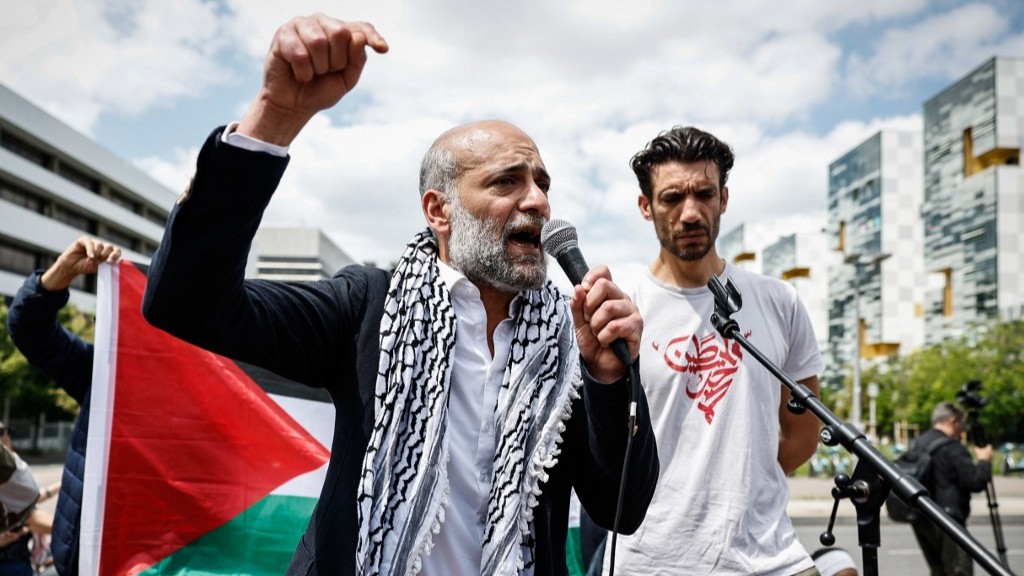
A prominent Egyptian-Palestinian activist and academic has secured a landmark provisional legal victory over the French government, after an administrative commission ruled that his planned deportation over pro-Palestine advocacy violates fundamental European rights to privacy and free expression.
Ramy Shaath, a veteran organizer of the 2011 Arab Spring uprisings in Egypt, had been targeted for expulsion by French authorities, who labeled him a “serious threat to public order” stemming from his participation in pro-Palestine demonstrations and leadership in Palestinian solidarity groups. But the Hauts-de-Seine departmental deportation commission determined Thursday that removing Shaath would run counter to France’s commitments to protecting fundamental civil liberties.
Shaath’s case carries unique layers of complexity that the commission weighed heavily in its ruling. The activist spent 900 days in Egyptian state detention between 2019 and 2022, and he has since been stripped of his Egyptian citizenship. Compounding this, he cannot be transferred to his ancestral home in Gaza, where Israel’s ongoing military campaign has created an uninhabitable, war-ravaged environment. The commission also found that deporting Shaath to an alternate third country would amount to an unacceptable, disproportionate violation of his right to private and family life; Shaath resides in France with a French spouse and child.
While the commission’s ruling is only advisory, and the French government retains the authority to move forward with a final deportation order regardless of the decision, Shaath framed the outcome as a significant embarrassment to state authorities and a turning point for pro-Palestinian advocacy in France.
“It’s a very important win – the ruling was absolutely decisive, saying that Ramy is not a danger to public order or to France in any way,” Shaath told Middle East Eye in an interview Friday. “Nevertheless, based on the French oppressive system, their decision is advisory, so the ministry can tomorrow, or the day after, issue a final deportation order for me.”
Shaath comes from a leading Palestinian political family: he is the son of Nabil Shaath, a veteran Palestinian chief negotiator and former Palestinian Authority prime minister, and previously advised late PLO leader Yasser Arafat as part of the PA’s peace negotiation team. Beyond his Palestinian political work, Shaath rose to prominence in Egypt as a leading organizer during the 2011 Arab Spring protests that ousted longtime autocratic leader Hosni Mobarak, and later served as coordinator of the Egyptian chapter of the Boycott, Divestment and Sanctions (BDS) movement pushing for accountability for Israeli occupation.
After his release from Egyptian prison in 2022, following a high-profile international pressure campaign that included intervention from French President Emmanuel Macron, Shaath settled in France on a one-year residence visa. His conflict with French authorities escalated in late 2023, when he co-founded the Urgence Palestine collective. Then-Interior Minister Bruno Retailleau moved to dissolve the group, accusing it of “glorifying a terrorist organisation such as Hamas, calling for an Intifada on national territory, and inciting hatred, violence or discrimination against Jews.” The dissolution attempt drew international pushback, with a group of United Nations experts warning that the move would represent an unnecessary and disproportionate restriction on fundamental civil freedoms.
Shaath applied to renew his French residence visa in September 2023, but never received a formal response from authorities. He filed 10 separate urgent appeals for renewal without success, despite his legal family ties to the country. On 30 April, he received formal notice at his Paris-area home that deportation proceedings had been opened against him.
A formal document from the Nanterre prefecture outlining the deportation order cited Shaath’s public speeches, lectures, and activist appearances as core justifications. It specifically called out his connections to leading pro-Palestine organizers in France, his public descriptions of Israel’s military campaign in Gaza as a criminal occupation, his public anti-Zionist stance, and his support for a one-state solution to the Israeli-Palestinian conflict.
Shaath has denounced what he calls a deliberate, extrajudicial administrative campaign against him. “We are facing an administrative maze that is beyond the law and every time they try to go to court they lost – but they’re still increasing those tactical games just like Third World fascist regimes and systems,” he told Middle East Eye.
Even as the case remains unresolved, Shaath emphasized that the commission’s ruling marks a critical victory for free speech for pro-Palestinian organizers in France, who have faced growing criminalization of their advocacy since the outbreak of the latest Israel-Gaza war in October 2023.
“It asserts that the language of Palestine and the language of calling for an end to Zionism, the right of the Palestinian people to resist even with arms…all are today cleared under the rule of freedom of expression,” he said. “We will win – they are losing the fight and that is why they are panicking.”