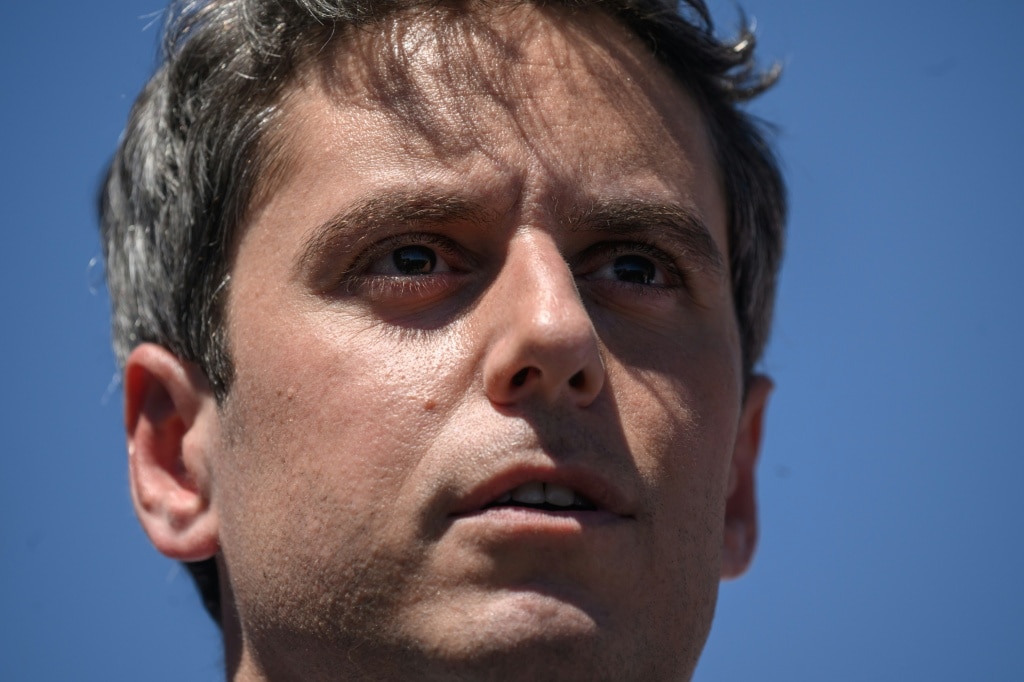
France’s political landscape has been upended by a historic announcement: 37-year-old Gabriel Attal, the youngest person to ever hold the post of French Prime Minister, officially declared his candidacy for the 2025 presidential election on Friday. The centrist contender made his announcement against a backdrop of clear blue skies in the small rural village of Mur-de-Barrez, a strategic choice aimed at addressing longstanding criticism that centrist parties lack deep roots in France’s countryside ahead of a contest that will likely be defined by the battle against the rising far-right National Rally (RN).
In his opening remarks to supporters, Attal pushed back against the stagnation that has come to define mainstream French politics in recent years. “I can’t take this kind of French politics anymore, where it’s just 50 shades of managing decline,” he told the crowd, positioning himself as a fresh alternative to both establishment gridlock and far-right populism. When he took office as Prime Minister in 2024 at age 34, Attal made history as France’s youngest head of government, and his rapid ascent through the political ranks has already drawn widespread comparisons to current President Emmanuel Macron, who won the Elysee Palace at 39 in 2017, becoming France’s youngest head of state since Napoleon. Attal will turn 38 in March, just one month before the scheduled April presidential vote, which Macron will not contest as he steps down after two terms.
Attal’s entry into the race creates a crowded field of high-profile candidates from across the political spectrum. He joins former center-right Prime Minister Edouard Philippe, 55, who now leads his own Horizons party, and 74-year-old hard-left leader Jean-Luc Melenchon as major declared contenders. For the far-right RN, the 2025 election represents the party’s strongest chance to seize the presidency in its history, with either party leader Jordan Bardella, 30, or former candidate Marine Le Pen expected to stand as the party’s nominee.
A product of France’s elite education system and an openly gay politician raised in Paris, Attal has opened up about his personal identity in recent months as he lays groundwork for his campaign. In a book published last month, the candidate dedicated an entire chapter to his partner, Stephane Sejourne, a European Commissioner and former French minister whom Attal describes as “the man of my life.” Attal has also spoken publicly about his mixed cultural background and experiences of prejudice: his father is Jewish, his mother follows Russian Orthodox Christianity, and he has said he has faced both anti-Semitism and homophobia throughout his life and career.
Attal’s short tenure as Prime Minister came to an abrupt end last year when President Macron dissolved the lower house of parliament and called snap legislative elections, a risky political gambit designed to halt the RN’s growing momentum that ultimately backfired spectacularly. The result was months of crippling political deadlock and a hung parliament, where the RN emerged as the largest single party in the legislature. Shortly after the dissolution, Attal formally distanced himself from Macron’s government, clearing the way for his independent presidential bid.
On the campaign trail, Attal already faces stiff competition from within the centrist and center-right space, most notably from Philippe, who led Macron’s first government as Prime Minister and has built a strong independent political base. Current polling consistently shows Philippe performing better than other centrist candidates in a hypothetical runoff against the RN nominee. Still, Attal has wasted no time in positioning himself as a candidate connected to working and rural French voters, a contrast to the common critique that Macron’s Renaissance party is too rooted in Parisian elite circles. “The day we stay locked in Parisian offices, in ministries, is the day politics stops,” Attal said in his launch speech. After entering politics in his early 20s, Attal climbed the ranks quickly: he won a seat in the National Assembly in 2017, the same year Macron was first elected, before going on to serve as government spokesperson, budget minister, and education minister between 2023 and 2024. During his time as education minister, he gained national attention for his work addressing school bullying and his controversial ban on the abaya, a loose full-length garment worn by Muslim women, in public schools.
Closing his launch speech, Attal struck an optimistic tone about France’s future, pushing back against narratives of inevitable national decline. “Having travelled a lot in France and met many French people, I’ve come to a conviction — a very strong one — that our finest chapters are still ahead of us,” he said.