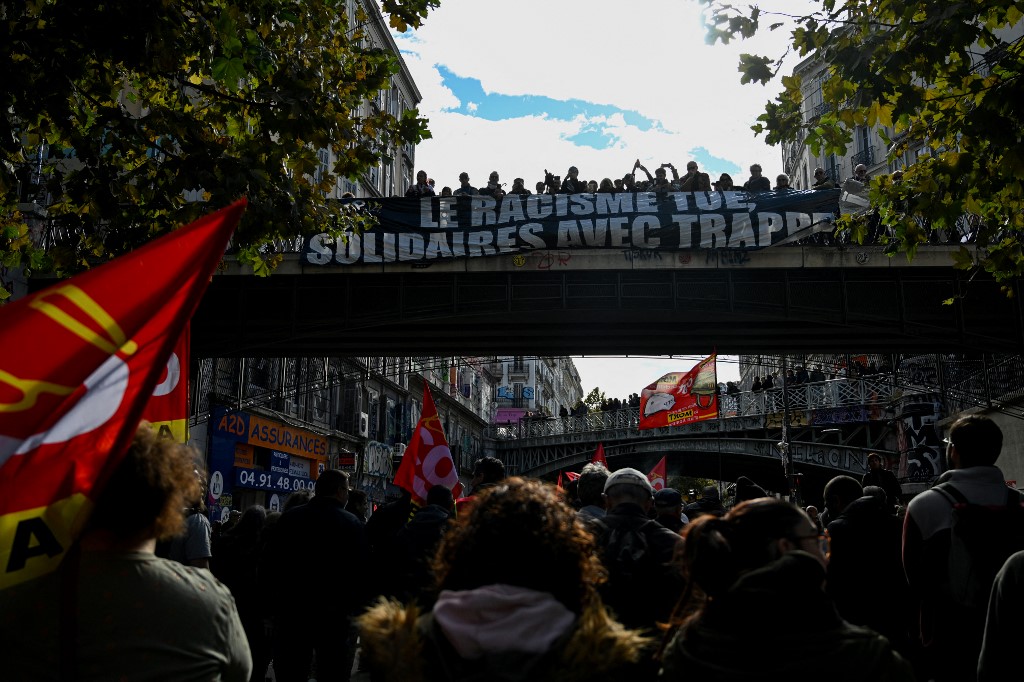
On 30 October, the streets of Trappes, a working-class suburban town north of Paris, were flooded with thousands of grieving and furious local residents who gathered to pay tribute to victims of a brutal targeted racist attack that occurred one week prior. The assault claimed the life of 26-year-old Black man Pengo Bossio Wangi, and left seven other people wounded, including a 12-year-old girl.
The 39-year-old suspected perpetrator, Kevin Tessier, has been placed in pre-trial detention, where he openly confessed to law enforcement that he deliberately targeted individuals he categorized as “Muslim, African or North African.” A search of his residence uncovered a copy of Adolf Hitler’s manifesto Mein Kampf, alongside homemade stickers bearing references to the National Rally (RN), the prominent far-right party led by Marine Le Pen, who is a leading 2027 French presidential candidate.
Trappes mayor Ali Rabeh emphasized that Tessier’s violent bigotry did not emerge in a vacuum, stating it was cultivated through repeated, dehumanizing rhetoric that framed marginalized ethnic and religious minority groups as legitimate targets for elimination. Rabeh directly held the RN and its current president Jordan Bardella accountable, referencing Bardella’s 2022 public remarks labeling Trappes as “a miniature Islamic republic.” The mayor further criticized mainstream politicians within traditional republican political circles who have sought to appease the far right by adopting its discriminatory language, normalizing its ideological talking points, and even codifying its policy demands into national law.
Rabeh also singled out the CNews television channel and the far-reaching media empire owned by conservative tycoon Vincent Bollore for their role in amplifying hate speech, and called on independent media outlets to uphold journalistic integrity and stop providing broadcasting airtime to public figures convicted of inciting racial hatred. One such figure is Eric Zemmour, leader of the far-right Reconquete! party and a potential 2027 presidential contender, who has been found guilty multiple times of incitement to hatred and discrimination. Zemmour recently publicly blamed “hordes of Arab and African barbarians” for looting that broke out during nationwide demonstrations focused on poor living standards and inadequate school and university conditions. He was far from alone in pushing such racialized framing: RN representatives, mainstream right-wing presidential hopeful Bruno Retailleau, and even the official government spokesperson all pinned unrest in working-class suburbs on alleged suburban “thugs.” Former Prime Minister Edouard Philippe, another leading 2027 presidential aspirant, went further to claim there was an “overrepresentation of French people from immigrant backgrounds among the rioters.”
These very same racialized suburban communities, known in France as banlieues, were the explicit targets of Tessier’s violent attack. He told police he carried out the assault to “avenge looted shopkeepers,” and chose Trappes as his target because he shared Bardella’s view of the town as “a stronghold of Islamists.” Dominique Sopo, president of leading anti-racist organization SOS Racisme, confirmed that the sustained discriminatory rhetoric targeting banlieue residents directly explains the motives behind the Trappes racist attack. “The recurring dehumanisation of people perceived as Arab, Black or Muslim, combined with the biased media coverage of the recent demonstrations, plays a direct role in pushing criminals to commit violent acts,” Sopo told Middle East Eye. “Portraying part of the population as ‘thugs’ or an ‘existential threat’ inevitably legitimises violent behaviour in the minds of certain individuals,” he added, warning that further racist attacks are highly likely in the lead-up to the 2027 presidential election.
Official data confirms the growing toll of far-right violence in France: since 2022, eight people have been murdered by far-right activists solely on the basis of their perceived ethnicity or immigrant background. Recent victims include Djamel Bendjaballah, killed in Dunkirk in 2024 by a member of the ultra-right French Patriotic Brigade (BFP), and Hichem Miraoui, an Arab man murdered in the Var region in 2025 by a neighbor who openly sympathized with the National Rally. Despite repeated demands from SOS Racisme and other civil society groups, the BFP has still not been formally dissolved by French authorities. Since President Emmanuel Macron took office, only roughly 20 far-right identity groups have been banned, even though experts estimate there are approximately 300 such organizations operating across French territory. In recent weeks, these far-right factions have carried out a string of targeted assaults on the sidelines of public demonstrations in multiple French cities, claiming their actions were intended to “defend local businesses.” According to reporting from Le Monde, some of these violent attacks on peaceful demonstrators took place in full view of national riot police, who not only failed to arrest the perpetrators but also reportedly detained the victims of the assaults and allowed the far-right attackers to leave the scene unimpeded.
In recent days, civil society organizations and independent media outlets have uncovered online communications where far-right individuals openly threaten to ambush racialized delivery workers, poison halal food products in supermarkets, and target Muslim worshippers holding street prayers outside mosques. On 31 October, graffiti promoting the idea of “remigration” — a far-right policy referring to the mass forced deportation of immigrants — was found spray-painted on the storefronts of multiple shops in Paris. French authorities moved that same day to ban a scheduled ultra-right conference focused entirely on promoting the remigration concept. The remigration doctrine is deeply tied to the far-right “Great Replacement” conspiracy theory, and France’s junior minister for combating discrimination Aurore Berge recently sparked widespread public outcry after she refused to classify the conspiracy theory as a racist ideology.
Abdellali Hajjat, a sociology professor at the Free University of Brussels, noted that such ambiguous, tolerant official positions on extremist ideas directly contribute to the “normalisation of far-right discourse” across French public life. “When members of the government embrace myths – not theories – such as the ‘Great Replacement’, ‘Brotherism’, or ‘Islamo-leftism’, they legitimise an entire racist and conspiratorial worldview,” he told MEE. The term “Brotherism” (or “Entryism”) — a false narrative claiming the Muslim Brotherhood is orchestrating a secret political infiltration campaign across French institutions — was the focus of a proposed Senate bill in May of this year, while the term “Islamo-leftism” — a baseless claim that segments of the political left have aligned with Islamist interests — has been invoked for years by a wide range of political actors including sitting government officials to discredit their political opponents. Hajjat further argued that the current Macron administration is actively “implementing a far-right agenda through the erosion of fundamental rights and freedoms – including the rights to association, protest and expression – and through the brutal repression of political dissent.”
The French Human Rights League (LDH) has repeatedly described new laws and legislative proposals that expand police powers, extend mass surveillance authorities, restrict the right to public protest, and target marginalized minority groups and civil society organizations as “liberty-restricting.” One such measure, the law on the presumption of self-defence passed by the National Assembly in July, has been nicknamed the “licence to kill law” by the LDH, as it significantly loosens the legal conditions under which law enforcement officers can successfully claim self-defence to avoid prosecution for use of force. The LDH has also consistently criticized the 2021 so-called anti-separatism law, which it argues fosters a pervasive climate of state suspicion and targeting directed at the country’s Muslim community. Meanwhile, Amnesty International has issued public warnings about the violent policing tactics used against recent nationwide demonstrations, including the deployment of less-lethal weapons that have the capacity to cause permanent, life-altering injuries. Since the wave of protests began in September, thousands of people across France have been arrested on charges ranging from minor public-order offences to destruction of public and private property, with 85% of all individuals taken into custody being minors.
In the immediate aftermath of violent incidents that broke out during the 17 October demonstrations, French Justice Minister Gerald Darmanin called for the implementation of exceptional legal measures, including reclassifying certain protest-related acts as organized crime offences and applying legal tools that are normally reserved exclusively for counter-terrorism operations. Darmanin specifically claimed that members of the “ultra left” and the “far left” were the primary instigators of protest-related violence and looting. He went on to assert that 2027 presidential candidate Jean-Luc Melenchon and his left-wing party France Unbowed (LFI), which was formally categorized as a far-left organization in a February ministerial circular, bore partial responsibility for the unrest surrounding the demonstrations. Prime Minister Sebastien Lecornu similarly accused LFI of “fuelling anger” across the country. These accusations have drawn broad support from Macron’s centrist governing coalition, the traditional mainstream right, and the far-right National Rally. Even Socialist Party presidential candidate Raphael Glucksmann — who has been criticized by large segments of the left for being disconnected from working-class communities and acting as an obstacle to left-wing electoral unity — publicly accused Melenchon of “brutalising public debate.”
However, official French intelligence service assessments confirm that traditional left-wing parties including LFI and the Communist Party, while present as participants at the demonstrations, had no involvement whatsoever in any of the violent incidents. An independent investigation by French investigative outlet Mediapart further revealed that internal intelligence reports directly contradict the government’s official political narrative, with some law enforcement officers reporting they were placed under explicit pressure to falsely blame LFI for acts of violence that the party had no role in instigating during the 17 October protests. LFI leaders have accused the government of deliberate political manipulation, stating these leaked revelations are proof of a coordinated broader campaign to demonize their party.
Jeremy Younes, a researcher at French media watchdog group Acrimed, supports the view that Melenchon’s party — which current polling projects could advance to the second round of the 2027 presidential election to face Marine Le Pen — is the target of a coordinated delegitimization campaign orchestrated by both mainstream media outlets and the country’s established political establishment. “Since its creation in 2016, LFI has faced hostility from journalists and commentators largely because it broke with the neoliberal consensus and adopted anti-racist positions that have led to it being labelled ‘Islamo-leftist’,” he told MEE. In France, nearly all major private media outlets are owned by a small cohort of billionaire owners and large industrial or financial groups that are ideologically opposed to core components of LFI’s policy platform, including proposals for sweeping wealth redistribution and the dismantling of private media monopolies to expand media pluralism. Younes describes mainstream media coverage of LFI as a relentless barrage of unsubstantiated attacks, denouncing what he characterizes as a systematic effort to exclude the movement from legitimate republican political discourse through manufactured, bad-faith controversies rather than evidence-based, substantive debate over policy proposals and factual realities. “Claiming that LFI raises issues such as racism and support for the Palestinian people merely to court Muslim voters is part of this broader effort to discredit the party,” he said. “The conditions under which the left can express itself are being undermined everywhere.”
The CNews channel has emerged as the most prominent outlet leading what critics have called widespread “LFI-bashing” coverage. Classified by press freedom group Reporters Without Borders as a far-right opinion channel, the rolling news station is currently the subject of a public petition calling for its broadcasting licence to be revoked. The petition has already collected nearly one million signatures, a threshold under French constitutional law that triggers a formal mandatory parliamentary review of the matter. A separate grassroots online campaign is also encouraging French social media users to actively reduce the algorithmic visibility of content that promotes far-right ideological narratives. Sopo of SOS Racisme notes that these citizen-led initiatives “can play a useful role,” and argues that “a civic awakening committed to building a society based on coexistence is necessary” to push back against rising hate. He added a note of caution, however: “Today, society is so polarised that it is difficult for an anti-racist movement to build broad public support.”
Professor Hajjat warns that if Marine Le Pen’s National Rally wins the 2027 presidential election, the party will already have all the pre-existing legislation it needs to fully implement its openly racist, sexist, homophobic and anti-social policy agenda. The academic argues that the ongoing normalization of far-right ideas, and their incremental incorporation into formal law by the current Macron administration, are actively clearing a path for Le Pen’s electoral victory, as she remains the clear frontrunner in all current public voting-intention polls. In the event of a Le Pen presidential win, Hajjat warned, “foreign nationals and French citizens of immigrant origin would be the first targets of legal discrimination in areas including housing, employment and education among others.”
France’s polarised road to 2027: Repression, racism and the rise of the far right