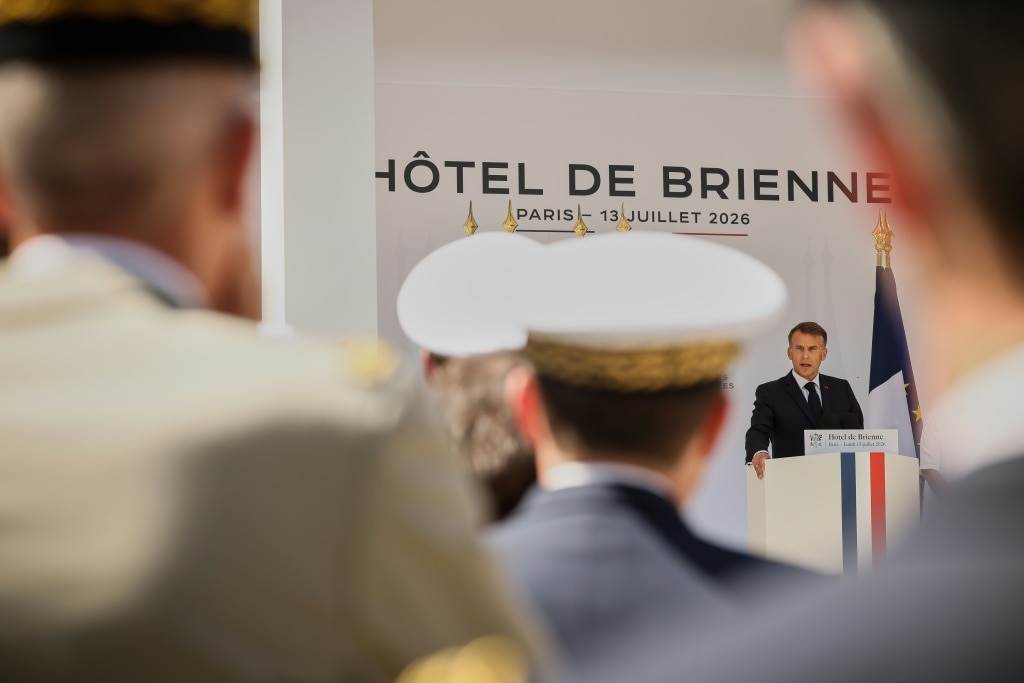
Ahead of a high-stakes gathering of Ukraine’s international backers in Paris, French President Emmanuel Macron has delivered a stark, unflinching message: Europe is prepared to defend itself and its core values of freedom and the rule of law, even if that means paying the ultimate price in blood. The Monday summit of the Coalition of the Willing, co-founded by France and the United Kingdom in the wake of Russia’s full-scale invasion of Ukraine, brings together at least 25 heads of state, including Ukrainian President Volodymyr Zelensky, just one day before France’s annual Bastille Day national holiday.
In his pre-parade address to French armed forces, Macron framed the current moment as a defining turning point for the continent. “Europe is in the process of becoming a power” ready to stand its ground, he told service members, adding that “peace is our goal. Yes, we cherish freedom and the rule of law. And yes, we stand ready to fight to defend them. Always, and at the cost of blood if necessary.” Following the summit, Zelensky and other visiting leaders will remain in Paris to take part in the traditional Bastille Day parade along the Champs-Élysées, an event the Élysée Palace says will be framed to highlight unwavering international solidarity with Kyiv.
Beyond his warning to adversaries, Macron also used the speech to push for deeper integration of European defense industrial partnerships, a call that comes just one month after France and Germany agreed to scrap their joint sixth-generation fighter jet program, a high-profile collaboration that fell apart over conflicting design and strategic priorities.
Not surprisingly, the summit has drawn sharp condemnation from the Kremlin. Russian authorities have dismissed the gathering as nothing more than a meeting of parties that have no interest in ending the conflict. “This is a coalition of warmongers,” Kremlin spokesperson Dmitry Peskov told reporters on Monday.
French officials struck an optimistic tone ahead of the talks, framing the moment as a landmark of both transatlantic unity and shifting momentum on the battlefield in Ukraine. One senior Macron adviser emphasized that the summit would cement the coalition’s commitment to Kyiv, making clear that “Ukraine’s supporters remain firmly committed to standing alongside the Ukrainian people, that there is absolutely no sign of fatigue, and that Russia cannot count on any such fatigue setting in.”
The summit also comes as the United States signals a shift toward greater backing for Ukraine. US President Donald Trump, who has previously sought to maintain open diplomatic channels with Russian President Vladimir Putin while issuing periodic criticism of both Moscow and Kyiv, pledged expanded support for Kyiv during the June G7 summit hosted by France, ahead of this week’s NATO summit in Turkey. Last week, US lawmakers also advanced bipartisan legislation that targets third countries purchasing Russian energy, clearing a path for far more robust economic pressure on Moscow.
During Monday’s talks, coalition leaders are set to prioritize expanded cooperation on air and missile defense with Ukraine, including plans to allow licensed production of Western-designed air defense systems inside Ukrainian territory. In a key development, Paris officials confirmed that the Multinational Force for Ukraine – a peacetime security force designed to be deployed once active hostilities end – will be officially declared ready for operation at the summit, with joint military exercises scheduled to begin in the coming months.
First launched in February 2025, the coalition has held more than 15 working meetings. During a January gathering attended by US envoys, members adopted the Paris Declaration, which outlines binding security guarantees to protect Ukraine from future Russian aggression and establishes a framework for monitoring any eventual ceasefire agreement. While the United States is not a formal member of the coalition and has repeatedly ruled out deploying American ground troops to Ukraine, it will take part in ceasefire monitoring activities. France, the United Kingdom and Spain have already confirmed they are prepared to deploy troops to the post-conflict force, a move that has drawn fierce warnings from Moscow, which says any foreign troops on Ukrainian soil would become “legitimate military targets.”
Despite the diplomatic momentum toward a ceasefire, prospects for an immediate end to fighting remain remote. Heavy clashes continue across the front line, and in recent weeks Ukraine’s air defense networks have been pushed to breaking point by a sustained barrage of Russian ballistic missile strikes. This month, Washington granted Kyiv permission to produce US-designed Patriot air defense systems, which are capable of intercepting ballistic missiles, but defense analysts warn it could take many months before the first domestically built systems roll off production lines and enter service. The Russian invasion, now in its fifth year, continues to put massive pressure on Ukraine’s military and civilian infrastructure, and Zelensky has repeated his urgent call in recent days for Western allies to accelerate and expand the delivery of military aid.