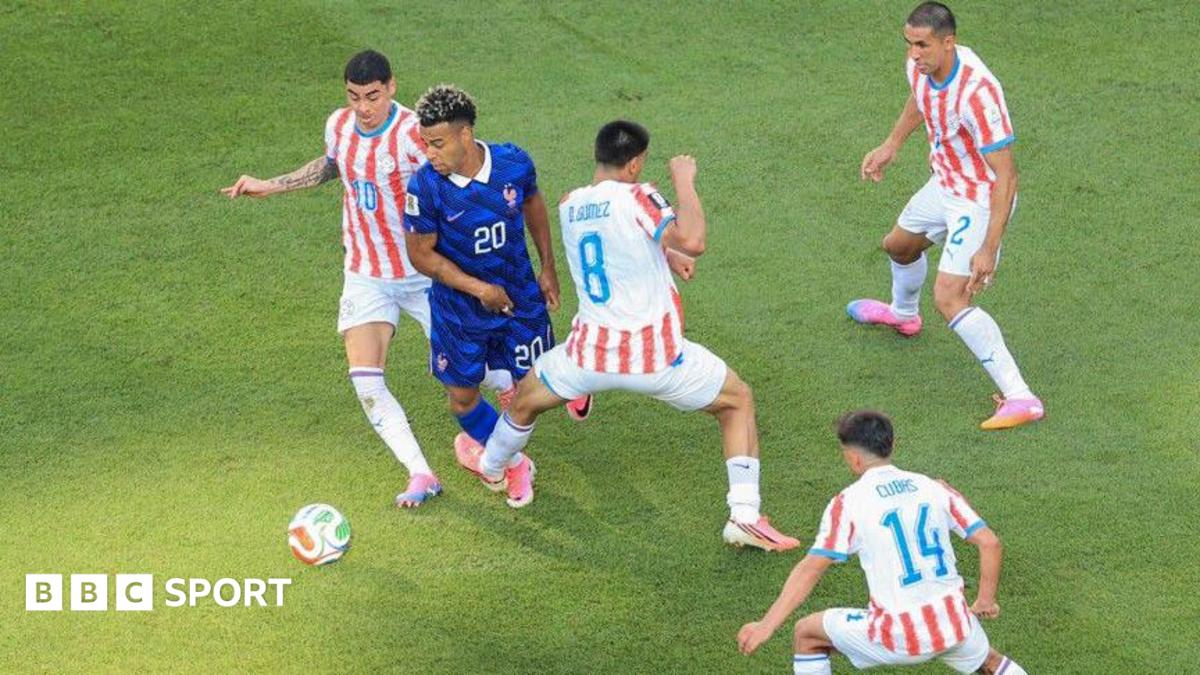
The 2026 FIFA World Cup’s round of 16 delivered one of its most bad-tempered encounters in Philadelphia, where France battled both extreme heat and a physical, aggressively tactical Paraguay side to secure a 1-0 victory and book a quarter-final spot against Morocco. Playing in brutal conditions that saw kick-off temperatures hit 38.3C – one of the hottest in World Cup history, just short of the 43C record set at the 1994 tournament between Ireland and Mexico – Les Bleus entered the match as heavy favorites, having breezed through earlier rounds with free-flowing, high-scoring football. For France, chasing a second consecutive World Cup title after their 2018 triumph, this match would demand a far grittier performance than any they had given so far in the competition.
Paraguay arrived at this fixture with plenty of goodwill from neutral fans, having pulled off one of the tournament’s biggest upsets in the previous round by knocking out four-time winners Germany on penalties. But any positive reputation they earned quickly evaporated in the Philadelphia heat, as the South American side deployed a array of aggressive, unsportsmanlike tactics targeted at disrupting France’s rhythm, most notably focusing on star forward Kylian Mbappe. Multiple high-profile fouls went unpunished by Uzbek referee Ilgiz Tantashev, who faced widespread criticism for failing to exert control over the match: Andres Cubas avoided a booking after a bone-rattling challenge on Adrien Rabiot, Juan Jose Caceres escaped sanction for kicking out at Mbappe, and Gabriel Avalos did not receive a card for elbowing Dayot Upamecano in the stomach late in the game as Paraguay pushed for an equalizer. Astonishingly, three French players received cautions over the course of 90 minutes, while not a single Paraguayan player was booked. Even off-the-ball incidents were rife: Matias Galarza attempted to trick officials into booking Michael Olise by going down easily after a minor shirt tug, and put his hand directly in Jules Kounde’s face during off-the-ball scuffles.
Former England goalkeeper Joe Hart, working as a pundit for BBC One, did not hold back in his criticism of Paraguay’s conduct. “Paraguay’s players were an absolute disgrace,” Hart said. “If they were on my team, I’d be dragging them off the pitch. I love how Mbappe has behaved in this game. The Paraguay players have come for him from minute one. When he was laughing at the players, he is allowed to be arrogant. The referee didn’t help in any circumstances. The fact that not one Paraguayan was booked inside the 90 minutes is astonishing.”
Former England defender Micah Richards echoed that sentiment, noting that Paraguay’s strong defensive play made their antics unnecessary. “It was embarrassing to see,” Richards said. “Paraguay are better than that. Defensively they were so good and they didn’t need to get into these antics.” Former Germany midfielder Thomas Hitzlsperger went further, saying he had no respect for Paraguay over their performance. “If you are from Paraguay, you probably like the team – they are like warriors,” he explained. “If you are French or neutral, you can have no respect for them any more. This is not just disgraceful, this is even worse.”
The defining moment of the match came with 20 minutes remaining, when Diego Gomez brought down Desire Doue in the penalty area. After initially waving away appeals, referee Tantashev reviewed the incident on the pitchside monitor at the encouragement of VAR and awarded France a penalty. Even before the kick, Paraguay players continued their gamesmanship: the entire team crowded Tantashev to delay the penalty, while Gustavo Velazquez deliberately scuffed the penalty spot to disrupt Mbappe’s run-up. Mbappe kept his composure, however, and converted the spot kick to score his seventh goal of the tournament, pulling him level with Lionel Messi at the top of the Golden Boot race. The goal also took Mbappe’s all-time World Cup tally to 19 goals in 19 tournament matches, leaving him just one behind Messi’s all-time knockout stage record. Remarkably, since 2018, Mbappe has scored more World Cup knockout goals (11) than entire elite nations including Brazil (10), England (10), Portugal (9) and Spain (4).
Tensions did not ease after the penalty, or even after the final whistle. After the match ended, Velazquez attempted to confront French players, sparking a minor scuffle on the pitch. French manager Didier Deschamps, who made history on the night by becoming the first head coach to record 10 World Cup knockout stage victories, revealed that his side had endured verbal abuse from the Paraguayan bench throughout the second half. “There were some insults from the other bench we could have done without,” Deschamps said in his post-match press conference. The French manager added that he had anticipated Paraguay would target Mbappe late in the game, instructing his physically largest players to surround the forward to protect him from potential rough challenges. “I asked the two biggest lads to go and stand around Kylian at the end because they were going to chop him down,” Deschamps explained. “It wasn’t easy. They use every trick in the book. It’s not the kind of football that will bring people to the stadium, but they defended well. It is always difficult against these South American teams.”
Mbappe, who laughed off Paraguay’s repeated provocations on the pitch instead of responding with aggression, offered a characteristically calm assessment of the win after the final whistle. “We know how to play ugly football,” Mbappe said. “They [Paraguay] thought we’d show up in tuxedos, but we were ready. Even at that game, we were better than them. That’s their style of football – there’s no right or wrong way to play the game. They tried to beat us that way, but we won.”
French players echoed Mbappe’s perspective, framing the hard-fought win as proof that Les Bleus can win in different ways, after cruising through earlier rounds with high-scoring, attractive football. Defender William Saliba, a Premier League winner with Arsenal, said France had prepared for Paraguay’s physical approach. “They were going to come at us hard, commit fouls, and try to provoke us,” Saliba said. “We had to stay in the game, because if we started wasting energy, getting into arguments, and losing our focus, things wouldn’t go well. It’s not easy, but sometimes it feels good to win a tough match like this, because since the start of the tournament, we’ve been used to scoring three goals. Today, it was a 1-0 win, but it’s just as valuable.” Forward Rayan Cherki added that the match proved France could compete through a physical battle as well as they do through free-flowing attack: “We knew it was going to be a fiercely contested match. But it was important to us to play a game like this during the World Cup – to remind everyone that the French team can play beautiful football, but can also go to war.”
BBC football issues correspondent Dale Johnson argued that the root of the match’s bad temper lay in the referee’s failure to establish control early on, a problem amplified by the 2026 World Cup’s mandate for referees to allow more physical play to promote free-flowing football. Johnson noted that referee Michael Oliver set a clear tone in an earlier round of 16 match between Canada and Morocco, handing out six yellow cards before half-time to clamp down on foul play, which led to a calmer second half with only two additional cautions. That stands in stark contrast to Tantashev’s performance in Philadelphia: while the official foul count was 13 for Paraguay and 11 for France, that statistic does not reflect the multiple unpenalized tactical and off-the-ball fouls committed by the South American side. The only correct decision that led to France’s win came via VAR intervention, not the referee’s initial call, Johnson added.
With the win secured, France now advance to the quarter-finals, where they will face Morocco at Boston Stadium on Thursday, with kick-off scheduled for 21:00 BST.