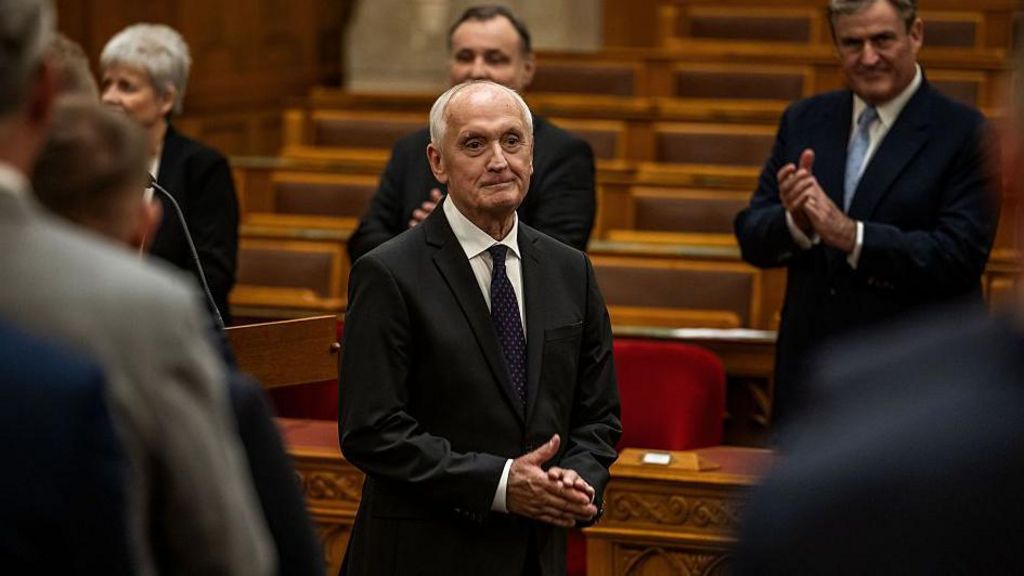
Hungary’s national parliament has elected 73-year-old András Baka, a veteran legal figure and former Supreme Court president, to serve as the country’s new head of state, capping a period of rapid political upheaval following the end of former Prime Minister Viktor Orbán’s long tenure.
While the Hungarian presidency is formally a largely ceremonial role, Baka’s term is set to be defined by high-stakes tasks at the core of the new government’s agenda: overseeing Prime Minister Péter Magyar’s administration’s push to dismantle the sprawling interconnected economic and political network built by Orbán during his years in power, and steering the process of drafting a new national constitution to replace the 2011 constitution enacted under Orbán’s government.
Following his landslide election victory, which saw him secure 140 votes against just 6 opposing votes, Baka used his first address to parliament to reject a politics of retribution. “We cannot build the new Hungary on revenge,” he told assembled legislators. “The majority of society now feels a sense of liberation and hope. Others feel disappointment and uncertainty. In a democratic society, this is not an anomaly, but a natural state of affairs.”
All 51 members of parliament from Orbán’s Fidesz party boycotted the vote, walking out of the chamber in protest of the removal of their preferred candidate, Tamás Sulyok, from the presidency last month. The move marks the latest chapter of friction between the new governing coalition and Fidesz, which has already faced sweeping institutional changes from the Magyar administration that took office in early May.
Since assuming power, the new government has moved at breakneck speed to roll back Orbán-era policies. It has already passed 27 new laws and ratified two constitutional amendments, canceled all the national states of emergency that Orbán leveraged to rule by decree—covering migration, COVID-19, and the war in Ukraine—and abolished the controversial Sovereignty Protection Office, which Fidesz repeatedly used to target independent journalists and non-governmental organizations critical of the previous government.
In its place, the administration created the National Asset Recovery and Protection Office, which has been granted broad authority to investigate and prosecute individuals accused of embezzling state funds during Orbán’s tenure. Fidesz has hit back at these changes, accusing the new Tisza-led government of establishing what it calls a “tyranny.” This criticism carries a sharp irony, however: Fidesz itself removed Baka from his post as Supreme Court president back in 2011, when he pushed back against the party’s efforts to weaken judicial independence and undermine the rule of law.
Another major institutional shift already underway is the overhaul of public service media. Public radio and television outlets have been off air since July 9, as the government overhauls their news programming to undo their transformation into Fidesz-era government propaganda outlets, with the stated goal of restoring full editorial independence to public media.
Two key constitutional amendments, numbered 16 and 17, have also reshaped Hungary’s political rules: they impose a two-term limit on sitting prime ministers and a three-term limit for members of parliament, while also restoring the Constitutional Court’s authority to review acts of parliament— a power that Fidesz stripped from the court during its time in power.
Despite Baka’s selection by the governing majority, the new president is not expected to be a rubber-stamp for the administration’s agenda. In a pre-election interview with the BBC, Baka openly stated his opposition to parliamentary term limits, arguing that they improperly intrude on the right of voters to freely select their own representatives.
Baka brings decades of international judicial experience to the role: he spent 17 years serving as Hungary’s judge to the European Court of Human Rights based in Strasbourg. Framing his entry into the presidency as rooted in legal principle rather than partisan ambition, Baka told the BBC last month: “I am not a political man. I got involved in politics through my professional, legal way of thinking.”
Baka is widely understood to be a transitional president. The constitutional amendment that created space for his appointment stipulates that a new head of state will be selected once the new constitution enters into force, with his maximum term capped at five years.
In his closing remarks to parliament on Tuesday, Baka made clear he would challenge Hungary’s longstanding cultural tendency toward reliance on strongman leadership. “The state is not there for itself,” he said. “It is there for the people.”