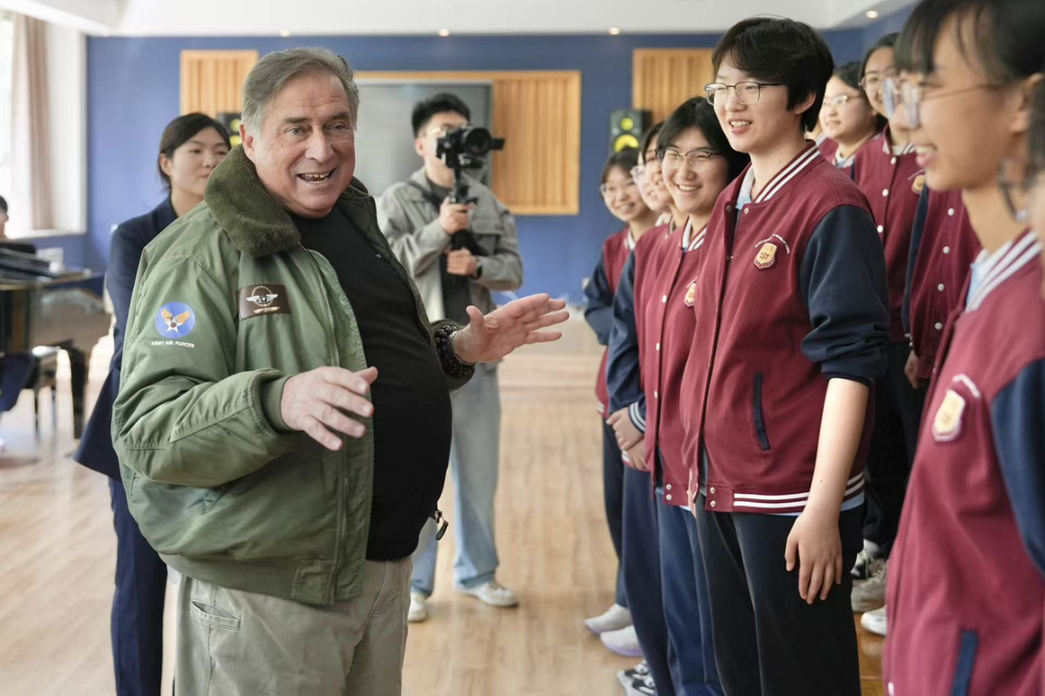
Eighty years after the World War II-era partnership between Chinese and American combatants and civilians, a delegation led by Jeffrey Greene, chairman of the Sino-American Aviation Heritage Foundation, has traveled to northern China’s Shanxi province to commemorate the enduring friendship forged by the legendary Flying Tigers and renew cross-cultural people-to-people bonds.
During the April 2026 visit, Greene lauded Shanxi’s consistent efforts to preserve the historical record of the Chinese People’s War of Resistance Against Japanese Aggression (1931-1945) and expand people-centered international educational exchange. He emphasized that the shared history of Sino-U.S. wartime collaboration remains deeply rooted in collective Chinese memory, noting that the mutual trust and joint effort displayed by Chinese and American people 80 years ago proved that partners can overcome even the most daunting obstacles when they stand side by side.
“This spirit of cross-border cooperation is a treasure that must be passed from one generation to the next,” Greene said. “In today’s deeply interconnected global landscape, the core values of the Flying Tigers legacy hold growing contemporary relevance. It continues to inspire both our peoples to rise above ideological and political differences, and work collaboratively toward shared goals that benefit everyone.”
A key focus of Greene’s visit was expanding the Flying Tigers Friendship Schools initiative, a program designed to connect secondary and postsecondary institutions in China and the United States. Greene called on more Shanxi-based schools to join the network, saying that structured exchange activities — including virtual dialogues, in-person student visits, and themed academic competitions — will deepen mutual understanding and foster genuine friendship between young people from both nations, ensuring the Flying Tigers spirit is carried forward into the new era.
Shanxi holds profound historical significance for this wartime legacy: it was one of the most critical battlefields of the Chinese resistance, served as the headquarters of the Eighth Route Army, and hosted multiple key revolutionary bases during the war. During their trip, delegation members visited two local educational institutions — Taiyuan University of Technology and Shanxi Experimental Secondary School — to tour campuses, learn about the schools’ unique academic profiles and existing international exchange programs, and hold open discussions with students and faculty on topics ranging from Flying Tigers history to U.S.-China cultural differences and youth people-to-people exchange.
Ma Xiaomin, deputy director-general of the Foreign Affairs Office of Shanxi Province, reaffirmed the province’s commitment to advancing the Flying Tigers legacy during the visit. He noted that the Flying Tigers spirit is far more than a historical footnote: it is a tangible, living witness to the joint struggle and mutual assistance between the Chinese and American people, and a precious spiritual asset that preserves the longstanding friendship between the two nations.
“The Foreign Affairs Office of Shanxi will fully support local schools to join the Flying Tigers Friendship Schools network,” Ma said. “We hope that by using this program as a binding link, we can build a strong bridge for exchange and mutual learning between Chinese and American young people, carry forward the great Flying Tigers spirit, and advance more practical cooperation between Shanxi and the United States in education, culture, and other key fields. In doing so, we can contribute our part to strengthening the non-governmental friendship between our two nations.”