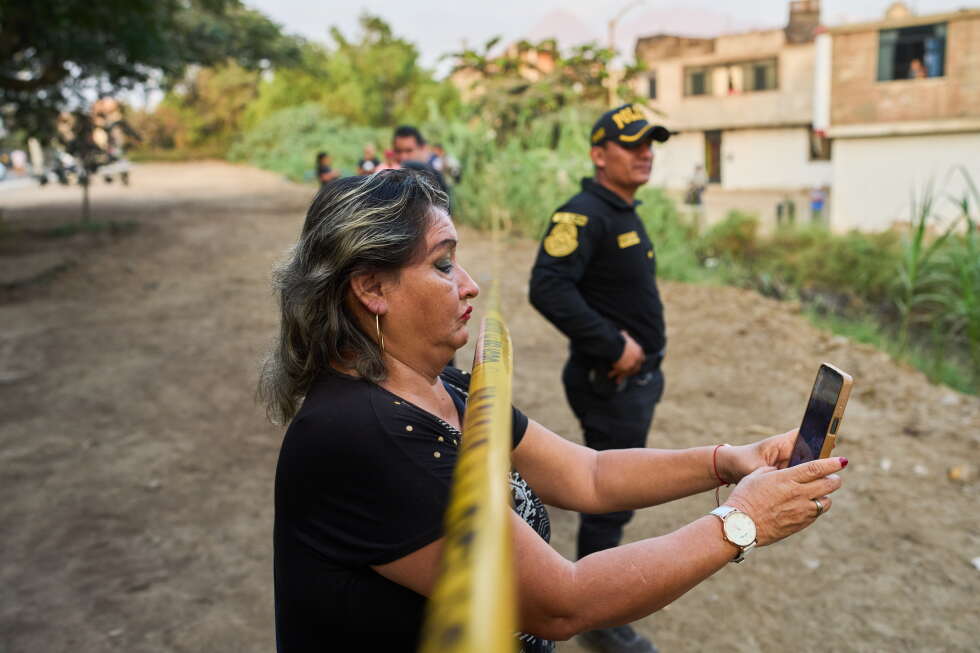
On the sun-baked desert stretches of northwestern Peru’s Pacific coast, Gladys Saavedra greets unfamiliar faces at her small Trujillo market stall with quiet wariness. Saavedra is one of dozens of female vendors who, even with meager daily sales, are forced to pool $300 every month to pay off criminal extortionists. Refusal comes with a devastating price: when the group stood their ground against demands last June, their entire market was burned to the ground.
Days after the attack, the women marched through city streets demanding state protection. For Saavedra, however, the lack of meaningful action from authorities came as no surprise. Already in August 2024, her own home had been targeted with explosives in a separate extortion attempt, and police failed to hold anyone accountable. This pervasive climate of gang violence is the defining issue hanging over Peru’s presidential runoff election, scheduled for Sunday, with many voters planning to travel to polling stations gripped by fear of falling victim to attack along the way. “You can’t even stick your head out for fear of being shot,” the 49-year-old vendor said.
The root of Peru’s worsening public safety crisis traces directly to the multi-billion-dollar illegal gold mining industry that has fueled the rapid expansion of organized crime across the country. While extortion first emerged in Trujillo more than two decades ago, official data shows the crime has exploded nationwide over the past five years: reported extortion claims have risen fivefold to hit 28,948 in 2025, while national homicides have doubled to 2,226 over the same period.
Police and security analysts explain that Trujillo-based gangs first built their power base by offering armed protection to illegal gold mining operations in nearby rural areas. The massive profits from this racket allowed them to expand into the city, hiring professional hitmen, acquiring military-grade weapons, and cementing control over urban extortion rings. Official estimates peg annual revenue from illegal mining at roughly $7 billion — nearly six times the $1.2 billion Peru’s criminal networks earn annually from drug trafficking. In 2025, the country exported 100 tons of illegally mined gold, almost matching the 109 tons of legally extracted gold shipped to global markets.
Early targets of extortion were public transportation operators, with drivers executed en masse when they refused to pay up. Last year alone, the independent Observatory of Crime and Violence recorded at least 239 transportation worker killings nationwide, more than half of which were motorcycle taxi drivers — a common form of transit in underdeveloped outer-city neighborhoods with unpaved roads. The murders of bus drivers have sparked widespread citywide transportation strikes and mass protests against government inaction.
Today, no sector of the local economy is spared from criminal extortion. In one Trujillo neighborhood that produces a quarter of Peru’s domestic footwear, union leader Máximo Varas estimates that roughly 1,500 small shoemaking business owners pay regular protection money to operate. “Everyone pays — even I get extorted. No one is safe,” Varas said. Across the city, marked stickers featuring symbols like a puma, a cross, or the Batman logo are plastered on the facades of buses, restaurants, corner stores, nightclubs, and even schools. Law enforcement has confirmed these stickers serve as public signals that a business has paid its required fee, and police regularly conduct removal operations to replace criminal markers with official law enforcement decals.
For 58-year-old local businessman Iván Díaz, the escalation of violence in Trujillo has been nothing short of exponential. In 2023, he was kidnapped from his office by attackers posing as police officers, who held him captive for 11 days. To force his family to pay a $250,000 ransom, the kidnappers cut off portions of two fingers on his right hand and sent torture videos to his relatives to pressure for quick payment. “I had to adapt to reality and keep a cool head,” Díaz recalled. In May, four members of the notorious Los Pulpos gang — a criminal network that formed in Trujillo in the 1990s and later expanded into neighboring Chile — were sentenced to life imprisonment for their roles in the kidnapping.
The economic toll of endemic crime on Peru is staggering: the Ministry of Economy estimated in July that criminal activity costs the country roughly $5 billion annually, a sum that includes both public spending on police operations and private costs for businesses and families that invest in surveillance cameras and private security guards. While wealthy municipalities in the capital, such as San Borja where both presidential candidates — conservative Keiko Fujimori and progressive Roberto Sánchez — reside, benefit from heavy uniformed police presence and additional private security patrols, working-class outlying neighborhoods across the country lack basic infrastructure like paved roads, potable water, and electricity — and above all, consistent police presence.
Security experts agree that turning the tide against organized crime requires two major overhauls: a widespread anti-corruption purge of Peru’s 130,000-strong national police force, and a massive injection of funding for criminal investigations. One active organized crime investigator, who spoke to the Associated Press on condition of anonymity due to restrictions on speaking to media, confirmed that outdated technology leaves police unable to track mobile accounts linked to the digital wallets criminals use to collect extortion payments.
Harvey Colchado, a congressman-elect and retired police officer, explained that budget cuts have gutted investigative capacity: five years ago, each of the country’s 70 police investigative units received a monthly budget of $29,000, but today the units have no allocated funding at all, as the state redirected resources elsewhere. Compounding this underfunding, Colchado said, are recent laws passed with bipartisan support from both Fujimori’s and Sánchez’s political parties that have made it far harder to prosecute and penalize organized crime members. The reforms eliminated preliminary detention for certain offenses and raised the legal threshold for seizing criminal assets and conducting search warrants.
For Saavedra and the thousands of Peruvians living under daily criminal control, this systemic failure has left communities completely unprotected. “This is a cancer,” she said. “(Police) don’t have the resources to trace the calls, to know where the messages are coming from. That’s the only way to stop it.”