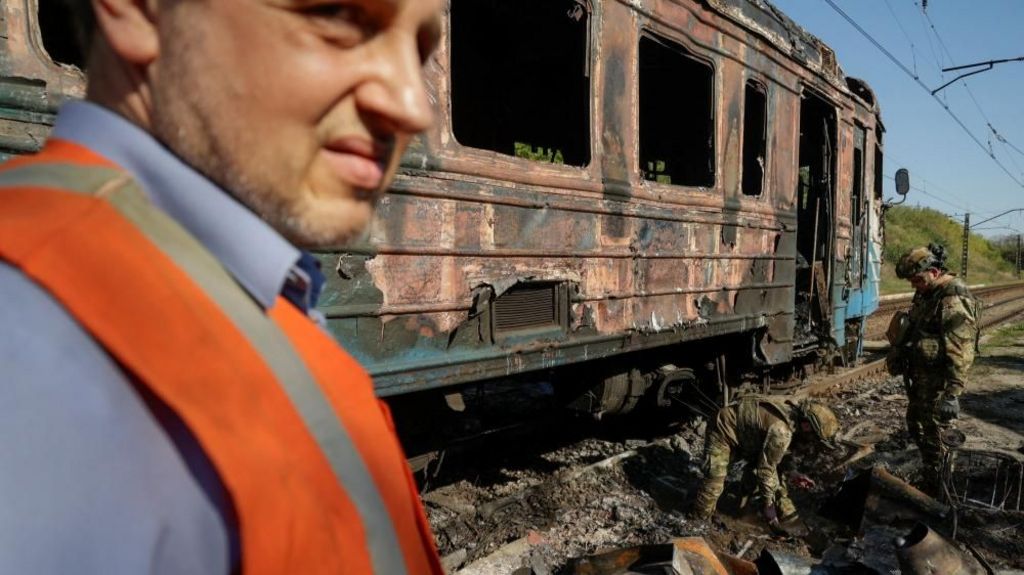
Since Russia launched its full-scale invasion of Ukraine in 2022, Ukraine’s national railway system has served as a critical lifeline, keeping the connected nation moving despite widespread conflict. Today, however, that lifeline faces escalating attacks that have upended travel for thousands of civilians and created an unprecedented challenge for state-owned rail operator Ukrzaliznytsia.
For Yuliia Ponomarenko, a 27-year-old marketing professional from Kharkiv, the danger of the new assault on Ukrainian rail hit close last month. Traveling to Warsaw, her journey was halted just kilometers from the Ukraine-Poland border after border guards rushed through carriages ordering an immediate evacuation. A Russian drone had just targeted a nearby locomotive, only minutes after a special train carrying former British Prime Minister Boris Johnson and other European officials had passed through the same stretch of track. Ponomarenko and her fellow passengers waited six hours for crews to extinguish the fire and clear the line, she recalled: “We were really lucky that we were delayed a little and it wasn’t our train.”
Ponomarenko’s experience is far from unique. As Russian drone attacks against passenger trains have intensified, growing numbers of travelers face repeated evacuations and extended delays, even in regions hundreds of kilometers from the front lines in eastern Ukraine. Official data from Ukrzaliznytsia provided to AFP shows that in September 2026 alone, 5,831 trains required emergency evacuation due to drone threats — an average of 205 service suspensions per day. The strikes are part of a broader campaign targeting Ukrainian critical infrastructure: two bridges in Kyiv have been attacked in recent days, with one strike trapping metro train passengers mid-journey.
Seventeen-year-old Anastasiia Ryvbalchenko survived a close call during a September 16 trip from Odesa to Kirovohrad. Forced to evacuate her train at 4 a.m., she and other passengers waited for more than an hour in darkness before a drone struck nearby. “There was an extremely loud explosion and everyone started running into the woods,” she said. Though the train was undamaged, the experience left her shaken. After continuing her journey on foot before being picked up by her family, Ryvbalchenko said, “I’m not going to travel by train anymore.”
Russian drone attacks targeting moving passenger trains launched in earnest at the end of 2025, turning a routine commute or long-distance trip into a high-stakes waiting game. For passengers, the new normal now follows a grim script: evacuate to the trackside, monitor Telegram for updates on drone and missile movements, and alert loved ones of delays, which can stretch from minutes to multiple hours.
For Ukrzaliznytsia, which once prided itself on outperforming many European rail networks for punctuality even in the early years of the war, this surge in attacks has forced a fundamental shift in priorities. “We used to say that during times of war we performed better than some railways in Europe in regular times,” said Oleksandr Pertsovskyi, the company’s chief executive officer. “But now the life of our passengers and crew members is the utmost priority.”
Russia’s defense ministry has denied targeting Ukrainian civilians, maintaining that all strikes on Ukrainian railways are focused on infrastructure used to move military personnel and weapons. Still, official statistics from Ukrzaliznytsia show a sharp upward trend in attacks on the company’s assets: of the 521 locomotives hit since the full-scale invasion began, nearly 60% have been struck in 2026 alone. Total attacks on railway facilities have jumped from 1,206 in 2025 to 1,700 so far this year.
Pertsovskyi described the current confrontation as a relentless “cat and mouse” game, with Russia leveraging increasingly sophisticated technology to target moving trains. “The latest wave of escalation and real war with railways is becoming extremely intense,” he said. “It’s a combination of the deadly force of their shahed drones and precision that they achieve with cameras and mesh networks so they can hit moving targets.” According to Pertsovskyi, Russia’s newest drone models are equipped with artificial intelligence and image recognition capabilities to improve targeting accuracy. While Ukraine has kept its defensive strategies close to the vest, disrupting drone connectivity via electronic warfare tools is a core part of its response.
Journalists were granted rare access to Ukrzaliznytsia’s hidden “Iron Command Centre”, an underground bunker in Kyiv where staff monitor every train and incoming threat in real time. On a large central display, color-coded markers for passenger and freight trains crawl across Ukraine’s 1000s of kilometers of rail track, while markers for incoming drones mark their positions. Any train falling within a 100-kilometer radius of an identified drone is immediately evacuated, and passengers are not allowed to reboard until the threat has moved on. “Our mission is not to let our train or our crew members be in that immediate attack area,” Pertsovskyi explained.
The operator’s proactive precautions have kept civilian casualties relatively low: eight company employees have been killed in 2026, six of them in a single incident when a ballistic missile struck a Kyiv locomotive depot. Still, the constant threat keeps the entire system on edge: during the on-site visit to the command center, a new air raid siren sounded in Kyiv, triggering an immediate evacuation of the city’s main central railway station.
With winter approaching rapidly, the hardest challenges may still lie ahead. Temperatures in Ukraine can drop to -20°C or lower during the coldest months, and heavy snow cover is common. Ukrzaliznytsia is already working to prepare for cold-weather evacuations, partnering with international donors to assemble winter emergency packs, deploy mobile heated shelters, and organize backup bus service in regions that face frequent evacuations.
Despite the mounting pressure, Pertsovskyi reaffirmed the railway’s commitment to keeping Ukraine connected. “We might be a slightly different railway, a reinvented railway,” he said. “But we’ll keep connecting the country, no matter what, be it winter, be it summer, no matter how hard the enemy hits us.”