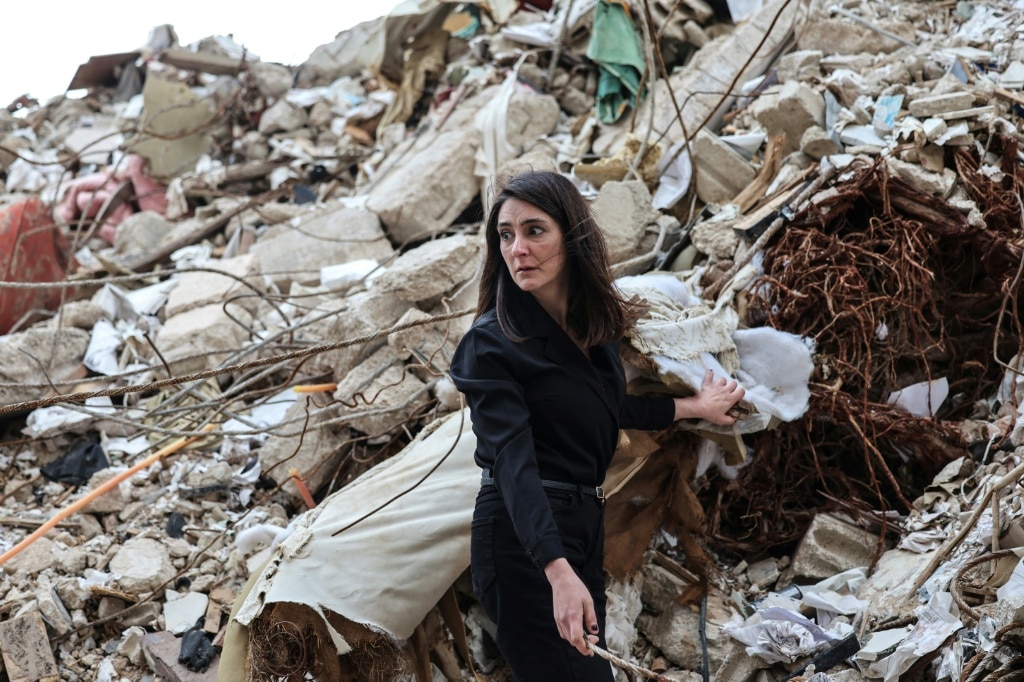
In the shadow of a shattered nine-story residential building in central Beirut’s upscale Tallet al-Khayat district, two childhood neighbors bound by shared grief have made a solemn promise: they will not rest until those responsible for the death of their families are held accountable. The April 8 Israeli airstrike that reduced their family home to rubble came just hours after a U.S.-Iran ceasefire was announced, part of a broad wave of air attacks across Lebanon that killed over 350 people on a day now etched into Lebanese collective memory as Black Wednesday.
Wael Sabbagh, a 52-year-old businessman based in Mexico, lost his mother Afaf and brother Hassan in the attack. Ghida Krisht, a 41-year-old aid worker based in another Beirut neighborhood that was also hit that day, saw her parents – 70-year-old renowned poet Khatoun Salma and 72-year-old Mohammed – and a relative who had fled earlier bombardment in southern Lebanon’s Tyre killed alongside them. For decades, their families had lived in the quiet building, believing they were far enough from conflict zones to be safe.
Sabbagh first learned of the strike through social media, scrolling through footage of destroyed buildings until he made the devastating confirmation that his childhood home had been targeted. “I lost my mother, my brother, my home, my childhood,” he told reporters, smoking one cigarette after another as he stood amid concrete rubble and splintered wood. “Nine people were killed in this building. They get talked about as if they were just statistics, but each of them was a loved one, a whole life cut short.”
Among the ruins, the two grieving relatives have recovered small, devastating mementos of the lives lost. Sabbagh found a dented metal bracelet that belonged to his brother Hassan, who wore it the day he died; it took rescuers three full days to identify his brother’s remains, and Sabbagh now wears the bracelet on his own wrist. He also pulled a crumpled scrap of his mother’s bedspread, chunks of the family dining table, and a intact red sofa cushion from the debris, and later used a crane to reach a half-damaged upper floor and retrieve his mother’s photo album. Krisht, meanwhile, found her mother’s purse, holding the last poem Salma ever wrote by hand.
Krisht recounted the agonizing hours after she learned of the strike: she called her parents repeatedly, only to get no answer. When she finally reached the site, rescuers would not let her see her parents’ disfigured remains – she identified them only by her mother’s signature red nail polish on her hand.
Now, Sabbagh and Krisht are building a comprehensive legal case to pursue accountability through international justice channels, a path only one other person has taken so far this year: French-Lebanese artist Ali Cherri, who launched legal action in France after his parents were killed in an earlier 2024 Israeli strike on a Beirut residential building. The pair acknowledge the road ahead will be long and fraught with barriers, noting that hundreds of other victim families lack the financial resources, connections, or emotional capacity to pursue legal action.
“We do have a voice, we are connected, and we are emotionally strong enough, despite everything we have lost, to demand accountability,” Sabbagh said. Krisht added: “We want to gather all the testimonies and evidence we can to document this and build a complete case. We cannot be silent about what happened. We want to pursue international justice and be an example for other families who have lost loved ones.”
Israeli military officials stated shortly after the strike that they had targeted a Hezbollah commander in Beirut, later identifying the target as Ali Yusuf Harshi, who they claimed was the personal secretary and nephew of Hezbollah Secretary-General Naim Qassem. Hezbollah has never confirmed Harshi’s death. Sabbagh insists the building held no weapons, no military assets, and no political activity, giving no justification for the attack that killed nine civilians.
The full casualty list from the Tallet al-Khayat strike tells the story of unintended civilian harm that has marked the months-long conflict: on the third floor, an elderly man, his son, and their Ethiopian housekeeper were killed. The pair shared a surname with Harshi, the target Israel claimed to have killed. The building’s owner, who lived on the eighth floor, was also killed. Krisht’s family and Sabbagh’s died on the sixth and seventh floors respectively, far from any alleged target location.
Since cross-border conflict between Israel and Hezbollah reignited on March 2, Lebanese official data puts the total death toll from Israeli attacks at more than 3,000 people. For Sabbagh and Krisht, every step they take through the ruins of their family home, every memento they recover, and every piece of evidence they collect for their legal case is a step toward honoring the people they lost – and demanding that the world does not forget what happened here.