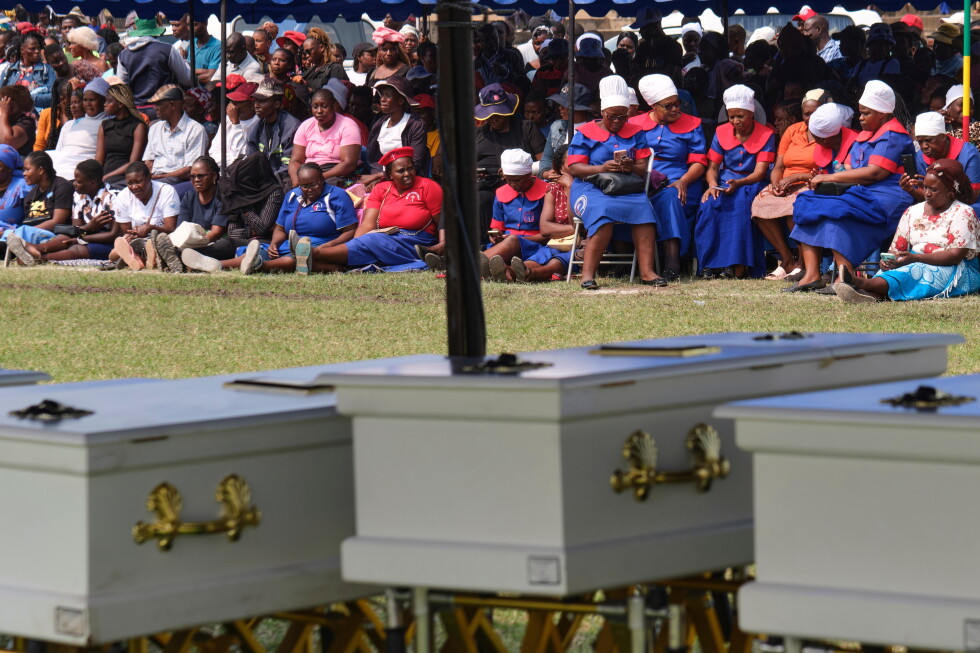
HARARE, Zimbabwe — Communities across Zimbabwe are in mourning this week after a devastating capsizing incident on Lake Kariba, the world’s largest man-made reservoir by water volume, left at least 46 people dead and dozens more unaccounted for. On Thursday, hundreds of mourners including senior national cabinet ministers assembled at Nyamhunga Stadium in the lakeside town of Kariba to pay their final respects to the victims, with plain wooden coffins arranged in rows across the stadium’s central pitch under large canvas tents.
The tragedy unfolded on Tuesday, when the overloaded, aging ferry set out from Kariba town bound for remote rural shoreline communities and isolated fishing camps scattered along the lake’s banks. For residents of these outlying areas, the ferry serves as a critical lifeline: years of underinvestment have left regional roads heavily damaged, and formal public road transport is either extremely limited or entirely non-existent for many local families. Many residents rely on the vessel both for daily travel and to move goods for small local businesses that support fishing communities.
Authorities have not yet released an official final count of how many passengers were aboard the vessel when it overturned, nor a confirmed number of those still missing. Independent estimates suggest as many as 153 people were on board, far exceeding the ferry’s official maximum capacity of 90 passengers. As of Thursday, disaster management teams confirmed that 77 people have been rescued from the lake, with the death toll climbing by two to reach 46 since initial counts were released on Wednesday.
The disaster has left countless families shattered, with some households losing multiple generations and multiple members. Collen Ndandalika, one grieving resident interviewed by state broadcaster ZBC News, lost his wife and three children in the sinking. “My wife and children all drowned. Two children have been recovered, but my wife and the other child are still missing. I still can’t believe this is a real world I am living in,” Ndandalika said. His wife had been traveling to rural camps to sell goods purchased in Kariba town, and had brought the couple’s children along to help with the business during school holiday breaks. “I have my brothers who are checking on the bodies to see if they can identify my wife and child. I am too traumatized to keep looking at dead bodies,” he added.
The tragedy has already sparked growing public criticism over the continued operation of the outdated, overcapacity vessel, as well as allegations of a slow initial rescue response. Multiple survivors have come forward to report that they begged the ferry’s captain to turn back to shore as strong winds built large waves shortly before the boat capsized, but their pleas were ignored.
In an official condolence message, Zimbabwean President Emmerson Mnangagwa acknowledged the systemic failures that allowed the disaster to occur. The president admitted the tragedy had “exposed serious deficiencies in our maritime capabilities which we have to address immediately so that our places of recreation do not become death traps to the innocent.” Following the statement, Mnangagwa declared a national state of disaster, ordering all relevant government agencies to redirect available resources to support affected families and speed up ongoing search and recovery operations.
Located on the Zambezi River along Zimbabwe’s northern border, Lake Kariba was created between the late 1950s and early 1960s with the construction of the Kariba Dam. Stretching more than 200 kilometers in length and reaching up to 40 kilometers wide in some sections, it remains the largest artificial lake on Earth by total water volume, and is a key economic and transportation hub for northern Zimbabwe.