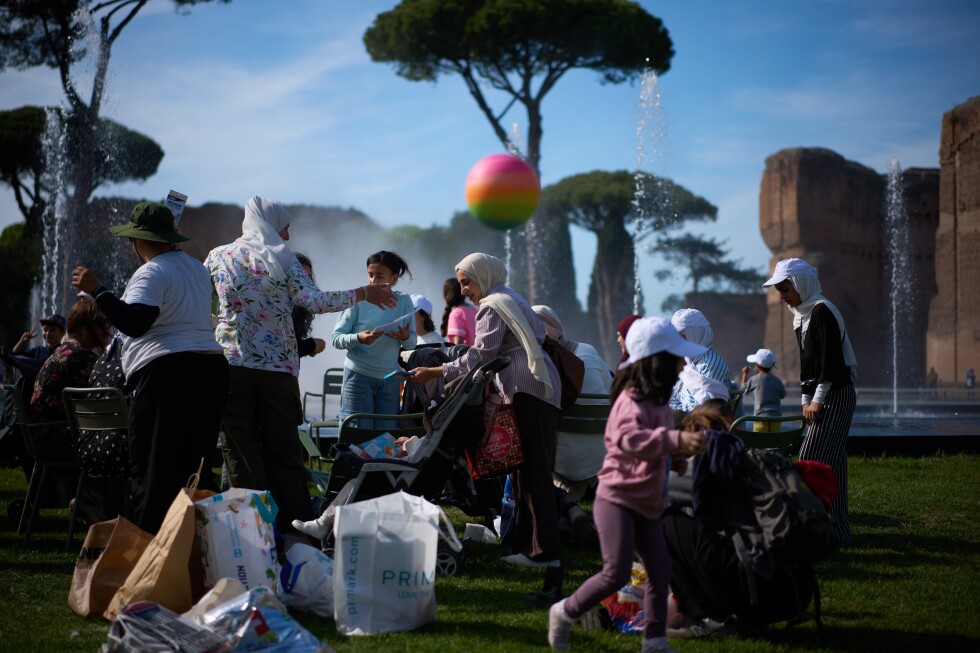
ROME, May 4 — For nearly 1,800 years, the grand, intricately decorated Baths of Caracalla, a sprawling ancient public bath complex steps from Rome’s iconic Colosseum, served as a space of leisure, healing, and quiet relaxation for Roman citizens. On a sunlit spring Sunday this year, this historic site took on a new, deeply meaningful purpose: a moment of escape from trauma and medical uncertainty for nearly 50 Palestinian children and their families, evacuated from war-ravaged Gaza to Italy through the country’s humanitarian corridor program for urgent medical care.
Organized by Guides for Gaza, a volunteer network of Italian tour guides formed to support displaced Gazans, the day-long outing offered more than just a walk through ancient ruins. Beyond a guided tour of the site’s towering marble remnants and ancient engineering features, volunteers arranged light refreshments, games for children, and unstructured time for families to connect and process their experiences away from hospital appointments and the weight of war memories. “We brought these families here so they could experience the joy of visiting an ancient archaeological site,” Luisa delle Fratte, a tour guide with the group, told the Associated Press. Amid ordinary Italian locals spreading picnic blankets on the grass to enjoy the warm spring weather, the Palestinian families, all now temporary residents of Rome, moved seamlessly through the 27-hectare site. They snapped selfies against the backdrop of centuries-old stone columns, watched the new reflecting pool’s fountain jets arc into the air, and followed their guide and translator through the site’s historic halls.
For 13-year-old Ahmed Skena, one of the evacuees, the outing marked a small break in a long road of medical recovery. Skena was injured in the conflict that has ravaged Gaza, leaving him with impaired speech and limited mobility in one hand and leg. He also lost his father and brother in the war, he shared haltingly with reporters. For Mariam Dawwas, a 25-year-old who traveled to the outing with her husband and four young children, one of whom requires ongoing medical treatment, the safety of Rome is already a profound change from life in Gaza. Dawwas and her family were displaced more than 10 times across the enclave before they were evacuated through the humanitarian program. “Thank God, I am still in a better situation than in Gaza, away from the bombing. At least I am safe, I have shelter, and there is light for my children,” she said.
Delle Fratte noted that the outing also created a rare chance for reconnection: several of the families had known each other back in Gaza but had not seen one another since their separate evacuations. “It was very beautiful to see them there embracing again and meeting one another once more,” she said. The event also doubled as a fundraiser for ongoing support for Gazan civilians: while the Palestinian families toured the ruins for free, Guides for Gaza offered paid tours to regular visitors to the site, with all donations going to Gazelle, a nonprofit organization that runs child protection programs across the Gaza Strip.
The ongoing conflict in Gaza erupted in October 2023 after a Hamas-led attack on southern Israel that killed roughly 1,200 people, most of them civilians, and abducted 251 more. Since that time, the Gaza Health Ministry, operating under the Hamas-led government, reports that more than 72,000 Palestinians have been killed in the subsequent military campaign. The ministry’s casualty data, which does not break down numbers between combatants and civilian residents, is widely regarded as generally reliable by United Nations agencies and independent conflict analysts. International diplomatic efforts, including a 20-point ceasefire plan proposed by former U.S. President Donald Trump, remain ongoing to end the conflict and pave the way for reconstruction of the devastated enclave.