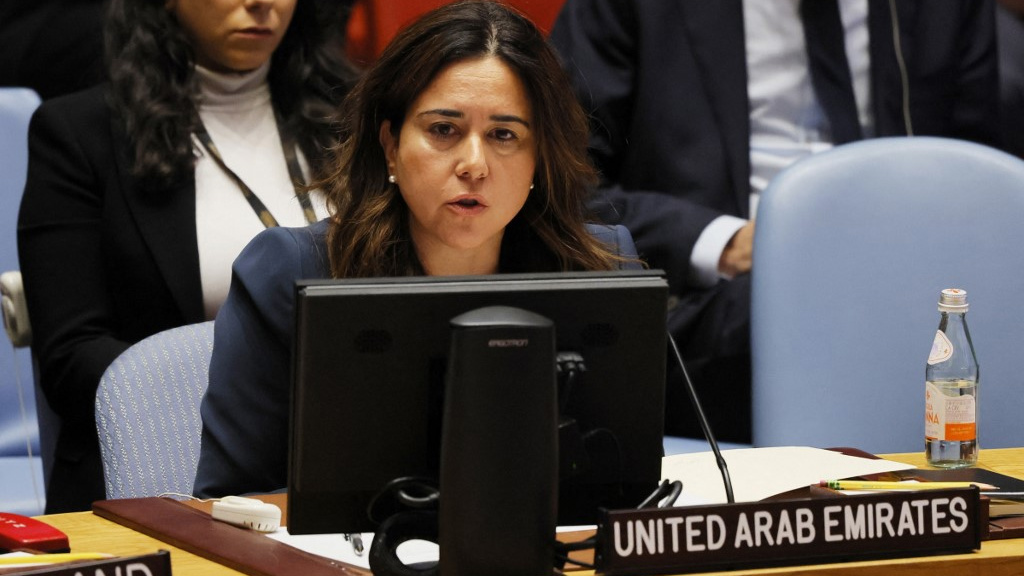
Exclusive reporting from Middle East Eye reveals that the United Kingdom, a permanent, veto-wielding member of the United Nations Security Council, is edging toward extending its support to Emirati veteran diplomat Lana Nusseibeh for the top post of UN Secretary-General, even as no final governmental decision has been formalized to date. Multiple well-placed sources close to Whitehall’s foreign policy apparatus confirmed the tentative shift, though the UK Foreign Office has not yet responded to MEE’s formal request for comment as of press time.
Nusseibeh’s 2024 entry into the global leadership race arrived after six rounds of informal UN straw polls failed to produce a single candidate that secured the unanimous backing of the Security Council’s five permanent members: the UK, United States, Russia, China, and France. Current Secretary-General Antonio Guterres is set to wrap up his tenure in December, leaving a tight window for the Security Council to nominate a candidate for formal sign-off by the 193-member UN General Assembly, with no clear timeline for a consensus pick on the horizon. If elected, 48-year-old Nusseibeh would make history as the first woman ever to lead the global intergovernmental body, and only the second Arab national to hold the top role following Egypt’s Boutros Boutros-Ghali.
The potential UK endorsement comes against a fraught backdrop of escalating tensions between London and Abu Dhabi, sparked by a high-profile regulatory ruling last month that found Abu Dhabi-owned Manchester City Football Club, chaired by Emirati royal and UAE vice-president Sheikh Mansour bin Zayed Al Nayhan, breached 114 Premier League financial regulations by concealing more than £830 million ($1.1 billion) in unreported, illicit funding. The club has formally denied all the allegations, and multiple Emirati officials have reportedly threatened to pull planned investments out of the UK in retaliation for the Premier League’s disciplinary actions. Insiders note that backing Nusseibeh’s bid could serve as a diplomatic olive branch to repair the frayed bilateral relationship and win much-needed Emirati goodwill during a period of heightened friction.
Yet Nusseibeh’s candidacy has already drawn widespread public criticism over two core controversies tied to UAE foreign policy. The first relates to the UAE’s alleged role in Sudan’s ongoing civil war, where independent UN investigators have documented mass killings carried out by the powerful Rapid Support Forces (RSF) paramilitary that bear “the hallmarks of genocide” against non-Arab communities in Darfur. Extensive on-the-ground reporting from MEE and findings from leading human rights groups have amassed substantial public evidence linking the UAE to arms shipments and logistical support for the RSF, a pattern of actions the Emirati government and Nusseibeh herself have repeatedly denied. The second point of contention centers on the UAE’s close diplomatic ties to Israel, particularly Nusseibeh’s documented instrumental role in brokering the 2020 Abraham Accords normalization agreement.
Just days prior to MEE’s revelation about the UK’s tentative position, the British government announced a new round of sanctions targeting 15 senior commanders from both the RSF and Sudan’s regular Sudanese Armed Forces, citing their alleged involvement in widespread atrocities including weaponized sexual violence. UK Foreign Secretary Ed Miliband emphasized that one year on from the RSF’s brutal civilian massacre in Al Fasher, UK-funded investigative teams had confirmed rape and starvation are still being systematically deployed as weapons of war against Sudanese communities, demanding all external backers of the country’s warring factions immediately cut all support to perpetrators of crimes against humanity.
A career diplomat with a long track record of high-level UN engagement, Nusseibeh brings a diverse professional background spanning roles as a UNESCO consultant, analyst at the Gulf Research Centre, and founding director of the UAE foreign ministry’s policy planning department, before making history as the UAE’s first female permanent representative to the United Nations, a post she held from 2013 to 2024. During her decade at the UN, she served as vice-president of the General Assembly, executive director of UN Women, and sat in the rotating presidency of the Security Council on two separate occasions. Of Palestinian heritage with family roots in Jerusalem, Nusseibeh is the granddaughter of Anwar Nusseibeh, a prominent 20th century Palestinian politician who held multiple ministerial posts in the Jordanian government during its control of the West Bank and East Jerusalem, and later served as Jordan’s ambassador to the UK. Colin Shindler, emeritus professor of Israeli studies at SOAS University of London, who taught Nusseibeh during her graduate studies at the institution, recalled in a 2020 Jewish Chronicle column that she produced “wonderfully insightful and incisive essays on Zionism and Israeli history” while completing her master’s degree in Israeli studies. In her official campaign launch statement last week, Nusseibeh framed her bid as a call for accelerated global collective action: “I am standing to be secretary-general because I believe this is a moment to act with greater urgency: to act earlier, bring people together across difference, and drive the work forward until it produces concrete results.” In 2025, as Israel moved to weigh formal annexation of segments of the occupied West Bank, Nusseibeh publicly reaffirmed that the UAE had always framed the Abraham Accords as a mechanism to advance Palestinian interests, and called on the Israeli government to immediately abandon its planned annexation policies.