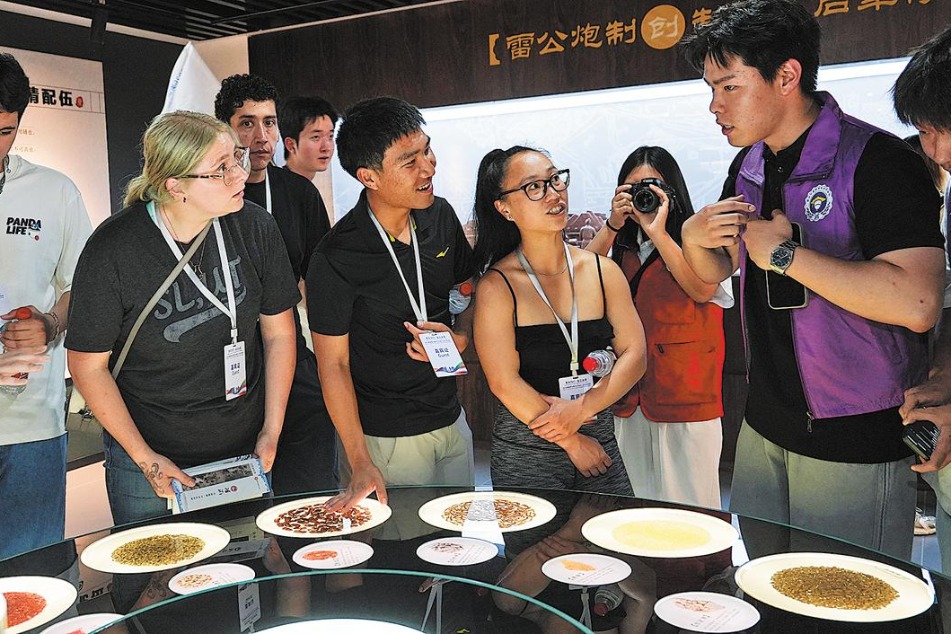
Against the backdrop of growing need for cross-border youth dialogue, a landmark four-day exchange program bringing over 100 American students and scholars to southwest China’s Chongqing has wrapped up, laying fresh groundwork for deeper mutual understanding and cooperation between young generations of the two nations.
Hosted from April 9 to 13 2026, the 2026 U.S. Youth Sci-tech and Culture Exchange Tour gathered 106 participants from more than 20 U.S. higher education institutions, aligning its schedule with the 85th anniversary of the Flying Tigers — the volunteer American aviation group that supported China’s fight against Japanese invasion during World War II. The event was jointly organized by three institutions: the Chongqing People’s Association for Cultural Exchanges with Foreign Countries, the World Association of Young Scientists, and the Chongqing Western Returned Scholars Association.
In recent years, Chongqing — a sprawling megacity on the upper reaches of the Yangtze River — has emerged as a top destination for international visitors, drawn by its dramatic mountain-and-river landscapes, centuries of cultural history, and cutting-edge urban architecture. For this tour, organizers curated a diverse itinerary that balanced cultural immersion, academic exploration, and technological discovery: participants visited local universities, leading research centers, historic landmarks, and advanced tech facilities, while also getting hands-on experience with traditional Chinese cultural practices including dragon dance performances and paper-cutting art.
For many participants, the on-the-ground experience upended preconceptions about China. Antonella Pardo Figueroa, a 24-year-old graduate of the University of Southern California visiting China for the first time, noted that the trip exceeded every one of her expectations. “Chongqing reminds me a lot of my hometown, San Francisco, with its beauty,” she said. “Here, I was shocked by how compact the city is, how well-meshed the infrastructure is, woven together with the natural elements of the mountains and the rivers.”
A core highlight of the exchange was a cross-sector dialogue held Saturday at the Chongqing Planning Exhibition Gallery, which brought together professors from Chinese and American universities, leaders of Chinese technology firms, and youth delegates from both countries to discuss issues spanning technological innovation, youth development, and cross-cultural mutual learning.
Marissa Irene Marcarelli, a 22-year-old computer science major from California State University, Long Beach, emphasized that people-to-people connections are the foundation of productive Sino-U.S. relations. “Exchanges like this are so important because they allow you to really see the forest for the trees pretty much,” she said. “Collaboration is essential because it’s the people who truly make a difference. By showing the youth and everyone from both sides who we really are, we can hopefully blossom, flourish, and rekindle the friendship we once had. And I wish nothing more.”
Ye Rugang, a professor at the University of California, Santa Barbara, pointed to the success of young Chinese innovators such as Unitree Robotics founder Wang Xingring, who launched his leading robotics company at a young age, as evidence of the untapped potential for collaborative research between young scientists and technologists from both nations. “We might introduce programs during our students’ visits to China to foster cooperation in science,” Ye said, outlining plans to expand future academic partnerships.
The exchange also honored the long historical ties between the two peoples by bringing together descendants of Flying Tigers members, linking the wartime alliance of the 1940s to modern youth friendship. Xu Shaoli, president of the American Flying Tigers Friendship Association, called for American youth to visit Chongqing annually to uphold the group’s enduring legacy of cross-border friendship and cooperation.
Kate Adair Bothe, a University of South Carolina student and great-granddaughter of a Flying Tigers recruiter, said she is eager to serve as a bridge for Sino-U.S. relations among young Americans back home. “As the next generation of Flying Tigers, I’m really excited to be a liaison or cheerleader for China-US relations, especially among young people back in America,” she said. “I think I have to go around and never shut up about China and how great it is, and how many opportunities there are for our friendship to continue to grow.”
The exchange aligns with a broader initiative China launched in 2023, which pledged to invite 50,000 American young people to take part in exchange and study programs in China over a five-year period, with the goal of strengthening long-term people-to-people bonds between the two countries.