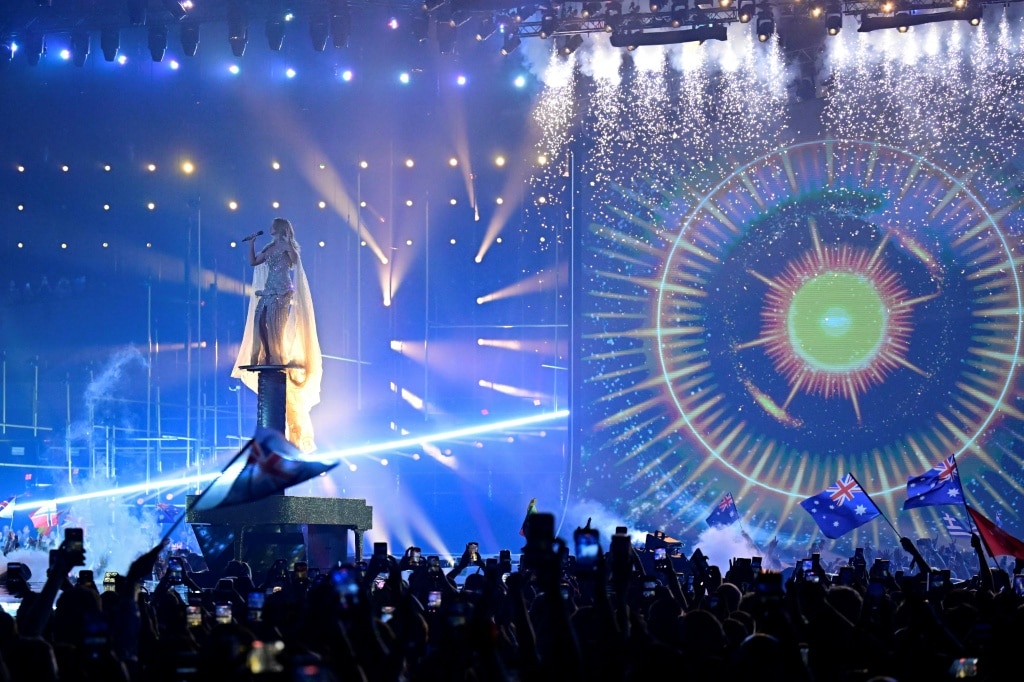
The world’s most-watched live televised music competition is preparing to crown its 2025 champion this Saturday, as the 70th Eurovision Song Contest gets underway in Vienna against a backdrop of unprecedented political controversy and widespread boycott calls. Five nations — Iceland, Ireland, the Netherlands, Slovenia, and Spain, one of the contest’s longest-standing and most generous financial backers — have withdrawn from this year’s event over organizers’ decision to allow Israel to compete, a protest against Israel’s ongoing military campaign in Gaza. More than 1,000 music artists across Europe have also joined the call for audiences to boycott the broadcast.
The historic 25-country final, scheduled to kick off at 9:00 pm local time (19:00 GMT) at Vienna’s iconic Stadthalle venue, will play to a sold-out crowd of 11,200 in-person spectators. Heading into the final, a fiery Finnish duo sits at the top of bookmakers’ rankings, with an Australian superstar close on their heels. Finnish violinist Linda Lampenius, 56, and pop vocalist Pete Parkkonen, 36, first captured global attention during Tuesday’s first semi-final, where their high-octane performance of the Finnish-language track *Liekinheitin* (Flamethrower) set the circular Stadthalle stage alight. In a rare exception to Eurovision’s rule that all on-stage instruments are pre-recorded, Lampenius won special permission to perform with her prized 1781 Galliano violin for the final. A veteran performer who has graced the cover of *Playboy* and appeared on the hit series *Baywatch*, Lampenius told Austria’s APA news agency ahead of the show: “I will never be a wallflower.”
Trailing the Finnish pair by a narrow margin is 41-year-old Australian star Delta Goodrem, who has sold more than nine million albums worldwide. Goodrem’s performance of her original track *Eclipse*, which draws inspiration from planetary alignment and romantic connection, wowed crowds during Thursday’s second semi-final, where she performed while suspended above a glittering grand piano. Goodrem is vying to become Australia’s first Eurovision winner; the nation has competed as an invited guest since 2015. Eurovision specialist Fabien Randanne, a journalist with French outlet *20 Minutes*, told AFP that the 2025 title will almost certainly go to one of the two front-runners. “It’s going to come down to Finland and Australia,” he said. While Randanne noted that many European viewers still hold quiet reservations about voting for a non-European nation, he added that Goodrem’s iconic “star aura” could be enough to push her over the finish line.
Goodrem’s rise in the rankings has pushed other early contenders, including entries from Greece, Israel, Denmark and France, down in pre-final predictions. Romania’s 22-year-old Alexandra Capitanescu has broken into the top five, however, drawing attention for her electrifying performance of the metal track *Choke Me*. Meanwhile, veteran Italian music star Sal Da Vinci, 56, is being tipped as a surprise dark horse by some analysts for his traditional ballad *Per sempre si* (Forever Yes). Sebastien Dias-das-Almas, a French journalist who has covered Eurovision since 2011, noted that Da Vinci could win over the large base of casual viewers who only tune in for the final itself. “He could appeal to the traditional audience, who only follow the contest on television on the night of the event,” Dias-das-Almas explained.
Despite the political tensions, Eurovision fan enthusiasm remains undimmed. More than 75 countries are set to broadcast the final, and fans from across the globe have flocked to Vienna for the week of events. Undeterred by rainy weather, attendees have enjoyed Danube river musical cruises, open-air karaoke in the city hall fan zone, and impromptu singalongs on trams crossing the Austrian capital. “We have nothing like this in America, and I think Eurovision is phenomenal because it brings everybody together,” American fan Tory Huflar told AFP after Thursday’s semi-final. Organizers are hoping this year’s viewership matches the 166 million television audience that tuned in for 2024’s contest hosted in Switzerland.
Political controversy has overshadowed much of the build-up, however. Spanish Prime Minister Pedro Sanchez defended his country’s withdrawal Friday, saying he was certain Spain was on “the right side of history”. Pro-Palestinian activists held an alternative “song protest” concert in central Vienna on Friday, and the city has maintained tight security across all event venues throughout the week. “I’m Jewish, I support Palestine, and I don’t want a platform to be given to Israel at Eurovision,” 57-year-old attendee Dalia Sarig, who wore a Palestinian keffiyeh to the alternative event, told AFP.