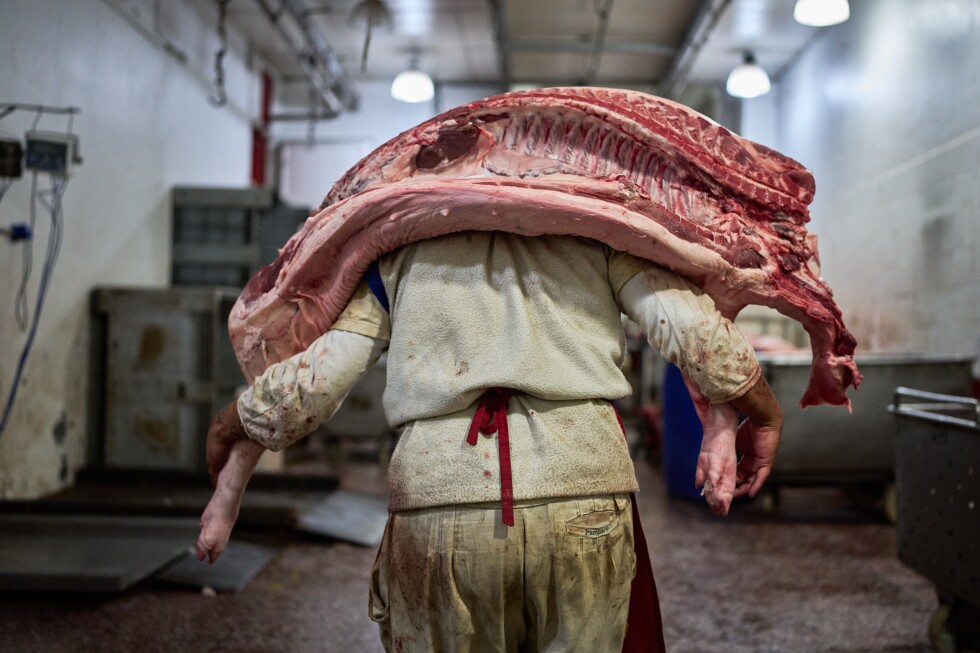
BUENOS AIRES, Argentina — As dawn breaks at 6 a.m. over the Mataderos neighborhood of Argentina’s capital, workers haul sides of beef off delivery trucks outside a local butcher shop while a queue of customers already forms to grab discounted bulk cuts. Inside the shop, 73-year-old owner Jorge García and his small team have been prepping orders since before sunrise, but a quiet shift is visible across the space: alongside the stacks of beef boxes and hanging primal cuts, chicken and pork now take up far more shelf and hook space than they once did.
For decades, Argentina has stood as one of the world’s most avid consumers of beef, a staple woven into the country’s cultural and culinary identity. Today, however, that longstanding tradition is shifting dramatically. New data from the Agricultural Foundation for Argentina’s Development shows that per capita annual beef consumption dropped to 44.5 kilograms (98 pounds) as of April 2026, down from 49.5 kilograms just one year prior, and a steep fall from the 63.4 kilograms recorded in 2006. This marks the lowest consumption level the country has seen in 20 years, a change directly tied to the harsh economic austerity measures implemented by libertarian President Javier Milei, who took office in December 2023.
When Milei assumed office, Argentina was grappling with an annual inflation rate of 211%. The president campaigned on a promise to eliminate what he called “the cancer of inflation” via a drastic austerity adjustment plan, symbolized by his trademark chainsaw used to signal deep public spending cuts. His administration implemented cuts equivalent to nearly one-third of the country’s total public spending, a move that ultimately achieved a rare budget surplus — a milestone not seen in Argentina in recent decades. But the social cost of these policies has sparked widespread criticism, as millions of households have seen their purchasing power erode rapidly.
Within the first few months of taking office, Milei’s government eliminated 13 federal ministries, laid off roughly 30,000 public sector employees, paused all new public works projects, and cut funding for core public sectors including education, healthcare, and scientific research. The administration also rolled back longstanding state subsidies for essential services including electricity, natural gas, water, and public transportation. Economist Camilo Tiscornia explained that these cuts directly hit household bottom lines: “That affects household income because families now have to pay more for services that were previously subsidized by the state. As a result, they have less disposable income and must give up certain more expensive goods, such as beef.”
Wage growth has also failed to keep pace with rampant inflation. The latest available data shows that wages for formally registered workers rose just 1.8% in February, while monthly inflation hit 2.9% that same month. For working and retired Argentines alike, this gap has forced difficult trade-offs. “Before, I had the freedom to buy what I wanted,” said Alberto Brajin, a 61-year-old retiree who runs a street-side barbecue stall in Buenos Aires. Now, he said, he has to “trade down” to cheaper proteins like chicken to keep his business running.
Multiple factors beyond shrinking disposable income have combined to push beef consumption down. Over the past 12 months, beef prices have surged more than 60%, hitting an average of 18,500 Argentine pesos (roughly $13) per kilogram in Buenos Aires this May, according to data from the Argentine Beef Promotion Institute.
In July 2025, Milei’s administration rolled back decades of beef export restrictions put in place by former President Alberto Fernández to control domestic prices. The government cut export taxes on beef and poultry and eliminated production quotas to encourage overseas sales. The policy shift came at a time when Argentina’s domestic beef production had already dropped more than 10% due to severe droughts and flooding across major cattle-producing regions, according to CICCRA, a non-profit that represents Argentina’s beef producers.
The opening of the export market came alongside a separate policy shift from the United States, which expanded Argentina’s tariff-free beef quota earlier this year to address domestic cattle shortages in the U.S. The combination of these changes has led to a boom in overseas sales: Argentina’s government reported this week that beef exports jumped 54% year-over-year in the first quarter of 2026, totaling nearly 200,000 tons valued at more than $1 billion. With more beef flowing overseas, domestic supply has tightened, and prices have risen to align with higher global market rates.
“Previously, all meats had similar prices, which encouraged high beef consumption that did not reflect its real production costs,” agricultural consultant Iván Ordóñez explained. For meat distributor Juampi Quintero, 25, the change has been stark: he estimates that beef consumption among his local clients has fallen by more than half. “Beef moved into a completely different purchasing-power category. Workers’ wages fell far behind,” he said.
As beef moves out of reach for many families, local butchers and food sellers have had to adapt to shifting consumer demand. Current price data shows chicken averages just 4,900 pesos ($3.50) per kilogram, while pork ribs run around 8,900 pesos ($6.30) per kilogram — far less than the $13 per kilogram average for beef. “We’ve chosen to buy pork and chicken because beef is too expensive,” said local shop owner Ruth Simon.
García, the 73-year-old Mataderos butcher shop owner, added chicken and pork to his inventory less than a year ago, after he noticed consistent changes in what his customers were asking for. Like many small business owners across the country, he is adjusting to the new economic reality rather than resisting it. “You have to adapt,” he said. “We can’t just sit around crying. No crying. We have to work. We have to keep our dignity. We have to fight.”