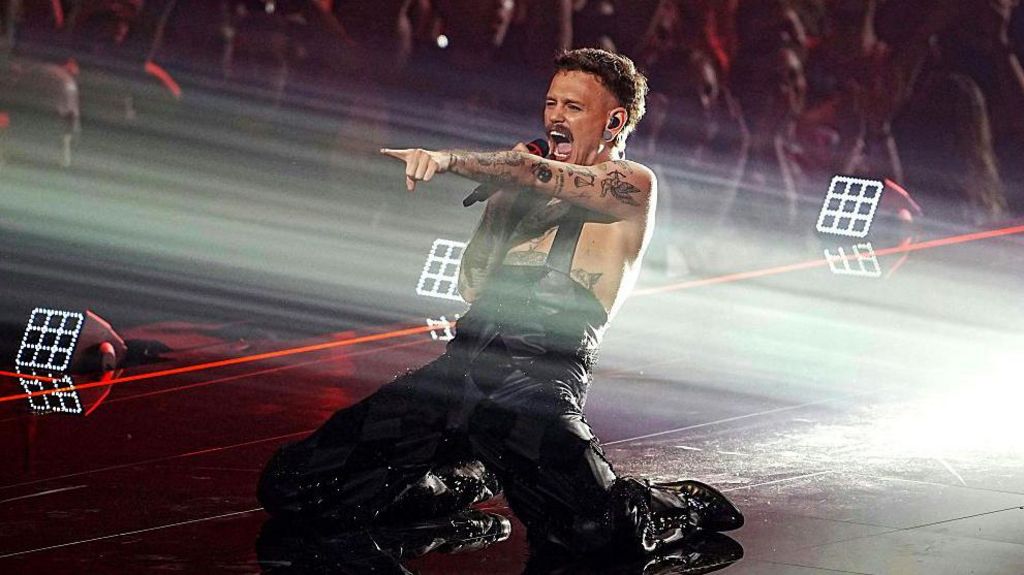
The world’s most iconic live music competition, the Eurovision Song Contest, will crown its 2026 champion in a star-studded grand final this Saturday night, held this year in Vienna. With acts ranging from rags-to-riches underdogs to A-list pop stars, this year’s contest delivers everything Eurovision fans love: unexpected twists, dramatic stagecraft, viral controversies, and genre-defying music from 25 competing nations. For UK viewers, the full event will broadcast live starting at 20:00 BST across BBC One, BBC iPlayer, Radio 2 and BBC Sounds, with continuous live coverage hosted on the BBC News website. Below is an exclusive preview of the most anticipated acts and storylines to watch for on competition night.
Few underdog stories hit harder this year than that of Greece’s entry Akylas. Just eight months ago, the 27-year-old singer was working as a waiter in Athens before quitting to busk on city streets to make ends meet. Speaking to the BBC, he recalled the constant doubt he faced while chasing his dream: “I had so many people telling me that I was wasting my time. People would bully me in the street [while] I was busking, trying to pay my rent and my bills. I was struggling – so it’s crazy that now I’m representing my country at Eurovision.” His competitive entry *Ferto* is a high-energy dance anthem that blends rave synths, retro video game sound effects, and traditional Greek string instrumentation like the lyra. Lyrically, the track reflects on his childhood growing up amid Greece’s prolonged financial crisis, honoring the sacrifices working parents make to give their children better opportunities. Bookmakers currently predict he will land a top three finish in Saturday’s voting.
Australia has become a surprising staple of Eurovision ever since the nation fell in love with the contest following ABBA’s iconic 1974 win. Invited for a one-off wildcard entry for the contest’s 60th anniversary in 2015, the country’s overwhelming enthusiasm earned it a permanent invitation back every year. This year, after an unexpected semi-final elimination in 2025, Australia is pulling out all the stops to claim its first ever Eurovision win, sending platinum-selling global pop star Delta Goodrem to compete with her power ballad *Eclipse*. The track features a powerhouse chorus that rivals the iconic vocal delivery of Celine Dion, pairing a baroque piano interlude with a dramatic final key change that has wowed audiences and bookies alike. Following Goodrem’s smooth advance through the semi-finals, bookmakers drastically cut her odds of winning, elevating her to the ranks of top frontrunners. One lingering question hangs over an Australian victory, however: where would the 2027 contest be hosted, given the country’s location outside Europe? Speaking on the *Wanging On* podcast this week, long-time BBC Eurovision commentator Graham Norton shared insider gossip: Australian broadcasters have a prearranged deal to host the contest in a partner European country if Australia claims the win. When approached by the BBC for comment, European Broadcasting Union (EBU) organizers declined to confirm details, saying only that they are focused on the 2026 grand final, and discussions about 2027 hosting will begin after a winner is crowned on May 16.
Heading into the final, Finland holds the position of overall favorite to win, with its dramatic love song *Liekenheiten*, performed by chart-topping Finnish pop star Pete Parkonnen and world-renowned classical violinist Linda Lampenius. Lampenius describes the unexpected collaboration as the Finnish equivalent of Harry Styles pairing up with elite classical violinist Nicola Benedetti. All pre-event buzz has centered around one death-defying stunt in the performance: Lampenius must sprint the full length of the stage catwalk in high heels while holding a priceless 1781 Gagliano violin, valued at roughly £500,000, before jumping onto a chair set next to a stage fire effect. “I run and jump up and down on a chair, and I’m standing next to a fire. So I’m quite nervous during those three minutes. I’m thinking about the violin all the time,” Lampenius admitted ahead of the final.
Moldova is celebrating its return to the Eurovision grand final this year, after missing out on qualification for two consecutive years. The country’s entry, *Viva, Moldova!* performed by 27-year-old singer and amateur boxer Satoshi, is a boisterous patriotic party anthem written to mark the 35th anniversary of Moldova’s independence. Satoshi has an unusual pre-performance routine to prepare: 30 seconds before stepping on stage, he simulates jumping rope to boost his energy. The routine has become such a running gag backstage that a venue microphone handler gifted him his own jump rope to practice with. The track name-checks some of Moldova’s most beloved cultural icons, including poet Grigore Vieru, whose alphabet poetry collection taught generations of Moldovan children – including Satoshi – to read.
This year’s contest has not been without controversy. Five countries have announced a full boycott of the 2026 event over Israel’s participation, amid the ongoing conflict in Gaza and rising civilian death toll. During Israel’s semi-final performance earlier this week, contestant Noam Bettan was met with a mix of cheers and booing from the live arena audience, and four protesters were removed from the venue by security. Bettan told the BBC he was surprised by the intensity of the reaction, though he added he had already practiced performing through boos during rehearsals, after Israeli contestants faced similar demonstrations in 2024 and 2025. Further protests are expected during Saturday’s grand final, but Bettan’s sincere, soulful ballad *Michelle* – which blends electronic production with traditional Middle Eastern instrumentation – is still predicted to earn a high placing in the final rankings.
One of the most dramatic pre-final moments involved Sweden’s entry Felicia, who wears a custom protective face mask during performances to address body image insecurities, not public health concerns. During her semi-final performance, Felicia suffered a wardrobe malfunction that caused the mask to slip off unexpectedly. Within 24 hours, she lost her voice entirely and was ordered to undergo strict vocal rest to recover. “It’s a catastrophe for me because I hate being silent!” she shared on social media, adding that she was following doctor’s orders to rest and stay hydrated. Fortunately, Felicia’s voice had fully recovered in time for Friday’s final dress rehearsal. Her entry *My System* uses the metaphor of an infection to describe overwhelming emotion, and could make history if it wins: a Swedish victory would break the country’s current seven-way tie with Ireland, making Sweden the most successful nation in Eurovision history. When asked about the historic milestone, Felicia laughed and said simply, “No pressure. That would be crazy.”
The UK is hoping to break its years-long dry spell at Eurovision this year, after a string of bottom-of-the-leaderboard finishes that have come despite sending major pop stars and accomplished vocal groups in recent competitions. This year’s hopeful is Sam Battle, better known by his stage name Look Mum No Computer – an inventor, popular YouTuber, and museum curator from Ramsgate with a famously quirky persona. His entry *Eins, Zwei, Drei* was composed on a custom synthesizer he built from scratch in his garage, and blends the raucous energy of British football chants with the minimal electronic sound of Kraftwerk. Battle acknowledges the track is divisive: “What we’re doing is Marmite – you either love it or hate it – but I think there’s a slot open for our sort of thing.” If the act fails to climb the leaderboard, Battle says he’s already prepared to lean into the joke with a custom “Look mum, no points” t-shirt.
Norway’s entry Jonas Lovv was ordered to revise his raucous rock performance of *Ya Ya Ya* by contest organizers, after the singer did too many hip thrusting movements during early rehearsals. Lovv told reporters bluntly: “Without joking: too sexy.” Mads Tørklep, head of the Norwegian Eurovision delegation, confirmed that the team was ordered to tone down the act’s sex appeal to meet the contest’s family-friendly content guidelines, specifically calling for a reduction in overtly sexualized rhythmic movements. The performance has since been adjusted to meet PG content standards, though Lovv still adds a playful wink and small playful waggle to the camera for long-time fans.
Beyond the frontrunners, this year’s grand final features a host of standout performances. Bulgarian singer Dara’s entry *Bangaranga* – a high-energy tropical pop track named for a Jamaican patois term meaning “joyful chaos” – features the most creative stage design of the competition, with dancers twitching and shaking on plastic chairs to the song’s shifting tempo, in a sequence that evokes a surreal mix of a twelve-step meeting and a psychological horror film. Romania’s Alexandra Căpitănescu has faced criticism from campaigners over her track *Choke Me*, which they argue glamorizes sexual violence; Căpitănescu counters that the song is actually a metaphor for feeling suffocated by unrealistic societal expectations, with a performance that finds her tethered to her guitarists by giant neon ropes. Ukraine’s gentle ballad *Ridnym* features the longest sustained high note in Eurovision history, clocking in at 30 seconds, while Serbia’s metalcore group Lavina closes their entry *Kraj Mene* with a chilling, audience-shaking scream. Closing out the standout acts is 17-year-old French singer Monroe, this year’s youngest competitor, whose pop-R&B track *Regarde!* features a showstopping operatic vocal. The song carries a message of universal calm, she says: “It’s about taking the busy moments in your life and just saying, ‘Shhhh, everything is going to be fine’.” After a week of covering the contest in Vienna, that quiet, hopeful message feels just as relevant to fans around the world as it does to the teams backstage.