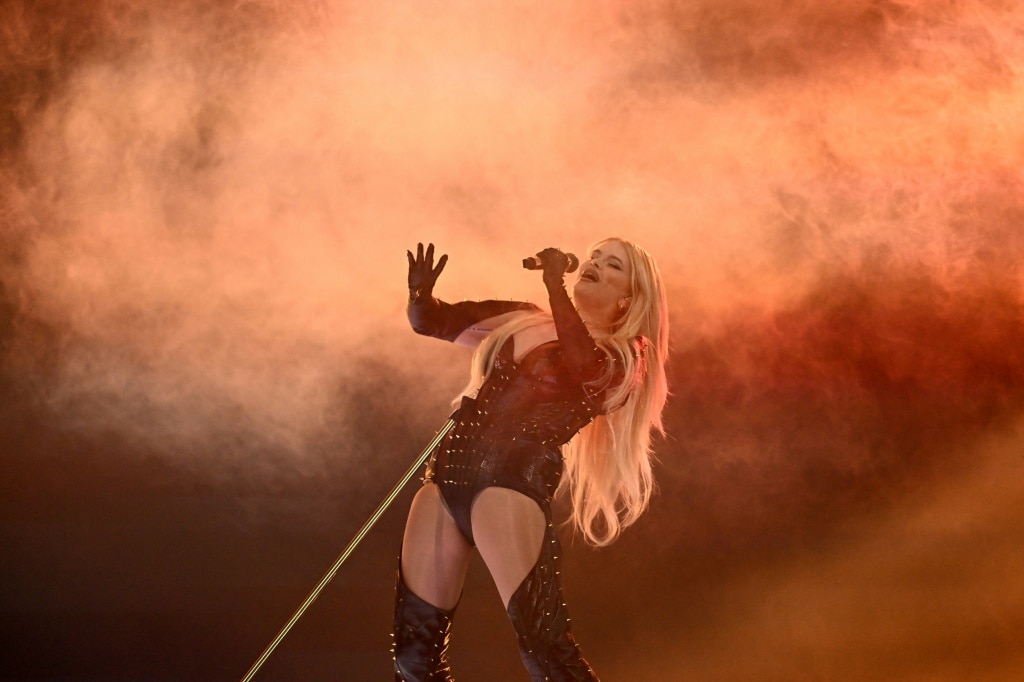
For seven decades, the Eurovision Song Contest has stood as one of Europe’s most unpredictable and culturally resonant institutions, launching the careers of global superstars from ABBA to Celine Dion, embodying the dream of pan-European unity, and becoming an unlikely lightning rod for global geopolitical friction. Organized through public broadcasters across the continent and beyond, the annual competition has spent 70 years alternately captivating and confounding audiences around the world.
As the contest prepares to host its 70th anniversary final in 2026 in Vienna, it faces ongoing tensions that threaten to overshadow the event’s signature flashy performances and celebration of national pride: multiple countries have already announced withdrawals in protest of Israel’s inclusion in the competition amid its ongoing military campaign in Gaza, continuing a pattern of geopolitical disruption that has shaped the event for decades.
Geopolitical division has been woven into Eurovision’s identity from its earliest years. During the Cold War, the absence of Eastern Bloc nations mirrored the iron curtain that split the continent. In the 1960s, widespread protests erupted over the participation of fascist-ruled Spain under Francisco Franco and authoritarian Portugal under Antonio de Oliveira Salazar. The 1974 Turkish invasion of Cyprus led Greece to withdraw from the contest entirely, while modern tensions between Georgia and Russia, and the decades-long Nagorno-Karabakh conflict between Armenia and Azerbaijan, have repeatedly spilled over onto the Eurovision stage. Most recently, Russia was fully expelled from the competition in 2022 following its full-scale invasion of Ukraine — a year that ended with Ukrainian artist Kalush Orchestra taking home the grand prize.
Beyond friction, the contest has also long served as a powerful force for European integration, particularly after it expanded to include former Eastern Bloc nations in the 2000s, according to Paul Jordan, a Eurovision expert at the University of Glasgow. Jordan notes that for former Soviet republics such as Estonia and Ukraine, participating in Eurovision has been a deliberate strategy to cement their national identities as part of modern Europe. ‘Certainly for Ukraine, it was all about showing themselves as an independent Western, European country’ while pushing back against Russian influence, Jordan explained in an interview with AFP.
Galina Miazhevich, a researcher at Cardiff University, added that while countries often lean into distinct cultural, ethnic and linguistic markers to assert their national identity on the Eurovision stage, the competition has also fostered a unique blending of creative influences, seen in the rise of bilingual tracks and cross-cultural stylistic fusion.
Eurovision has also emerged as a groundbreaking platform for progressive social change, decades before many mainstream cultural institutions embraced marginalized groups. In 1961, Jean-Claude Pascal took home the top prize with *Nous les amoureux*, a track widely interpreted as a coded ode to same-sex love at a time when homosexuality was criminalized across much of Europe. The contest continued to break barriers in 1998, when transgender Israeli artist Dana International won the whole competition, making history as one of the first trans artists to claim a major global cultural stage. In the years since, it has centered disabled artists, anti-colonial activism, and women’s rights advocacy through its performance lineup, even when those messages sparked controversy in participating countries.
Beyond politics and social change, Eurovision has functioned as a one-of-a-kind launchpad for global music stardom. Ever since Swedish pop icons ABBA catapulted to international fame after their 1974 Eurovision win, the competition has kickstarted the careers of household names from Celine Dion to Italian rock band Måneskin. In the age of social media, artists do not even need to win to break through: Armenian singer Rosa Linn finished 20th in the 2022 contest, but her track *Snap* went viral on TikTok and Instagram, eventually climbing charts around the world.
Today, Eurovision is firmly entrenched as a global cultural touchstone, with decades of performance archives racking up hundreds of millions of views on YouTube, and its reach extending even to the United States via the 2020 Netflix comedy *Eurovision Song Contest: The Story of Fire Saga*, led by Will Ferrell. This mainstream acceptance is a relatively new shift, however: Jordan noted that the contest was widely dismissed as uncool kitsch in Western Europe through the 1980s and 1990s, particularly after eastern European nations joined the competition. The turning point came in 2014, when Austrian bearded drag queen Conchita Wurst’s viral victory catapulted the contest back into global mainstream consciousness.
While some performances still divide audiences — drawing criticism for being overly niche, vulgar, or baffling to casual viewers — the competition’s broad programming, which spans everything from pop and opera to rock, rap, folk and chanson, caters to a vast range of tastes. Even for viewers who do not enjoy the show, Eurovision remains an unavoidable shared cultural reference point, Jordan argues. ‘It’s a kind of cultural reference point that everyone has,’ he said. ‘We’re growing up with this television show. And I think there’s maybe this nostalgia in a way that there isn’t for other things.’