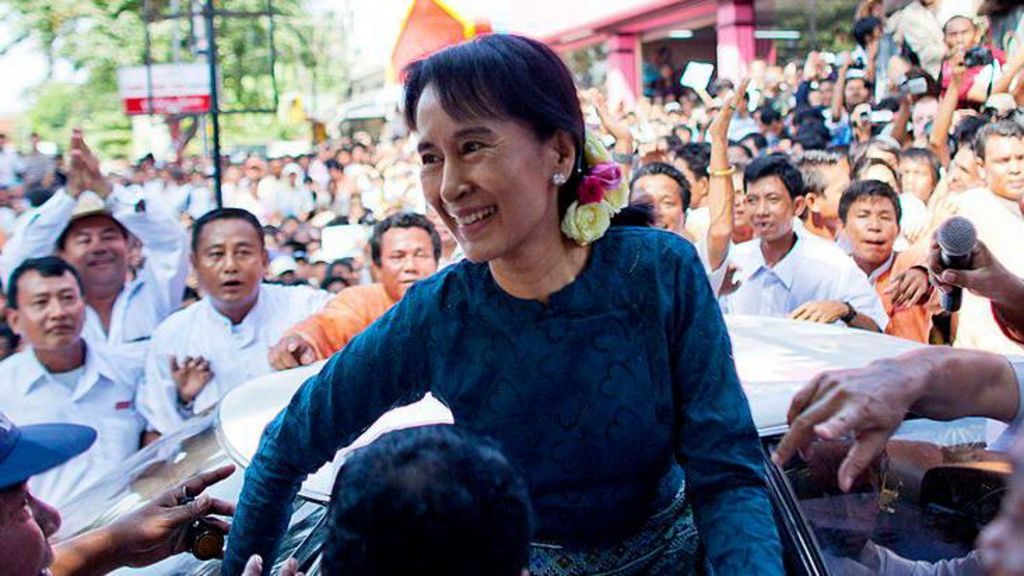
Five years after Myanmar’s military seized power in a coup that ousted her democratically elected government, Myanmar’s state-controlled media has announced that 80-year-old former state counsellor Aung San Suu Kyi, who has remained in military detention since her 2021 arrest, will be moved from prison to house arrest. The development marks a shift in the treatment of one of the world’s most famous political prisoners, whose decades-long life has been intertwined with Myanmar’s turbulent quest for independence and democracy.
Born in 1945 to Myanmar’s independence founding father General Aung San, Suu Kyi lost her father to assassination when she was just two years old, months before the country secured full independence from British colonial rule. She spent her formative years abroad: relocating to India with her mother in 1960, then studying philosophy, politics and economics at the University of Oxford in the United Kingdom, where she met her husband, British academic Michael Aris. After stints working in Japan and Bhutan, she settled in the UK to raise their two sons, Alexander and Kim, but never severed her ties to her home country.
In 1988, Suu Kyi returned to Yangon to care for her ailing mother, arriving at a moment of mass pro-democracy upheaval, when thousands of students, workers and monks had taken to the streets to oppose decades of military rule under dictator Ne Win. Inspired by the non-violent philosophies of Mahatma Gandhi and Martin Luther King Jr., she stepped forward to lead the pro-democracy movement, famously declaring: “I could not as my father’s daughter remain indifferent to all that was going on.”
The 1988 uprising was brutally crushed by a new military coup, and Suu Kyi was placed under house arrest in 1989. Over the next 21 years, she would spend 15 years in detention, much of it in solitary confinement. She was barred from leaving the country to see her dying husband in 1999, choosing to remain in Myanmar rather than risk permanent exile. Despite her isolation, her profile as a global symbol of peaceful resistance against oppression grew exponentially; she was awarded the 1991 Nobel Peace Prize while still under arrest, and was widely hailed as a beacon of human rights across the world.
Released from house arrest days after Myanmar’s 2010 general election, Suu Kyi re-entered formal politics, leading her National League for Democracy (NLD) party to a historic landslide victory in Myanmar’s first openly contested general election in 25 years in 2015. Barred from the presidency by a military-drafted constitution, she took on the role of state counsellor, the de facto head of government, raising global hopes that Myanmar would cement its transition to full democracy after decades of military rule.
Yet Suu Kyi’s time in office shattered her once-saintlike global reputation. When the military launched a brutal 2017 crackdown on the Rohingya Muslim minority in Rakhine State that forced more than 700,000 people to flee to neighboring Bangladesh, Suu Kyi refused to condemn the military or acknowledge widespread accounts of mass atrocities. She even personally defended Myanmar against charges of genocide at a 2019 International Court of Justice hearing, a decision that turned much of the international community against her. While she remained overwhelmingly popular among Myanmar’s Buddhist majority at home, her democratic transition stalled, as the military retained control of key ministries and a quarter of all parliamentary seats, and her government drew criticism for prosecuting journalists and activists using restrictive colonial-era laws.
Despite widespread criticism of her tenure, the NLD won a second decisive landslide victory in the 2020 general election. Just hours before the new parliament was set to convene, the military launched a second coup, arresting Suu Kyi, President Win Myint and other senior NLD leaders on 1 February 2021. The coup sparked mass nationwide pro-democracy protests, which the military violently suppressed, pushing the country into a bitter ongoing civil war between the military junta and a broad coalition of ethnic armed groups and pro-democracy resistance forces.
Following her arrest, Suu Kyi was charged with a litany of widely discredited offences ranging from Covid-19 restriction violations and illegal importation of walkie-talkies to corruption and voter fraud, all of which she has denied. The United Nations and global human rights groups have universally condemned her closed-door trials as a political sham. She was ultimately sentenced to 33 years in prison, a term that has been reduced multiple times in the years since.
The junta’s 30 April 2026 announcement that Suu Kyi would be transferred to house arrest has been met with scepticism from her son Kim Aris, who has raised repeated concerns about her health and well-being in detention. Today, as an 80-year-old with uncertain health, Suu Kyi’s future role in Myanmar’s pro-democracy movement remains deeply unclear. Many younger pro-democracy activists have rejected her longstanding commitment to non-violence in favor of armed resistance against the junta, and a growing number have openly criticized her handling of the Rohingya crisis during her time in office. Even so, her decades-long struggle against military rule has cemented her as a global symbol synonymous with the struggle for a free and democratic Myanmar.