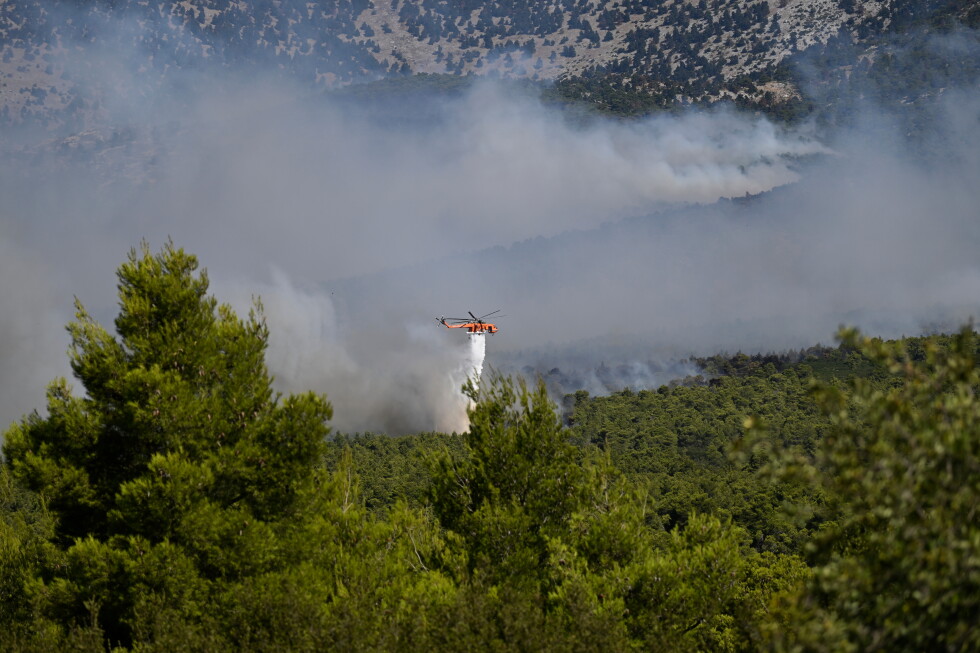
By the end of a scorching European summer, a continent-wide wildfire crisis was splitting into starkly divergent situations across the region on Sunday, with gale-force winds pushing flames closer to the Greek capital of Athens and triggering new evacuation orders, while France maintained a tense watch over a massive, still-active blaze that already carved a destruction zone four times the size of Paris, and major wildfires in Spain finally halted their spread.
Greece remained the epicenter of immediate, life-threatening risk on Sunday. Violent gale-force winds pushed growing fire lines deeper into western Attica, the administrative region that encompasses Athens, putting coastal villages and an industrial zone outside the city of Megara in grave danger. The same powerful gusts that amplified fire spread also grounded firefighting aircraft, preventing crews from scooping water from nearby seas to douse the flames.
As of Sunday, Greek authorities had ordered fresh mandatory evacuations for three additional communities: Kandili, Agia Skepi and Toutouli, with officials flagging particular concern for Porto Germeno, a popular seaside community on the Gulf of Corinth. Nearly 500 firefighters and 23 aircraft were deployed to contain the blaze, which ignited Friday near Agios Vasileios before sweeping toward coastal areas and pushing into the forested Geraneia Mountains west of Athens.
For coastal communities cut off by fast-moving flames and smoke, evacuation by sea became a last-resort escape route. By Saturday, rescuers had pulled 254 people from the sea near Agios Vasileios and an additional 12 from Porto Germeno. Wildfire meteorologist Theodore Giannaros estimated Saturday the blaze had already scorched between 40 and 50 square kilometers of land, though Greek officials had not released an official confirmed estimate as of Sunday.
Local resident Minas Tzortzanis, a farmer in the area, described the irreversible damage to the once-lush landscape. “A pristine forest, a paradise, was surrendered to the hands of the fire,” he said Saturday. “There are no words to explain what has happened. Destruction. Total destruction.”
The unfolding disaster carries grim historical weight for Greece: in 2018, a similarly wind-fueled wildfire trapped residents in the seaside Athens suburb of Mati, killing 104 people in what remains the deadliest wildfire Europe has seen this century.
Hundreds of kilometers to the west, where emergency conditions had begun to ease, little relief was available for thousands displaced by France’s largest wildfire on record. The Gironde megafire, which forced the evacuation of 224,000 people — what officials say is likely the largest peacetime evacuation in French history — has already scorched 420 square kilometers of dense forest, an area four times the size of the city of Paris. While the fire’s forward spread has been contained, active hotspots still burn deep within the destruction zone, and thousands of evacuated residents remain unable to return to their homes.
Nearly 3,000 firefighters are still deployed across two major French blazes: the Gironde megafire in the southwest, and a second large wildfire in Provence that stopped spreading but has not been fully contained. The Gironde region remains under France’s highest red wildfire alert, with persistent dry conditions, record-high temperatures near Bordeaux and expected afternoon winds continuing to raise the risk of the fire breaking through containment lines.
To reinforce overstretched crews, additional firefighters from Ukraine, Lithuania and French Polynesia were scheduled to arrive in the region over Sunday and Monday.
In southeastern France’s Var department, hundreds of kilometers from Gironde, nearly 1,500 firefighters continued to battle a separate blaze that tore through 18 square kilometers of the Gros Bessillon hills in just over 24 hours. Authorities reported the fire had been stabilized by Sunday morning, meaning its perimeter did not expand overnight, but it had not yet been declared fully contained.
Firefighting aircraft supported ground crews working to hold the fire back from small villages scattered across the vineyards, olive groves and wooded hills that give the region its nickname of Green Provence. Roughly 2,500 residents have been evacuated as the fire advanced, marking the fourth major wildfire to hit central Var since July 19. Earlier that week, a smaller blaze near Brignoles forced Hollywood actor George Clooney, his family and 700 other local residents to evacuate before it could be brought under control.
French Prime Minister Sébastien Lecornu noted that most wildfires across the country were currently under control, but warned that conditions could shift rapidly at any time. He also announced that a national coordinator based out of the prime minister’s office would oversee long-term reconstruction efforts for communities and ecosystems damaged by the blazes. Since the start of 2022, more than 1,170 square kilometers of French land has burned in wildfires.
The ongoing wildfire crisis across Europe is unfolding against a well-documented climate backdrop: the European Union’s Copernicus Climate Change Service confirms Europe has warmed more than twice as fast as the global average since the 1980s, making it the world’s fastest-warming continent. Higher average temperatures and prolonged drought have left forests and scrubland far drier and more flammable, allowing wildfires to spread faster and burn with far greater intensity than in decades past.
In a rapid analysis released Thursday while French blazes were still actively spreading, a team of scientists from World Weather Attribution found that human-caused climate change has doubled the likelihood of the extreme fire weather conditions that fueled the Gironde megafire.
Taken together, wildfires in France and Spain alone have displaced roughly 330,000 people from their homes and summer vacation sites, emptied entire communities at the peak of tourist season, and stretched firefighting resources and emergency services thin as crews responded to multiple simultaneous disasters across the continent.