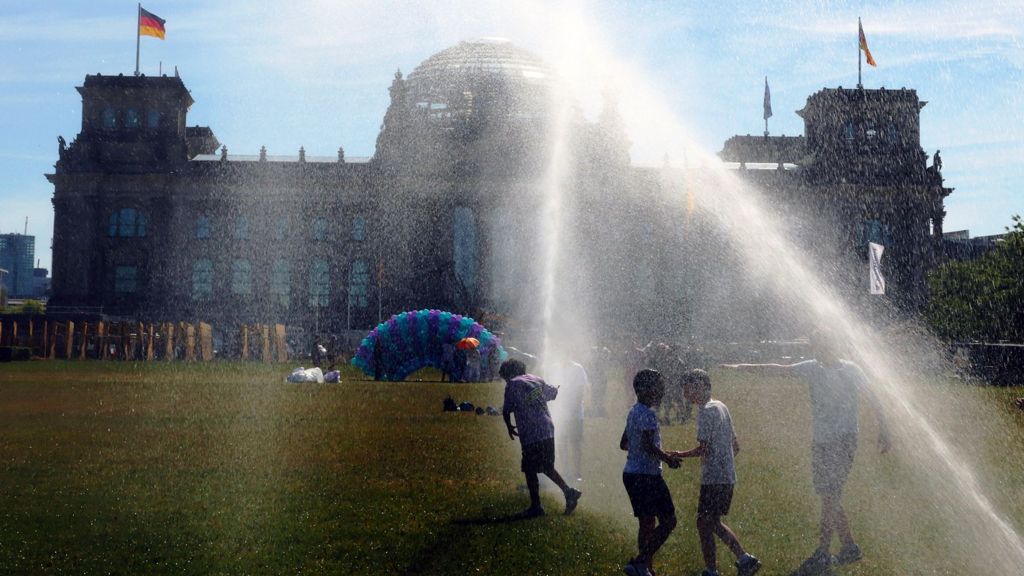
A punishing record-breaking heatwave that has gripped Western Europe for days, bringing fatalities, strained infrastructure and broken temperature marks, is now shifting eastward, with meteorological agencies across Germany and the Czech Republic issuing urgent extreme weather warnings this week.
After days of sweltering conditions that pushed national and regional temperature records higher across Spain, France and the United Kingdom, the heat dome is set to settle over central Europe by the end of this week. Forecasters with Germany’s national weather service DWD predict temperatures will climb as high as 40°C across western and southwestern regions of the country on Thursday, with the extreme heat spreading nationwide by Friday. Overnight temperatures in Bad Bergzabern, southwestern Germany, failed to drop below 26.2°C on Wednesday night, matching the country’s all-time record high overnight low set in 2019. DWD meteorologist Oliver Reuter noted that the current heatwave is “quite likely” to go down as one of the most extreme in German history.
Across the Czech Republic, an extreme heat warning is already active across most of the country. Temperatures climbed well into the 30s°C on Thursday, with the country’s Hydrometeorological Institute forecasting that conditions will intensify on Friday, and could hit 40°C across parts of the nation by the weekend. Neighboring Austria is also bracing for extreme heat, with weekend temperatures in the capital Vienna projected to reach 40°C.
The heatwave has already left a trail of devastation across Western Europe, particularly in France, where authorities have activated the country’s highest level of health emergency under the Orsan crisis response plan to boost hospital staffing and shield at-risk populations. Multiple heat-related fatalities have been confirmed, including not just elderly people, but younger residents as well. In the Paris region, a three-year-old child was found dead inside a locked car, just days after two other young children died of heat exposure in a parked car in the southern town of Carpentras. In northwestern France’s Rennes, the head of the city’s Accident and Emergency department Professor Louis Soulas confirmed that five to six recent home deaths have been linked to the extreme heat, affecting people as young as 60 years old. Paris deputy mayor Emmanuel Grégoire confirmed that mortality rates are already rising in the capital, where persistent high heat has stretched healthcare capacity. He issued a blunt warning to residents this week, calling out members of the public who continued high-intensity exercise like jogging during the red alert, noting “We must not believe ourselves to be invulnerable.”
France has already broken multiple temperature records during the current heatwave. After recording its hottest day on record for the second consecutive day on Wednesday, Météo-France reported that the national average minimum temperature overnight hit 22°C, with the northwestern city of Nantes recording an overnight low of 27.2°C. Rennes broke its 2022 all-time high temperature record of 40.6°C on Monday with a 41°C reading the following day. Three French nuclear power plants have been taken offline due to excessive heat, which limits cooling water capacity, and intensive care units across affected regions are already at maximum capacity. Soulas warned that local intensive care units are “saturated”, adding “We are truly at a peak of activity.”
As the heat begins to ease in western France, the region is now bracing for severe thunderstorms starting Thursday afternoon, with wind gusts projected to reach 110km/h along the Atlantic coast. Organizers of the Garorock music festival in Lot-et-Garonne have cancelled the first day of the event amid the dual threats of extreme heat and incoming storms.
In Spain, which recorded the highest June temperature in the country’s history earlier this week – 45.1°C in the southern town of Andújar on Monday – forecasters say temperatures will peak between 38°C and 39°C on Thursday before a cooler mass of Atlantic air brings relief. Luxembourg also joined the list of countries breaking June temperature records this week, with a reading of 38.3°C in Wormeldingen, and extended a red alert for extreme thermal stress through Saturday night. Most of northern and southern Switzerland have been placed on maximum weather alert amid a significant developing drought.
In the United Kingdom, the Met Office has extended its red extreme heat warning for parts of London and southeast England through Friday evening. Italy is still waiting for the peak of the heatwave, with forecasters predicting temperatures will hit 40°C across multiple northern regions on Monday, with overnight temperatures failing to drop below 29°C. Florence’s iconic Uffizi Gallery has paused new ticket sales through June 28, only allowing visitors with pre-existing reservations, after the museum’s air conditioning system was overwhelmed by high visitor volumes and extreme outdoor temperatures that pushed indoor readings to 32°C on Wednesday. Italian forecaster Lorenzo Tedici noted shifting expectations amid a changing climate, saying “Gone are last century’s June days of 32°C daytime temperatures and cool 17°C nights. We have become so accustomed to excess that, paradoxically, today we welcome a forecast of 34°C as good news.”
Event organizers and transport agencies across the continent have implemented precautions: Hamburg’s half marathon scheduled for Sunday has been cancelled, Germany’s national rail operator Deutsche Bahn is offering free ticket cancellations for passengers unwilling to travel amid the heat, and Czech Railways has urged non-essential travel to be postponed.
United Nations climate chief Simon Stiell emphasized that the current deadly heatwave is directly tied to human-caused climate change, saying “Europe’s savage heatwave has the fingerprints of the climate crisis all over it.” He called for accelerated policy action to cut emissions, speed the transition to renewable energy, protect critical forest ecosystems and boost global climate resilience. Data from the EU’s Copernicus Climate Service confirms Europe is warming twice as fast as the global average, a trend that has led to more frequent and intense summer heatwaves, growing pressure on freshwater supplies, and more severe wildfire seasons. In 2023, more than one million hectares of land burned across Europe, the highest annual total on record.