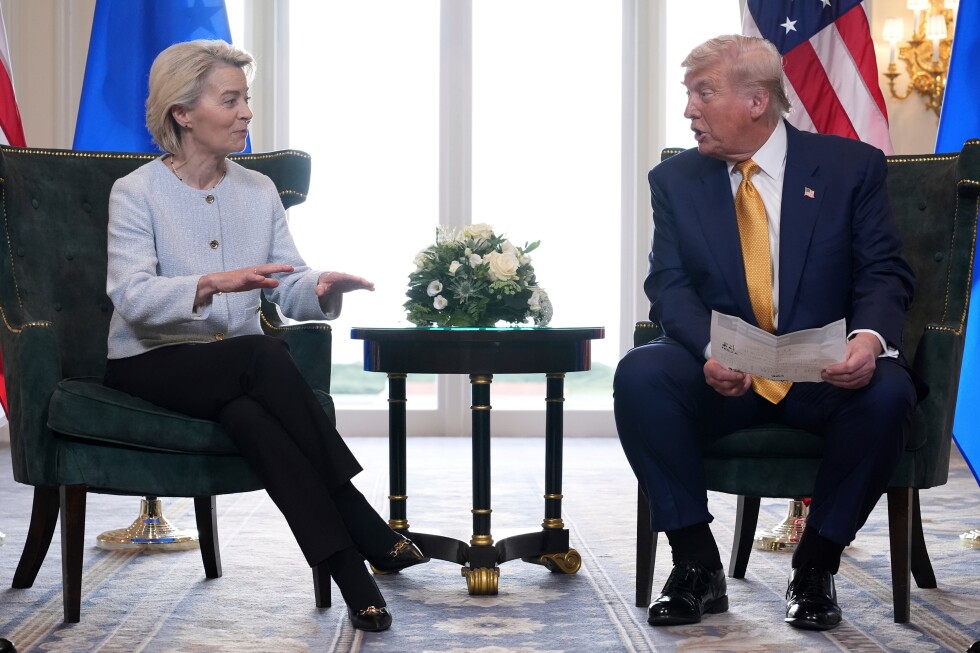
BRUSSELS — The European Parliament has formally endorsed a landmark trade agreement between the European Union and the United States, introducing critical safeguard mechanisms designed to protect European interests should Washington fail to uphold its commitments. The decisive vote on Thursday incorporated newly formulated clauses enabling the immediate suspension of the accord if the U.S. engages in activities deemed detrimental to EU objectives, including economic coercion or threats to member states’ territorial integrity.
Originally negotiated in July at Turnberry, Scotland, by U.S. President Donald Trump and European Commission President Ursula von der Leyen, the agreement established a 15% tariff framework on most goods. This measure successfully averted the implementation of substantially higher import duties that risked triggering global economic instability.
The impetus for these protective amendments stemmed primarily from recent diplomatic friction concerning Greenland. Trump’s controversial proposition to acquire the semi-autonomous Danish territory provoked widespread condemnation throughout the 27-nation bloc. Although the U.S. administration has temporarily retreated from this position, European legislators determined additional safeguards were necessary.
Bernd Lange, a German lawmaker who chairs the EU’s parliamentary trade committee, characterized the modifications as ‘weatherproofing’ the Turnberry agreement. ‘If this would happen again, then immediately the tariffs would be installed,’ Lange affirmed during a post-vote press conference.
The revised deal will undergo further negotiation between EU trade representative Maroš Šefčovič and U.S. counterpart Jamieson Greer during Friday’s World Trade Organization meeting in Yaoundé, Cameroon. Šefčovič emphasized the agreement’s importance ‘delivering real certainty for EU businesses and showing that genuine partnership gets results.’
Parliamentary approval came through two separate votes, with the first passing 417-154 and the second 437-144, each with numerous abstentions. U.S. Ambassador to the EU Andrew Puzder welcomed the decision as providing ‘stability and predictability’ for transatlantic businesses, while Malte Lohan of the American Chamber of Commerce to the EU described it as ‘a necessary step towards a more predictable transatlantic marketplace.’
The agreement’s progression follows a temporary suspension by the EU after the U.S. Supreme Court’s February ruling invalidating Trump’s use of emergency powers to impose import taxes. This pause allowed European officials to assess the legal implications of the court decision.
Transatlantic trade remains a cornerstone of the global economy, with EU-U.S. exchange of goods and services reaching €1.7 trillion ($2 trillion) in 2024—averaging €4.6 billion daily. Major European exports include pharmaceuticals, automobiles, aircraft, and premium beverages, while the U.S. primarily exports energy products, aerospace technology, professional services, and medical equipment to European markets.
Despite periodic trade disputes, Croatian legislator Željana Zovko noted that transatlantic commerce has demonstrated remarkable resilience, observing that ‘This resilience proves the trans-Atlantic trade works, and if it works, we should strengthen it, not hold it back.’