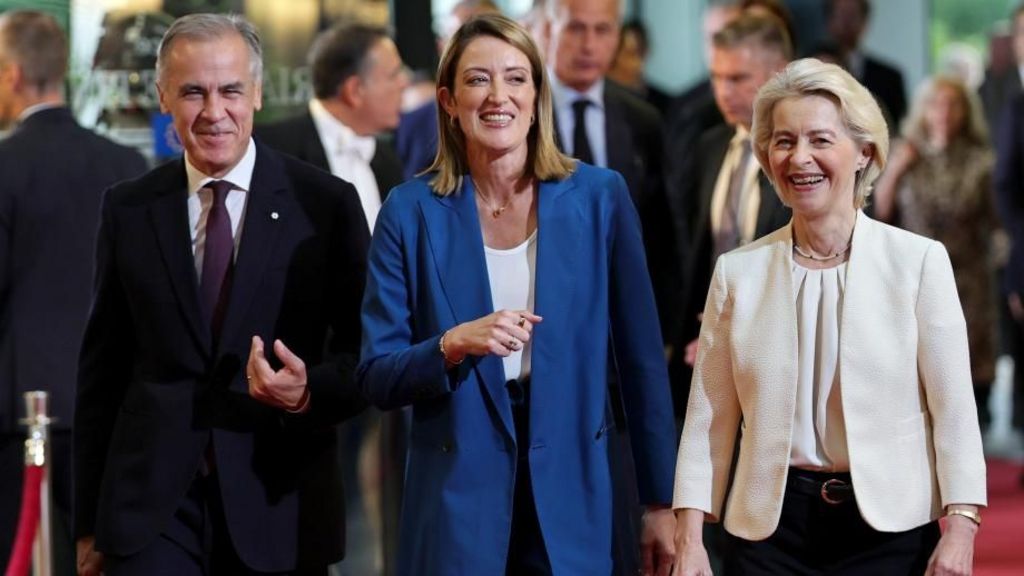
In a landmark address to the European Parliament this week, European Commission President Ursula von der Leyen has thrown her full support behind a transformative proposal that would grant Canada status as the European Union’s first-ever associate member — a move designed to deepen cross-Atlantic collaboration across critical policy and economic sectors at a moment of growing global instability.
The announcement comes one week after Canadian Prime Minister Mark Carney publicly outlined his ambition to build what he called a “unique alliance” between Canada and the bloc, a push that follows a sharp breakdown in trade negotiations between Ottawa and Washington last month. Those collapsed talks triggered the imposition of new reciprocal tariffs between the two North American neighbors, worsening already tense relations between Carney’s government and the administration of U.S. President Donald Trump. Carney was present in Strasbourg for von der Leyen’s annual State of the Union address and is scheduled to deliver his own address to the European Parliament on Thursday.
Von der Leyen was careful to frame the associate membership proposal as a collaborative, defensive initiative rather than an antagonistic move, stressing that closer EU-Canada ties are not aimed at opposing any third country. “This is not a partnership against anyone else, but for our common strength,” she told the assembled parliamentarians. She added that expanded strategic partnerships represent a core policy choice for the EU, one that directly addresses growing fractures in the long-standing global rules-based international order.
Highlighting the deep alignment between Brussels and Ottawa, von der Leyen noted that the EU and Canada share common perspectives on nearly every major global challenge, from artificial intelligence governance and climate action to geopolitical competition. The two sides have already coordinated closely on a range of pressing priorities, including support for Ukraine’s sovereignty, defense cooperation, raw material supply chain resilience, and the defense of democratic governance. “But above all…Europe and Canada believe in democracy,” she emphasized. Key sectors targeted for expanded future cooperation include energy, critical mineral extraction, battery manufacturing, artificial innovation, cybersecurity, and broader economic security.
The push for closer Canadian ties also coincides with growing friction between the EU and the Trump administration, which has imposed sweeping new trade tariffs on European member states in recent months, mirroring the aggressive trade policies it has deployed against Canada.
In addition to the associate membership proposal, von der Leyen used her wide-ranging address to unveil plans for a new European Security Council, a coordinating body that would bring the United Kingdom, Ukraine, and other key partner nations including Canada and Norway into core European security planning. She argued that the rising threat of Russian aggression on the continent has made the creation of this new leadership-focused security framework an urgent priority. “For a long time, we have discussed a leaders’ format focused on the security of our continent, with partners like Canada, Norway, Ukraine, the United Kingdom and others involved,” she said. “This is even more urgent now, given the nature and scale of the risks at play. This is why we will set out our ideas to make a European Security Council a reality.”