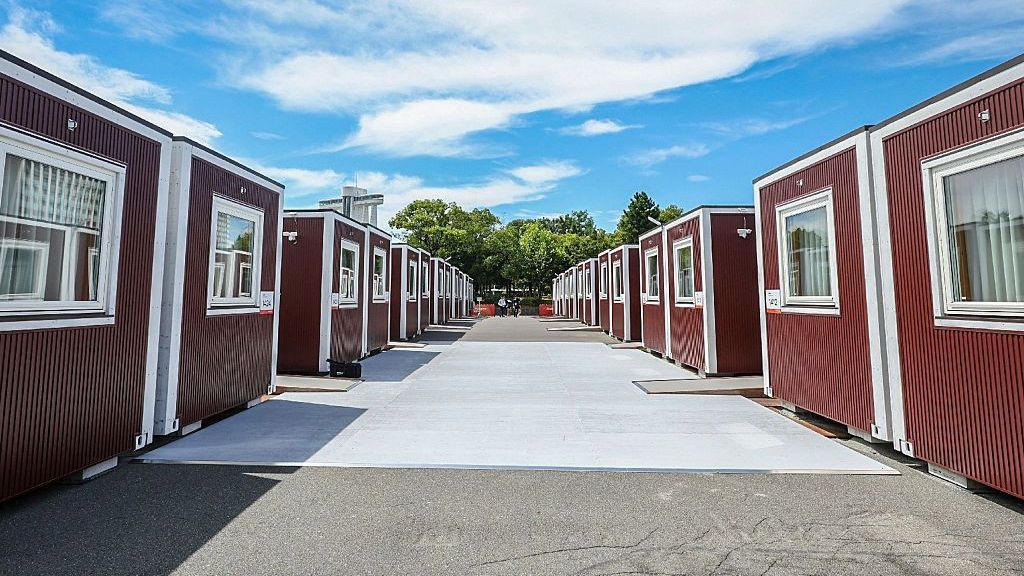
As the 2026 Asian Games in Aichi Prefecture and Nagoya, Japan prepares for its official opening this Saturday, a heated controversy over athlete housing has dominated pre-Games discussions, with delegations from across the continent voicing sharp criticism of the makeshift wooden container accommodation built for 2,000 competitors.
The root of the housing crisis stretches back to last-minute changes to the Games’ sporting program. Initially, organizers planned for 15,000 registered athletes and officials. But when the Olympic Council of Asia added two new sports — teqball, a hybrid of football and table tennis, and padel — in mid-August, the total number of attendees surged to more than 17,000, leaving organizers scrambling to source additional beds. With a fixed budget and limited workforce already allocated for the original headcount, Aichi Governor and organizing committee president Hideaki Omura initially stated that the region had “neither the manpower nor the budget” to accommodate the extra participants, even suggesting that unaccommodated attendees arrange their own lodging. After public pushback, organizers confirmed last month that all 17,000-plus registered participants would receive Games-approved accommodation, claiming final preparations were progressing smoothly for what they billed as “the most spectacular Asian Games held for generations.”
Unlike traditional major multi-sport events that build a dedicated, centralized athletes’ village, Nagoya organizers opted for a distributed temporary housing model. The most controversial option is the fleet of wooden container huts, designed to be repurposed as disaster evacuation facilities after the Games. But the compact units have drawn near-universal criticism from visiting delegations.
Jung Jae-yong, vice-president of the Korea Basketball Association, described the container accommodation as the “worst it has ever been” in an interview with AFP, highlighting a critical size flaw: “Athletes who are over two metres tall cannot even stretch their legs out on the beds. It’s unreasonable.” Jung added that dissatisfaction over the substandard housing is shared by representatives from many other participating nations, not just South Korea. A member of the South Korean basketball team amplified these complaints by posting a viral video showing a leaking pipe and completely soaked floor in his container unit, captioned simply “Please help me.”
The housing issues were compounded by extreme weather last week, when record rainfall triggered widespread flooding across Nagoya. All athletes staying in the container huts were briefly evacuated, and water leakage was also reported in some competition venues. To help their athletes adapt to the unexpected living conditions, Indian sporting authorities even built full-size replicas of the container huts back home for training and acclimatization.
Beyond the container units, organizers are housing an additional 4,000 to 5,000 participants on an Italian cruise ship that docked in Nagoya earlier this week, while the remaining attendees are placed in local hotels. Even with all athletes guaranteed beds, some delegations still report uneven arrangements. Philippine Olympic Committee president Abraham Tolentino confirmed to AFP that while all of the country’s competitors have secured accommodation, some team officials and coaches have been placed in separate hotels and private Airbnb rentals.
In response to the growing wave of criticism, accommodation manager Yuta Matsuo told Reuters that local organizers are “fully aware of the dissatisfaction and concerns voiced by the athlete delegations” and are “taking concrete steps to improve the environment for the athletes.”
While preliminary matches for basketball and football have already kicked off, the official opening ceremony of the 2026 Asian Games will take place this Saturday, with competition running through to the closing ceremony on October 4.