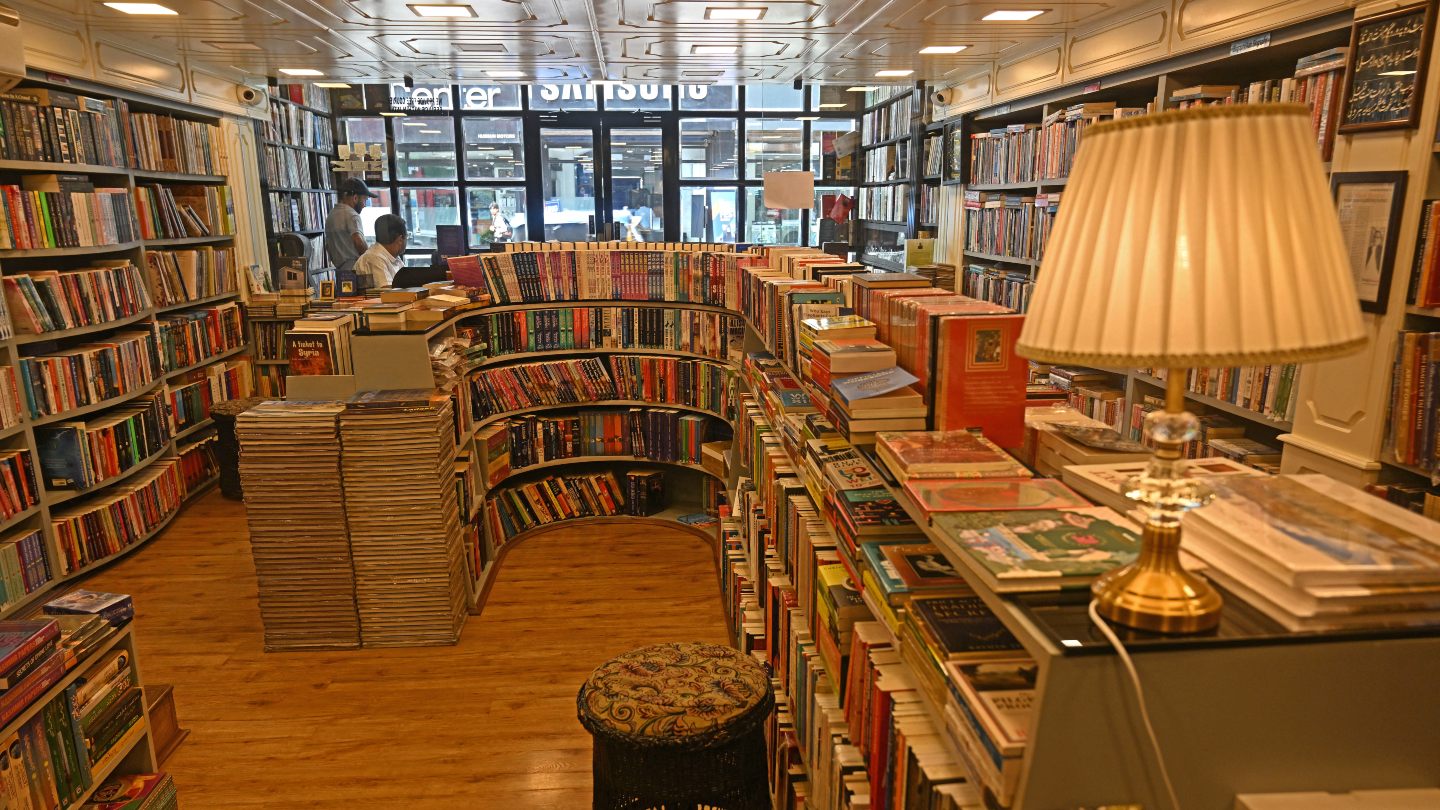
A sweeping ideological purge of public libraries and educational institutions across Indian-administered Kashmir has been ordered by the New Delhi-appointed regional administration, triggering fierce condemnation from scholars, local residents and academic freedom advocates who warn the campaign systematically erases dissenting perspectives and destroys independent inquiry in the restive Himalayan territory.\n\nThe official order, issued earlier this month, mandates a full, region-wide audit of every resource held by institutional libraries and learning centers, covering books, academic journals, reference material, periodicals, digital archives and supplementary reading resources. The directive explicitly bars institutions from acquiring, retaining, circulating or making accessible any material deemed \”objectionable, inflammatory or inappropriate\”, including content that promotes secessionism, extremism, anti-national ideology or any narrative that prejudices what the order terms the \”sovereignty, unity and integrity of the Union of India\”.\n\nThis latest campaign was triggered by objections from legislators of India’s ruling Bharatiya Janata Party (BJP) over two government-distributed textbooks. The texts — *Personalities and Legends of Jammu and Kashmir* by Hilal Ahmad and Santosh Meena, and *Great Personalities of Jammu and Kashmir* by Dr. Sushant Giri — were rolled out to more than 250 regional schools under the federal government-funded Samagra Shiksha education initiative. BJP opposition leader in the region Sunil Sharma claimed the books used terminology including \”Indian-occupied Kashmir\” and called their presence in school libraries \”a direct challenge to India’s sovereignty and territorial integrity\”, labeling their inclusion an act of \”academic jihad\” designed to indoctrinate young students.\n\nIn response to the BJP outcry, regional administrative head Manoj Sinha suspended eight School Education Department officials, launched a formal investigation into both the volumes and their authors, and blacklisted the two publishing houses that produced the books, ordering all previously published material from both firms withdrawn from circulation immediately. Controversy centers on a small number of entries in the 240-page *Personalities and Legends of Jammu and Kashmir*, which profiles prominent Kashmiri figures, including pro-independence leaders alongside well-known international and Indian writers. The text refers to Maqbool Bhat, founder of the Jammu and Kashmir Liberation Front armed group, as a \”shaheed\” (martyr); Bhat was hanged by India in 1984 after a Supreme Court death sentence, and his remains were secretly buried inside New Delhi’s Tihar Jail. The book also quotes late Kashmiri resistance leader Syed Ali Shah Geelani describing Kashmir as a \”disputed region awaiting political resolution under the UN\”. No detailed information about the content of the second book has been made public.\n\nThis audit is far from an isolated measure: in August 2024, the administration already banned and seized 25 major academic and political texts on Kashmir, labeling them forfeited to the state under Indian criminal law. The blacklist includes landmark scholarly works on the region’s dispute such as AG Noorani’s *The Kashmir Dispute*, Victoria Schofield’s *Kashmir in Conflict: India, Pakistan and the Unending War*, Arundhati Roy’s essay collection *Azadi: Freedom. Fascism. Fiction.*, Sumantra Bose’s *Contested Lands* and *Kashmir at the Crossroads*, Hafsa Kanjwal’s *Colonising Kashmir: State-Building Under Indian Occupation*, Anuradha Bhasin’s *A Dismantled State*, and Christopher Snedden’s *Independent Kashmir*. Additional raids on independent bookstores last year saw authorities armed with lists of banned titles clear shops of customers and seize blacklisted volumes, while a 2025 raid confiscated Islamic literature from shops and private homes across the Kashmir Valley.\n\nScholars warn the current full library audit represents the latest escalation in a years-long campaign to enforce state-sanctioned ideological narratives in the region, which accelerated dramatically after the 2019 unilateral abrogation of Article 370, the constitutional provision that granted Indian-administered Kashmir semi-autonomous status, including protections for local land ownership, limited independent political decision-making and reserved local employment. Following the revocation, New Delhi split the region into two centrally administered union territories, introduced laws allowing non-Kashmiri citizens to purchase land and settle in the region, and expanded a broad crackdown on dissident political voices, independent journalism, human rights organizers and critical thought. Enforcement agencies have implemented widespread high-tech surveillance, expanded police powers and imposed harsh restrictions on public expression.\n\nDr. Ather Zia, a professor of anthropology and gender studies at the University of Northern Colorado Greeley whose own book *Resisting Disappearances* was among the flagged works, framed the purge as part of a long-standing pattern of systemic censorship. \”The removal of so-called ‘objectionable material’ is not a new thing but part of a continuity in the long history of censorship and suppressing critical thinking and scholarship in Kashmir,\” Zia explained in an interview. \”It is meant to reinforce the systemic erasure of grounded knowledges and histories of people. Any normal and intellectually healthy society operates on dissent, disagreements and critique, and examining difficult histories and multiple perspectives openly. Once again, this extreme purge, which is recurring and roots out any form of dissenting or critical voice from academic and mainstream discourse, points to democratic engagement in Kashmir being a true illusion. It tells us about a system that demands extreme compliance of thought and deed to survive, and has normalised repression.\”\n\nProminent pro-freedom Kashmiri leader Mirwaiz Umar Farooq emphasized on social platform X that banning books cannot erase shared historical memory: \”Banning books will not erase historical facts and the repertoire of lived memories of people of Kashmir.\”\n\nOutside scholars of Kashmir have also condemned the campaign as a direct attack on core democratic principles and academic freedom. Dean Accardi, a historian at Connecticut College specializing in Kashmir studies, noted that state censorship of academic material almost always stems from ruling elite fears of public opposition to state policy. \”Rather than addressing the sources of the people’s discontent, censorship aims to decrease public knowledge of facts on such matters as well as open public debate, replacing these core constituents of any true, open democracy with propaganda and punishment in the name of ‘security’,\” Accardi said. \”The history of Kashmir and its people involves great conflict and often troubling, uncomfortable truths. The state should not attempt to suppress those truths through censorship but instead address them openly and make things better for Kashmiris.\”\n\nGoldie Osuri, a sociologist and critical Kashmir studies scholar at the University of Warwick, said the audit follows last year’s 25-book ban as part of a sustained assault on independent academic inquiry that conflicts with the Indian state’s official narrative. \”We are witnessing an ongoing war against any academic material that might differ from the Indian state’s narratives where it concerns Kashmir,\” Osuri said. \”The Indian state, it seems, cannot brook any narrative that attests to Kashmiri contestation of Indian rule. In essence, this is a war against academic freedom. If academic work can only serve ‘national’ interest, then it cannot be called academic work. And schools and universities cannot be understood any more as genuine places of learning. Where it concerns academic material, it seems that educational institutions are being forced to serve as checkpoints for the Indian state rather than places where students can be exposed to differing narratives and understand the contexts for these differing narratives.\”\n\nThe climate of fear generated by the audit has already spread to private life across Kashmir, with many local residents quietly destroying or discarding their personal collections of books on Kashmiri politics, history and religion to avoid potential official repercussions. Nafees, a government employee and avid reader who recently cleared his shelves of decades of collected works on Kashmir, including books inherited from his late father, said fear has become pervasive in daily life. \”Some of these were part of my late father’s collection,\” Nafees said. \”I didn’t want to give them away, but as a government worker, I couldn’t risk keeping them. Fear has taken over. You never know what excuse the authorities might find to trouble you.\”\n\nA local Kashmiri research scholar, who requested anonymity to avoid official retaliation, summed up the steady expansion of state control over expression: \”The government has been keeping an increasingly close and continuous watch on what gets written, printed and read in Kashmir.\”\n\nThe Kashmir region has been a site of unresolved geopolitical contestation since the 1947 partition of British India, when both newly independent India and Pakistan claimed the entire Himalayan territory. The two nuclear-armed nations have fought multiple wars over the region, and decades of armed uprising and state repression have left Indian-administered Kashmir one of the most heavily militarized regions in the world, with daily repression shaping the lives of millions of local residents.
‘Erasing historical facts’: India orders massive crackdown on books in Kashmir’s libraries