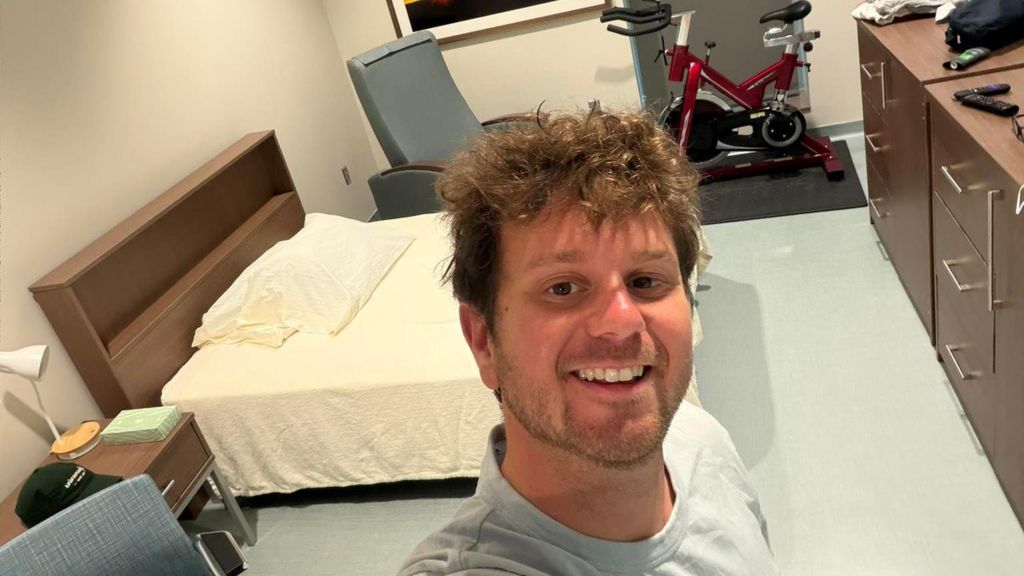
For 29-year-old photographer and content creator Jake Rosmarin, what was supposed to be a 35-day expedition cruise to some of Earth’s most isolated destinations ended in unthinkable tragedy and an unexpected 40-day quarantine in a locked medical facility in Omaha, Nebraska. On a recent Wednesday, Rosmarin whiled away the first days of his isolation by assembling a homemade egg sandwich for breakfast, using pre-ordered ingredients pulled from a numbered menu provided to all the quarantined passengers at the National Quarantine Unit.
Rosmarin had originally planned to return home to Boston to his fiance shortly after the cruise concluded. But an outbreak of hantavirus aboard the expedition vessel MV Hondius left three passengers dead, triggering an international debate over repatriation protocols for the remaining exposed passengers and stranding the ship for days as it searched for a port willing to accept it. Today, 15 surviving passengers including Rosmarin are serving out a 40-day quarantine at the University of Nebraska Medical Center’s National Quarantine Unit – the only federally operated quarantine facility in the continental United States.
In an interview with BBC on Wednesday, Rosmarin explained that he has settled into the quiet, constrained routine of his quarantine stay. Twice daily, a nurse clad in enhanced personal protective equipment – including medical-grade masks and face shields, though not full hazmat suits – stops at his door to check in and request a temperature reading, which has remained normal so far. When medical staff entered his room Tuesday to collect blood samples for hantavirus testing, they wore full protective gear, and followed strict decontamination protocols to change out all equipment between patient rooms. As of Wednesday morning, Rosmarin had not yet received his test results.
To make his 40-day stay more comfortable, Rosmarin has arranged for comfort items to be delivered to his quarantine room, mixing personal orders with care packages sent by his family and fiance. He is expecting a mattress topper, new pillows, and other small items to make his basic facility room feel more like home. The first package he received contained an adult coloring book focused on inspirational quotes, though he is still waiting for a second package holding his coloring pencils to arrive. His room is already equipped with basic amenities: a private bathroom, a desk, a television, a landline telephone, and even an exercise bike to help him pass the long days of isolation.
All quarantined passengers pre-order their meals 24 hours in advance via the facility’s fixed menu, selecting items by their number on the list. For the Wednesday breakfast when he spoke to reporters, Rosmarin combined a la carte menu items to build his own breakfast sandwich, pairing scrambled eggs, bacon, and an English muffin with hot coffee and vanilla almond milk.
Throughout the entire outbreak, which began unfolding in the final days of the cruise, Rosmarin has shared regular updates about his experience on his social media channels – a choice he says has helped him manage his mental health through the crisis. His first posts, shared while the ship was still stranded at sea looking for a port, were raw and emotional, as he struggled with fear and uncertainty about the outbreak. Since arriving in Omaha, however, his posts and his overall outlook have become much calmer, he says.
“On the ship, every day I felt like I was trapped in a nightmare that I couldn’t wake up from,” Rosmarin told the BBC. “It still hasn’t fully hit me what we’ve been through, but I’m in a much better headspace now that I’m here in quarantine.”
As a content creator who builds his public life around sharing experiences online, Rosmarin says continuing to post has felt like a natural way to process the event, and public response has shifted over time. While he initially faced criticism, conspiracy theories, and even hate speech from online commenters – some of whom accused him of being selfish for pushing to disembark the stricken ship – many of those early critics have since reached out with messages of support. That outpouring of genuine public care, he says, is what got him through the most terrifying seven days of the crisis while the ship was stranded.
The outbreak was announced to passengers less than a day before they were scheduled to disembark, Rosmarin recalled. After the captain called all passengers to a lounge to share news of the first hantavirus case, Rosmarin and many other passengers immediately retreated to their cabins, and did not leave until the ship was finally cleared to dock. For days, the ship was stuck at sea with seriously ill passengers on board, as ports around the region refused to accept the vessel, leaving the exposed passengers in limbo with no way to test for the virus or get ill passengers medical care. Rosmarin called that period “really sticky, tough and scary.”
The turning point, he says, was finally stepping off the ship. “It was an overwhelming wave of emotion – I cried,” he said. “It really felt like we were finally being saved.” The journey to Omaha was still intimidating: he recalled being shocked by the sight of emergency personnel clad in full hazmat suits processing passengers off the ship, and felt nervous about the travel to Nebraska. But once he settled into his quarantine room, he says it was the most mentally calm he has felt since the outbreak was first announced.
The current arrangement for the American passengers sees 15 quarantined, asymptomatic passengers staying at the National Quarantine Unit in Omaha. One additional American passenger – Dr. Stephen Kornfeld, who provided emergency medical care to ill passengers while on the ship – has tested positive for hantavirus and is currently isolating in a nearby biocontainment unit. Two more American passengers were transferred to a biocontainment unit at Emory University in Atlanta for care.
Looking ahead to the remaining weeks of quarantine, Rosmarin says he plans to start writing about his experience to preserve the memory, so he can share the full story with his children someday. He also keeps in regular contact with his fiance, family, and other quarantined passengers staying at the Omaha facility, to stay connected while isolated.