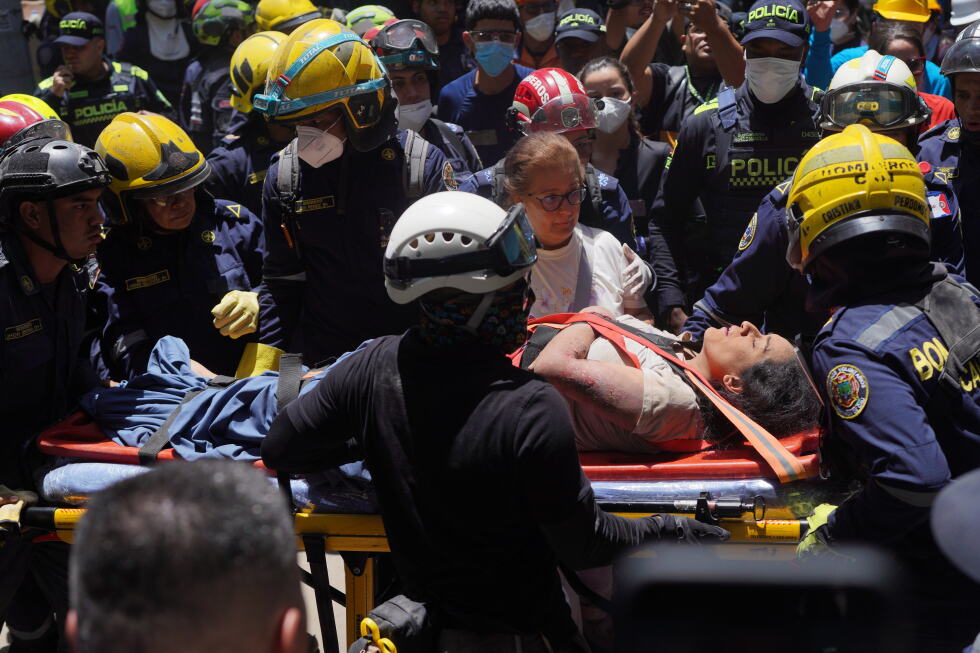
In western Colombia, rescue crews are engaged in a desperate, time-sensitive push to pull survivors from the rubble left by a devastating 7.4-magnitude earthquake that has already claimed hundreds of lives and left thousands unaccounted for. The disaster has emerged as the first major test of the young administration of Colombian President Abelardo de la Espriella, as his government scrambles to coordinate a response alongside domestic civil society groups and international humanitarian organizations.
As of Tuesday, President de la Espriella confirmed that the death toll from the quake had reached at least 181, with an additional 2,595 people injured. Official government figures put the number of missing residents at 195, but independent databases maintained by civilian groups place that count far higher, at nearly 4,000. Overnight operations continued across the four hardest-hit urban centers: Cali, Pereira, Manizales, and Quibdo, with search teams working nonstop to beat a critical 48 to 72-hour window that aid experts identify as the most likely period to find surviving trapped victims. While access to clean water and food can extend that window of viability for trapped people, every passing hour lowers the odds of successful rescues.
Amid the widespread destruction that has leveled entire neighborhoods, small moments of hope have cut through the grief. Rescuers have pulled a dust-covered infant alive from a crack in a collapsed concrete wall, and crowds broke into cheers when another team successfully extracted an injured woman and carried her to an awaiting stretcher on the street.
The official disaster response has been complicated by long-running crises that predate the earthquake: deep systemic poverty and decades of civil armed conflict that have already displaced millions of Colombians across the affected region. Giovanni Rizzo, country director for the Norwegian Refugee Council, emphasized the severity of the compounded crisis in comments Tuesday, noting that “this earthquake compounds an already severe humanitarian situation, and there is a need for increased support for the humanitarian response.”
Some structural advantages for aid delivery have emerged from Colombia’s recent peace and conflict processes, however. María José Torres, the United Nations’ resident coordinator in Colombia, explained that the 2016 peace accord between the national government and rebel groups has left humanitarian organizations already positioned in many conflict-affected regions, including Choco Department, the site of the earthquake’s epicenter. Torres said that this pre-existing on-the-ground presence has exponentially boosted the ability of aid groups to reach affected communities quickly.
International support has begun flowing into Colombia from across the globe. The United States has committed more than $15 million in emergency humanitarian aid. Mexico’s president has offered to deploy hundreds of specialized search and rescue personnel, alongside tons of medical supplies and heavy rescue equipment. Salvadoran President Nayib Bukele also announced Tuesday that his country would dispatch two planes carrying 100 tons of emergency aid in the coming days, and offered public solidarity to the Colombian people: “Our prayers are with the families of the victims, the wounded and all the Colombian people,” Bukele wrote on social media platform X.
This report featured contributions from journalists Suarez in Bogota, Janetsky in Mexico City, with additional reporting from Associated Press writers Edith M. Lederer at the United Nations and Manuel Rueda in Bogota.