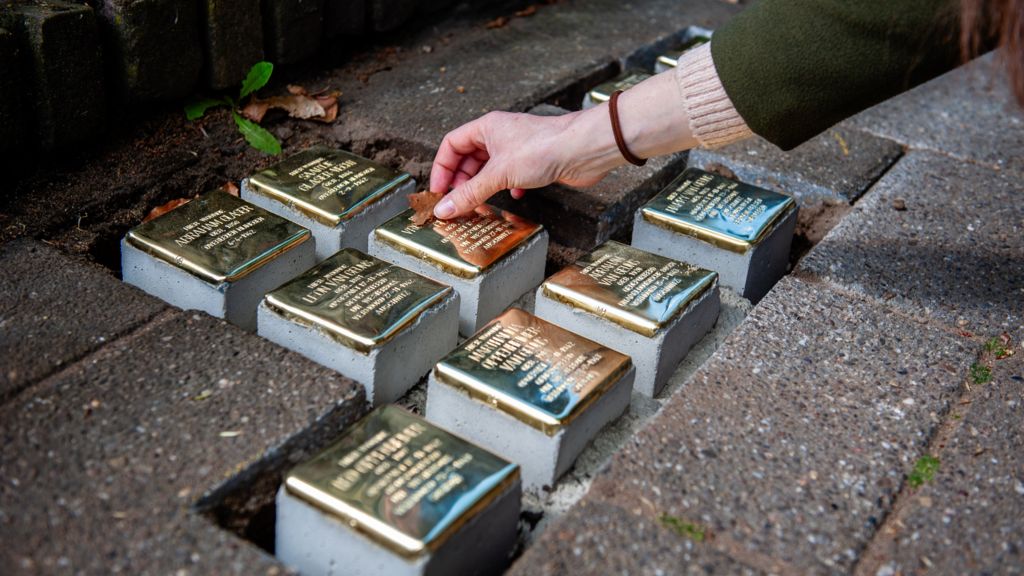
A small town in eastern Germany has sparked nationwide outrage after local leaders approved a ban on the iconic ‘Stumbling Stone’ memorials that honor victims of Nazi terror, shining a new spotlight on the growing influence of extreme-right politics in the region.
Heidenau, a town located near Dresden in the state of Saxony, passed the ban last week in a vote backed by councillors from the Alternative für Deutschland (AfD) — a populist party whose Saxony branch is officially classified as a right-wing extremist movement by Germany’s domestic intelligence service — and the mainstream conservative Christian Democratic Union (CDU).
Conceived by artist Gunter Demnig in the 1990s, the Stolpersteine, or Stumbling Stones, project has grown into one of Europe’s most distinctive decentralized acts of Holocaust remembrance. Thousands of palm-sized brass plaques have been embedded into sidewalks across Germany and more than a dozen other European countries, each placed directly outside the former homes or workplaces of Jews, Roma, LGBTQ+ people, political dissidents and other groups targeted for extermination by the Nazi regime. Funded almost entirely by public donations, the memorials are designed to be encountered unexpectedly in daily life, forcing passersby to literally “stumble” over the plaque and pause to reflect on the atrocities that unfolded in their own community.
Under the Heidenau council’s approved motion, all future memorials to Nazi victims will be moved exclusively to the town’s Nordfriedhof cemetery. The proposal claimed that many local residents viewed the sidewalk plaques as inappropriate, arguing that concentrating remembrance at the cemetery would prevent people from stepping directly on the memorial markers.
The decision has drawn immediate fierce condemnation from across German politics and Jewish communities. Germany’s federal Education Minister Karin Prien, herself a member of the CDU, called the ban a outright “scandal” in comments to the newspaper Bild.
“Anyone who banishes Stolpersteine and memorial sites commemorating Jewish life from public spaces to the cemetery is prioritising death over life and rendering Jewish people invisible once again,” Prien said, adding that the Saxony state branch of her own CDU shared direct responsibility for the outcome.
Charlotte Knobloch, a respected Holocaust survivor and former president of the Munich Jewish Community, also spoke out against the move, calling it “completely the wrong approach.” She told Funke Media Group she was “appalled that a democratic party would stoop to supporting such a transparent manoeuvre by the extremists of the AfD.” While Knobloch noted she does not personally support the placement of Stolpersteine on sidewalks — a policy already in place in her home city of Munich, where public building plaques are used instead — she emphasized that decentralized, public remembrance is non-negotiable for a healthy culture of memory. “Decentralised remembrance – which is not banished from public space but, on the contrary, permeates and shapes it – was crucial to a genuine culture of remembrance,” she said.
Demnig, the creator of the Stumbling Stone project, said the ban came as no surprise amid the AfD’s recent electoral gains in eastern Germany. The party has secured landmark victories in recent state elections in Saxony-Anhalt and Mecklenburg-Vorpommern, building a strong base in the former East German region on an anti-immigration, “Germany First” and Russia-friendly platform.
“It was certainly to be expected that something like this would happen,” Demnig said of the Heidenau ban. The AfD has repeatedly rejected German intelligence’s classification of several of its state branches as extreme-right, dismissing the designation as political overreach.