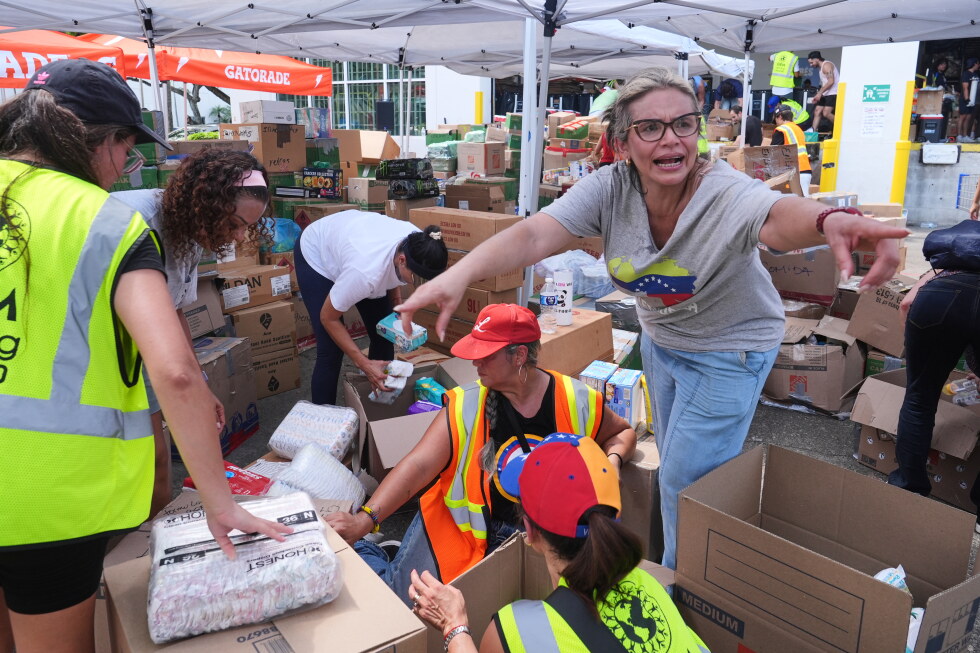
Last June, two powerful back-to-back earthquakes measuring 7.2 and 7.5 magnitude struck just 39 seconds apart across central and northern Venezuela, leaving a trail of catastrophic destruction that upended thousands of lives. The disaster killed at least 4,500 people, left thousands more unaccounted for, damaged or destroyed more than 850 buildings, displaced 17,000 residents, and crippled critical infrastructure for power, clean water and public sanitation. Nearly three weeks after the tremors, a massive, community-led relief operation based out of South Florida is still working around the clock to get life-sustaining aid to vulnerable Venezuelan communities, a effort made possible by a dramatic shift in U.S.-Venezuela relations following the January U.S. military raid that led to the capture of former Venezuelan leader Nicolás Maduro.
The operation is centered at the Doral, Florida headquarters of Global Empowerment Mission (GEM), a non-profit humanitarian organization where half the local population identifies as Venezuelan. For 18-year-old Alessandra Izaguirre, whose grandmother’s Caracas home narrowly escaped destruction in the quakes, volunteering here is personal. Currently based in the U.S., Izaguirre says the shock of seeing her family and so many other Venezuelans displaced pushed her to act, even from thousands of miles away. She has spent the past two weeks preparing meals for the hundreds of volunteers that report to GEM’s warehouses daily.
Izaguirre is just one of thousands of participants in what has become one of the largest grassroots humanitarian mobilizations for South America in recent history. Every day, hundreds of volunteers sort through donated supplies curated to match the most pressing current needs, pack shipments, and prepare them for daily flights bound for Caracas. The effort draws donations from across the U.S., Canada, Mexico and beyond, and is facilitated through a formal partnership with the U.S. State Department, with logistical support from the U.S. military.
This new operating model is a stark shift from years past, when Maduro’s government routinely blocked international humanitarian aid, labeling it an act of foreign interference. GEM founder and president Michael Capponi was even denied entry to Venezuela while attempting to deliver aid during Maduro’s tenure. Today, the entire supply chain remains under GEM’s full control: private planes carrying aid are unloaded by U.S. military personnel, transported on GEM-funded trucks, and stored in GEM-controlled warehouses, never passing through the hands of Venezuelan government officials. This independent structure has addressed widespread longstanding concerns among donors about corruption and theft of aid by Venezuelan officials, building trust that has supercharged donations.
Within hours of the June 24 earthquakes, GEM activated its headquarters as an official donation collection point. After the organization completed its first successful, fully transparent aid delivery, donations poured in faster than Capponi, a veteran of decades of global disaster response, had ever seen. Major national brands including Goya, Walmart and Amazon donated bulk supplies, while professional U.S. sports teams contributed six-figure donations. But the bulk of the aid still comes from small, individual contributions: thousands of everyday people stopping at local supermarkets to buy a few cases of canned goods or packs of diapers, dropping them off at GEM’s warehouses.
At times, lines of donors dropping off supplies stretched so long that local police were called in to manage traffic. Two brothers drove a fully loaded U-Haul of relief goods all the way from Canada, while other convoys arrived from as far as Nevada, California and Texas. Across GEM’s three Doral-area warehouses, up to 1,000 volunteers pack aid daily, building pallets of bulk essentials and assembling individual care packages that hold enough food, water and hygiene supplies to support two people for five days. Many volunteers tuck handwritten notes of encouragement into the packages, including messages like “Te queremos Venezuela” – “We love you, Venezuela.”
Many volunteers have personal connections to disaster or to the Venezuelan diaspora. Twenty-five-year-old Mariela Vila, who survived Hurricane Maria’s devastating 2017 strike on her native Puerto Rico, has worked full-day shifts at GEM since the effort launched. “The Latino community gathered together to help Puerto Rico when we needed it, so I felt I had to give that same support to Venezuela,” she explained. Billy Richardson, GEM’s U.S. logistics director, added that volunteer enthusiasm is so high that staff often have to push people out at the end of the workday, with many taking paid vacation from their regular jobs to keep packing shipments.
GEM’s long-term plan calls for delivering at least 100,000 care packages per month for the next three to six months, while also beginning to plan for longer-term recovery needs such as permanent housing for displaced families. To date, nearly one million pounds of supplies have been shipped from Florida to GEM’s newly leased Caracas warehouses, where the organization partners with trusted local nonprofits and community leaders to distribute aid twice daily in the hardest-hit regions. In a recent high-profile distribution, U.S. Marines landed an amphibious craft on a Venezuelan beach and unloaded hundreds of GEM packages directly to a line of 2,000 waiting residents.
A State Department spokesperson explained that partnering with GEM and other independent nonprofits allows the U.S. to leverage existing community networks and the deep connections of the Venezuelan diaspora in the U.S. to deliver aid directly to those who need it. Multiple other U.S.-based humanitarian groups have also confirmed they are now able to operate independently in Venezuela without interference from government officials, a change unthinkable just six months ago.
Still, the new U.S.-led aid framework faces lingering questions over transparency and accountability. Critics note that the U.S. currently controls billions of dollars in seized Venezuelan oil export revenue, and there are unanswered questions about how much of that funding is being directed to earthquake recovery. Laura Cristina Dib, Venezuela program director at the Washington Office on Latin America, noted that “there are a lot of transparency questions that linger on the use of that fund at a moment when Venezuelans desperately need that money for protection and recovery.”
U.S. officials have pushed back on these concerns. John M. Barrett, the U.S. charge d’affairs for Venezuela, told reporters that the current interim Venezuelan government has been “fully compliant” with all U.S. requests to advance the relief effort, and that oil revenue controlled by the U.S. Treasury is being made available for relief. A State Department spokesperson added that, separate from the oil revenue, the U.S. has committed more than $386 million in direct funding for earthquake response, and is working to support the interim government’s budget operations to improve liquidity for recovery.
On the ground in the hard-hit coastal city of Maiquetía, recipients of GEM aid say the support is already making a life-changing difference. Last week, Yoniel Reyes sat in a temporary displacement tent unpacking his GEM care package – packed and sealed 1,300 miles away in Doral – which held instant meals, bottled water, canned food, hydration supplements and hygiene kits. “I never imagined I would be receiving aid from the U.S.,” Reyes said. “We Venezuelans are thankful, very thankful.”