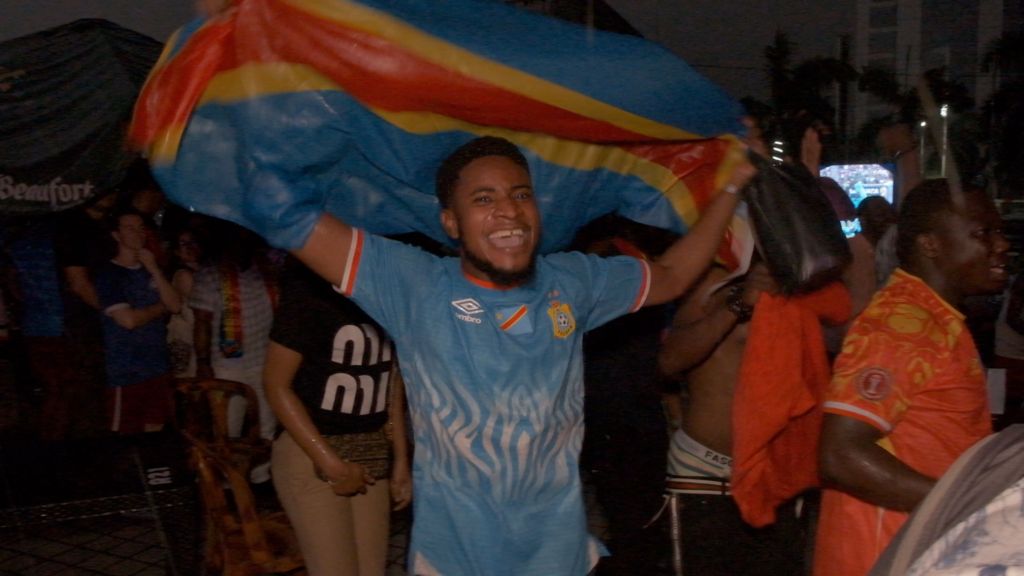
Jubilation erupted across the Democratic Republic of Congo (DRC) this week after the national men’s football team, the Leopards, booked their first place at the FIFA World Cup in more than half a century, prompting the government to declare an immediate national public holiday to honor the historic achievement.
The dramatic qualification came in an inter-confederation playoff against Jamaica on Tuesday, where former Manchester United defender Axel Tuanzebe, a Congolese native born in conflict-torn Bunia, netted the winning goal in the 100th minute of extra time to seal a 1-0 victory. When the final whistle blew, elated fans poured into the streets of the capital Kinshasa in the early hours of Wednesday morning, waving national flags, chanting slogans, and celebrating a moment decades in the making.
Within hours of the win, DRC’s Ministry of Labour and Employment announced that Wednesday would be a nationwide public holiday, allowing all Congolese citizens to mark the “momentous” victory “in unity, fervour and national pride”. Most businesses, banks and retail outlets across Kinshasa shut their doors for the day to accommodate celebrations, though a small number of workplaces continued operations as normal, due to the very short notice of the holiday announcement, which was made at 8 a.m. local time on Wednesday itself.
This milestone marks only the second time DRC has qualified for the World Cup. The nation’s only previous appearance came back in 1974, when the country was still known internationally as Zaire. The Leopards will kick off their 2026 World Cup campaign against Portugal — led by global superstar Cristiano Ronaldo — in Houston, United States, on June 17, before facing Colombia and Uzbekistan in the group stage. The 2026 tournament, expanded to 48 teams and co-hosted by the U.S., Mexico and Canada, will see DRC join nine other African nations in the finals.
For a country that has endured decades of persistent armed conflict, with renewed violence escalating in the eastern region over the last two years following territorial advances by the M23 rebel group, the historic win has offered a rare moment of collective national joy. One Congolese supporter spoke to the BBC amid the Kinshasa celebrations, saying, “Whatever we may be feeling at the moment, amidst pain and war and occupation, this victory makes us proud… I feel so emotional and happy.”
Tuanzebe, whose hometown of Bunia sits at the center of the ongoing unrest, called his game-winning goal “without a doubt the most important” of his entire professional career. “I’m so grateful to have scored that goal for the team, for the nation. I realise the magnitude of what it represents and the joy it brings to people,” he said after the match.
Notably, the congratulations have crossed tense regional political divides. Even as diplomatic relations between DRC and neighboring Rwanda remain sharply strained, with Rwanda widely accused of backing the M23 insurgency — a claim Rwandan authorities deny — the Rwandan government issued a public message of celebration for DRC’s qualification. Deputy government spokesperson Jean Maurice Uwera wrote in a post on X, “Leopards stepping up for Africa! Congratulations DR Congo, go make the continent proud on the world stage.”
In the Kinshasa neighborhood of Kingabwa, jubilant fans took to the streets chanting “Christiano Ronaldo is next”, already looking ahead to the team’s opening group stage match against the five-time Ballon d’Or winner’s side this summer.