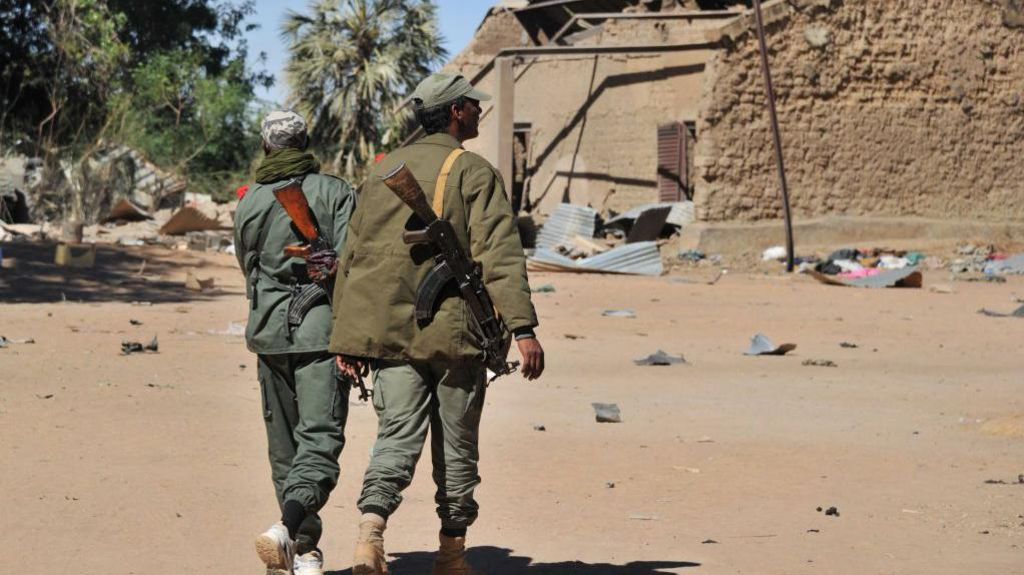
More than a decade of rolling insurgency has reached a new brutal peak in central Mali, after coordinated simultaneous attacks on two rural villages left dozens of civilians and militiamen dead this week — marking the deadliest single assault since jihadist and separatist groups launched a nationwide coordinated offensive last month.
The al-Qaeda-affiliated militant group Jama’at Nusrat al-Islam wal-Muslimin (JNIM) has officially claimed responsibility for the Wednesday night raids on the villages of Korikori and Gomossogou, located in Mali’s volatile central Mopti Region. Initial casualty counts from sources quoted by Agence France-Presse (AFP) put the death toll at 30, but separate accounts from diplomatic and humanitarian sources speaking to Reuters and regional security journalism collective West African Network for Peace and Security (WAMAPS) have revised the provisional number of fatalities to at least 50. Multiple residents and local sources confirm that while most victims were members of local self-defense militias, the death toll also includes teenage civilians and young children, with an unknown number of residents still unaccounted for in the wake of the assault.
Local witnesses describe attackers entering the villages under cover of night, opening indiscriminate fire on residents, ransacking and looting residential and community structures, and setting multiple properties ablaze. A security source told AFP the attacks were carried out in retaliation for recent operations by Dan Na Ambassagou, a community-organized self-defense militia formed to counter years of persistent militant violence in central Mali.
Mali’s military junta, led by General Assimi Goïta — who seized power in a 2020 coup — has responded to the assault with immediate counteroperations. Military officials confirmed that a “targeted strike” was launched in the attack area, with roughly a dozen jihadist fighters “neutralized” in the operation. Bandiagara Region Governor condemned the violence in an official Thursday statement, labeling the coordinated assaults “despicable and inhumane acts.” A subsequent military update clarified that nearly 10 additional “terrorist” fighters were killed and an insurgent logistical base was destroyed during further counteroffensive actions.
The latest attack comes against a backdrop of rapidly escalating instability that has gripped Mali since April, when an alliance of jihadist militants and separatist rebels from the Azawad Liberation Front (FLA) launched a coordinated nationwide offensive aimed at ousting Goïta’s military regime. That opening wave of attacks included a suicide truck bombing targeting the residence of Malian Defense Minister Sadio Camara near the capital Bamako that killed the top security official. Just this week, Goïta announced he would fill the vacant defense minister post, with support from army chief of staff General Oumar Diarra.
Speaking at a Wednesday press briefing in the capital, Malian army commander Djibrilla Maiga acknowledged that insurgent groups have been working to regroup and rearm in the weeks following the April offensive, warning that “the threat is still present” and confirming that military forces are working to disrupt further militant advances.
Unlike previous deployments, when Mali relied on United Nations peacekeepers and French counterinsurgency forces, Goïta’s junta has partnered with the Russia-linked Africa Corps, a paramilitary force that grew out of the now-fractured Wagner Group, to combat the insurgency. Even with this support, the FLA-led offensive has forced Russian fighters to withdraw from the key northern city of Kidal, which is now fully under separatist control. The FLA has since announced plans to advance on other northern population centers and issued an explicit demand for the full withdrawal of Africa Corps forces from all Malian territory. Beyond territorial gains, insurgents have also tightened a blockade on Bamako, establishing a network of checkpoints on all major road arteries leading into the capital to cut off supply lines.
Mali’s ongoing crisis traces its roots back to 2012, when a Tuareg separatist rebellion in northern Mali evolved into a full-scale Islamist insurgency that has since spread to central and eastern regions of the country. Today, large swathes of northern and eastern Mali remain completely outside of government control. When Goïta’s junta first seized power, it held broad popular support on a promise to end the decade-long security crisis. Following the coup, however, the new regime expelled UN peacekeeping forces and French counterinsurgency troops that had been deployed to stem the insurgency, clearing the way for the current surge in violence that has pushed the country to the brink of state collapse.