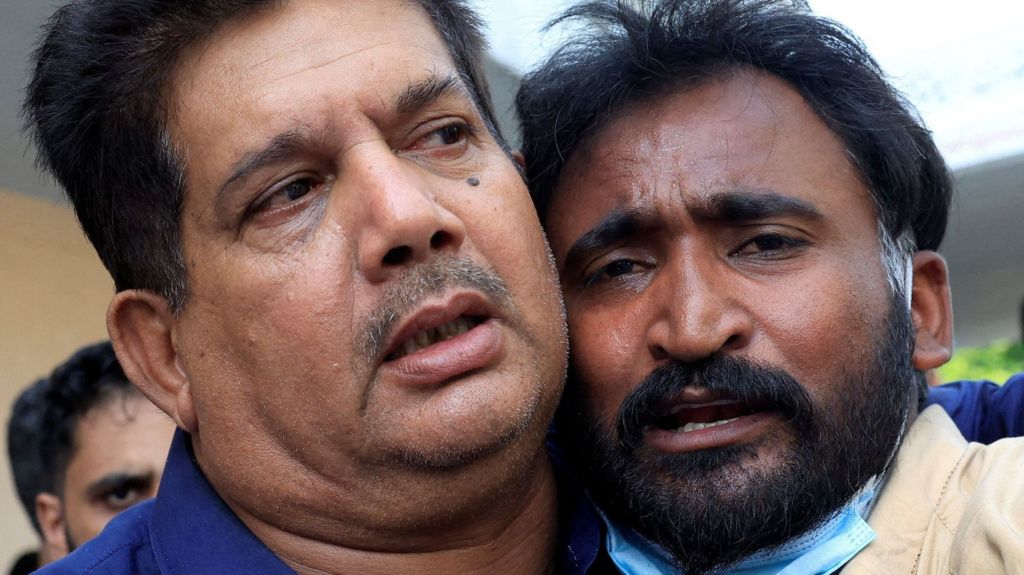
Just moments after dawn broke over Islamabad on a Wednesday morning, a catastrophic fire tore through the maternity ward of one of Pakistan’s largest state-run medical facilities, leaving 14 newborn infants dead and igniting widespread public anger over systemic safety failures. The blaze originated in a faulty air conditioning unit on the third floor of the mother and child wing at the Pakistan Institute of Medical Sciences (PIMS), a flagship public hospital in the Pakistani capital. Of the 15 babies present in the ward when the fire started, only one survived.
Eyewitness accounts paint a chaotic, terrifying picture of delayed response, inadequate safety infrastructure, and locked exits that trapped vulnerable patients as smoke and flames spread rapidly. Hivsa Walid, who was at the hospital visiting her sister-in-law — who had given birth just days earlier — was nearby when the fire began. She initially mistook panicked shouts for news of a natural patient death, before spotting thick smoke billowing through the hallway. The pair managed to escape with their unnamed newborn, fleeing bare of any belongings.
“We didn’t even think about our things. We just grabbed the baby and ran down the stairs,” Walid told reporters. “Some women had given birth just hours before. Everything happened so fast, it was all a blur.”
Grieving relatives have decried a hours-long wait for emergency responders and a lack of emergency preparedness at the hospital. Khurram Mehmood, a 40-year-old father who lost his three-day-old daughter in the fire, told reporters that rescue teams took far too long to arrive. Jaweria, another grieving mother, said the maternity ward door was locked from the outside, leaving her waiting outside in agony for help. “I cried and screamed for two hours,” she said. “Police showed up after four hours just to start an investigation. Why did the doctors leave those babies locked inside? To hell with all of you — rescue teams, police — babies burned to death and no one came to save them.”
Hospital administration has pushed back against claims that the door was locked. Rana Imran Sikander, PIMS’s executive director, told the BBC that the door was staffed, not locked, and that the controlled access policy was in place to prevent infant abductions — a known issue at public hospitals across Pakistan.
Multiple witnesses, however, confirm that emergency safety measures were virtually non-existent at the facility. Walid noted that even as a leading government hospital, PIMS lacked functioning fire safety equipment and clear emergency evacuation protocols. “There should have been fire extinguishers, there should have been procedures, but no one did anything — everyone just ran,” she said. One bereaved father, who had been visiting the ward for eight days prior to the fire, told Reuters the building had no functional fire security systems and no accessible emergency exits. “Most doors were kept locked. They only left one door open for visitors, because they worried we would come to see our babies too often,” he said.
Witnesses also reported that on-duty medical and security staff were absent when the fire broke out. Trapped relatives had to break down interior doors to escape, while rescue teams had to smash exterior windows to reach the blaze and evacuate patients, one anonymous witness told AFP. Abdul Ghafoor, another witness, said he tried to enter the building to rescue trapped patients but was turned back by dense toxic smoke. “Patients were trapped inside with all that black smoke, and rescue teams didn’t get here for almost two hours,” he said.
Islamabad’s Chief Commissioner Sohail Ashraf has disputed claims of delayed response, telling AFP that emergency teams arrived on scene “immediately” after the first emergency call was placed.
The tragedy is the latest in a string of deadly fire incidents across Pakistan in recent years, where lax enforcement of building codes, weak safety regulations, and chronic underinvestment in public infrastructure have repeatedly led to high death tolls. Earlier this year in January, a fire at a shopping mall in Karachi killed dozens of people, with survivors reporting that locked emergency exits dramatically increased the number of fatalities.
In response to the PIMS fire, Prime Minister Shehbaz Sharif issued a statement expressing “deep sorrow and heartfelt regret” over the loss of the newborns. He ordered federal authorities to launch an immediate full investigation into the cause of the blaze and the response failures, and has already suspended Federal Health Secretary Aslam Ghauri, the top-ranking official in Pakistan’s national health department. “The loss of these children is an irreparable tragedy,” the prime minister’s statement read.