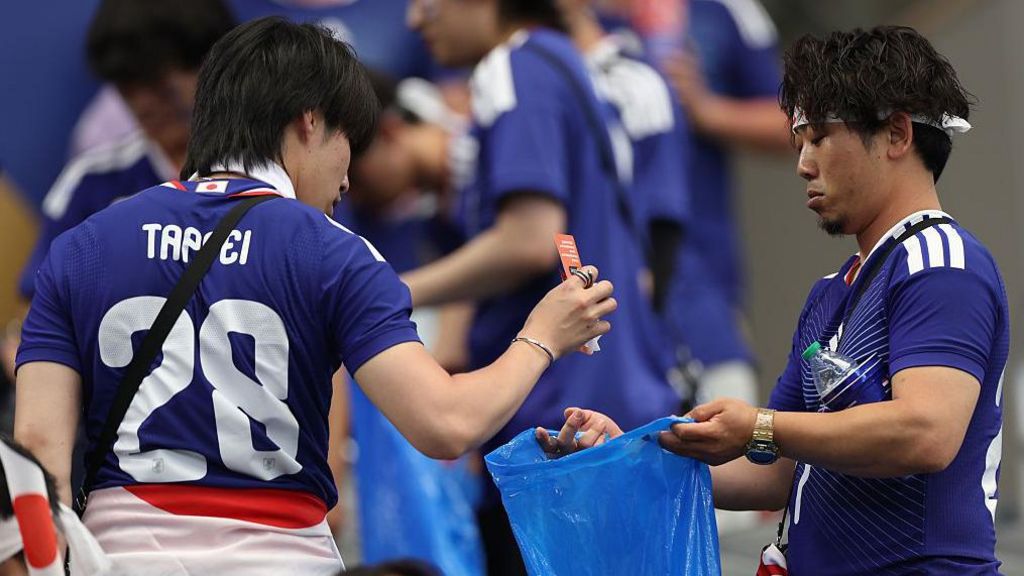
Japanese football supporters have long earned international acclaim for their post-match tradition of tidying stadium stands during global tournaments, a habit rooted in deep-seated cultural norms around public cleanliness. But this same well-regarded practice has recently ignited fierce online debate back home, as critics call out a stark double standard: the same men who dutifully pick up trash in public venues often shift nearly all domestic housework burdens onto their female partners at home.
The conversation was ignited after a viral social media graphic circulated widely on the platform X, racking up more than 60,000 likes. The image juxtaposes two scenarios: the first shows a male Japanese fan sorting trash in a World Cup stadium, while the second depicts the identical figure lounging on a home sofa scrolling through a mobile phone, a full basket of unwashed laundry sitting beside him, as his wife stands at the kitchen sink washing dishes. The graphic’s caption delivers a straightforward call to action: Japanese men need to step up and contribute more to household chores, given their already well-documented low ranking among high-income nations for time spent on domestic work.
Social media users quickly weighed in, sharing sharp and varied perspectives on the controversy. One user echoed a famous quip from American author PJ O’Rourke, writing, “Everyone wants to save the world, but no one wants to help mom do the dishes.” Another pointed out the unspoken irony of the situation, noting that many of the men attending World Cup matches had likely left young children at home entirely in the care of their wives to travel for the game.
OECD statistics from 2021 back up the claims of unequal domestic labor. Across the world’s most developed economies, Japanese men spend the least amount of time on unpaid housework, logging just 47 minutes per day. By comparison, Japanese women dedicate more than three hours daily to unpaid domestic labor – more than five times the workload their male partners take on. This gap grows even wider in young dual-income households with young children: a 2021 Japanese government survey found that in families with children under the age of six where both partners work full-time, women spend more than seven hours a day on chores, while men contribute less than two hours.
Some online critics have gone further, adding another layer of criticism by calling out the perceived hypocrisy of celebrating Japanese fans for cleaning stadiums abroad, when large public events in Japan regularly leave streets and public spaces littered with uncollected trash afterward.
But the debate has not been one-sided. Many observers argue that the stadium clean-up tradition should be encouraged rather than nitpicked apart. One X user pushed back against the criticism, asking, “Where’s the embarrassment in that? It’s way better than reports saying ‘Japanese people are littering abroad.’” Supporters also point to a positive ripple effect of the tradition: the practice has inspired fans from other competing nations to adopt the habit. A recent viral social media video showed Portuguese fans collecting trash from their stands using large plastic bags, with many online commenters crediting Japanese fans for establishing this positive trend.
As the conversation continues to unfold, it has put a long-simmering issue of gender inequality in Japanese domestic life under an unexpected global spotlight, sparked by a cultural tradition that was once widely praised.