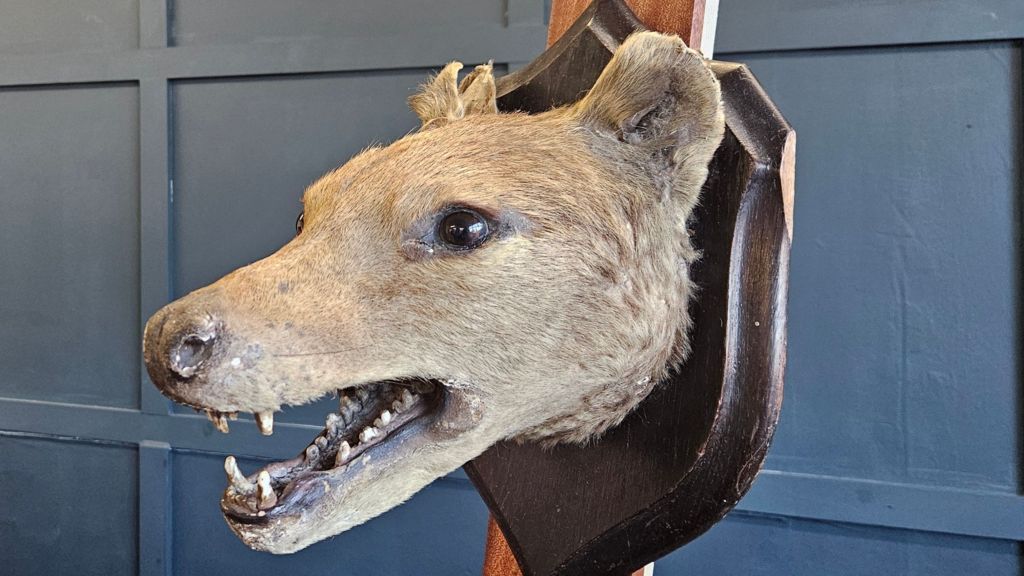
A long-forgotten taxidermied head of the now-extinct thylacine, more commonly referred to as the Tasmanian Tiger, spent years tucked away under its owners’ bed before the family realized its extraordinary historical and scientific significance, Bristol-based auction house Auctioneum has confirmed. Dubbed Trevor by the auction team, this remarkably well-preserved specimen is only the third verified complete thylacine taxidermy head known to exist globally, marking it as the most high-value lot the boutique auction firm has ever handled. The landmark discovery traces back to August 2024, when the owners spotted widespread news coverage of a separate misidentified Victorian-era thylacine head — previously mistaken for a fox pelt part — that sold for a five-figure sum after sharp-eyed collectors identified its true nature. The family soon realized their own long-stored heirloom matched the description of the ultra-rare marsupial remains, and brought it to Auctioneum for evaluation. Lead auctioneer Andrew Stowe recalled the moment he first unwrapped the historic artifact, noting he was stunned by its pristine condition and immediate recognition of its rarity. Prior research confirms the specimen was originally harvested by a Tasmanian farmer in Sheffield, northern Tasmania, in the early 1900s, before being transported to the United Kingdom in 1905, where it has remained in private family hands ever since. The thylacine, a dog-sized carnivorous marsupial once native to Australia, New Guinea and Tasmania, was relentlessly hunted by European settlers throughout the 19th and early 20th centuries, pushing the species to total extinction when the last confirmed captive individual died at Hobart Zoo in 1936, with formal extinction classification following shortly after. The sudden emergence of a second intact thylacine head within months of the widely publicized August sale has stunned zoological researchers and private collectors alike, as the vast majority of surviving thylacine specimens are held in museum collections, with almost no new private finds documented for generations. The newly verified specimen has already been formally logged into the International Thylacine Specimen Database (ITSD), a global centralized repository tracking all remaining physical remains of the lost species. Dr. Stephen Sleightholme, a leading thylacine researcher affiliated with the ITSD, emphasized that these rare surviving artifacts provide irreplaceable tangible data for ongoing studies of the unique marsupial predator, as well as critical documentation of human-driven species extinction. The taxidermy head is scheduled to go under the hammer at a public auction in Bath on November 26, with a pre-sale estimated value ranging from £30,000 to £50,000. Stowe noted that the auction team, which initially considered the August thylacine head sale a once-in-a-career event, could scarcely believe they had uncovered a second of the only three known surviving specimens, describing the dual find as a truly unprecedented occurrence in the history of natural history artifact auctions.