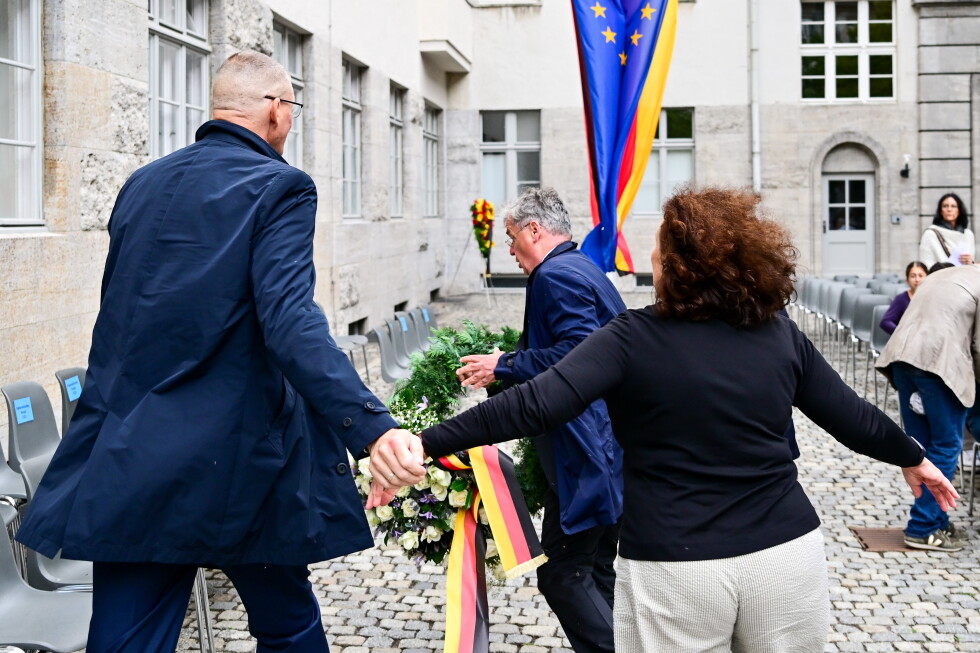
On Monday, an 82nd anniversary commemoration of the 1944 failed assassination plot against Adolf Hitler turned contentious in Berlin, as a descendant of one of the Nazi regime’s executed resistance activists attempted to remove a floral tribute laid by Germany’s far-right Alternative for Germany (AfD) party at the historic execution site.
Tobias Korenke, great-nephew of Dietrich Bonhoeffer—an influential Protestant pastor and theologian who was linked to the plot and executed by the Nazis in 1945—took direct action against the wreath placed by AfD’s federal parliamentary group, according to reporting from Germany’s national news agency dpa. The confrontation quickly drew intervention from on-site security personnel, and the wreath sustained damage during the brief physical scuffle.
In comments following the incident, Korenke made clear the depth of opposition to the far-right party’s participation in the memorial. “Many descendants, myself included, feel really great anger when we see AfD laying wreaths here,” he said. “We will not accept this.”
The confrontation comes as AfD holds growing political influence in modern Germany: the party secured second place in the country’s 2021 national parliamentary election, and currently stands as the largest opposition bloc in the federal legislature. Ahead of regional elections set for September, the party is aiming to win its first ever state governorship, a milestone that would shift the country’s political landscape dramatically. AfD has repeatedly pushed back against widespread accusations that it holds extremist ideological positions.
Per dpa’s reporting, AfD confirmed it had provided the wreath for the official memorial event, though it remained unclear whether any of the party’s representatives were in attendance at the time of the scuffle. AfD legislator Götz Frömming argued that the party has a formal right to participate, noting it is automatically invited to such official events as a seated party in the national parliament.
The July 20, 1944 plot, led by Col. Claus von Stauffenberg, saw the resistance fighter smuggle a briefcase packed with explosives into a military conference with Hitler at the Nazi dictator’s headquarters in what was then East Prussia. The assassination attempt failed only by chance: an attendee unknowingly moved the briefcase to the opposite side of a heavy table leg, which deflected most of the blast and saved Hitler from fatal injury. When word spread that Hitler survived the explosion, the coordinated plot collapsed rapidly. Von Stauffenberg and most of his core co-conspirators were executed by firing squad just hours after the attempt. Bonhoeffer, who had long opposed the Nazi regime and collaborated with the resistance network, was put to death months later in 1945.
The memorial event proceeded as planned after the scuffle, featuring a keynote address from German Education Minister Karin Prien. Perspectives among descendants of the plotters remained divided on AfD’s right to participate: Karl von Stauffenberg, grandson of the plot’s leader, confirmed to Welt television that he believed AfD was seeking to exploit his grandfather’s anti-Nazi legacy for political gain. Even so, he argued that the party should not be barred from laying a wreath, framing the allowance as a core principle of democratic governance. “We are democrats … we must see that we also allow people who think differently to speak,” he said.