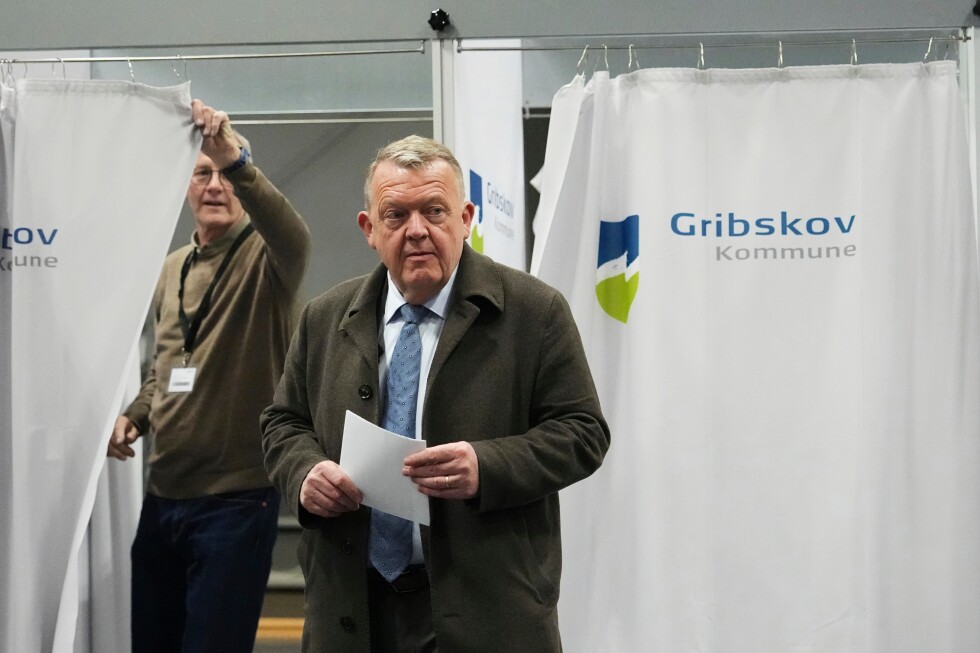
COPENHAGEN, Denmark — Denmark faces a period of political uncertainty following Tuesday’s parliamentary elections that failed to deliver a decisive majority to any single party or coalition bloc. The inconclusive outcome has positioned Foreign Minister Lars Løkke Rasmussen and his centrist Moderate party as the pivotal force in determining the Scandinavian nation’s next government formation.
Center-left Prime Minister Mette Frederiksen, despite leading her Social Democrats to remain the largest parliamentary party, confronts diminished support compared to the previous 2022 election. Her outgoing administration, notable for being the first in decades to bridge Denmark’s traditional left-right political divide, resigned on Wednesday as customary procedure. Political leaders subsequently engaged in roundtable discussions regarding potential governing arrangements before anticipated consultations with Danish King Frederik X.
The electoral campaign predominantly centered on domestic economic concerns rather than international tensions, notably sidestepping the recent diplomatic friction surrounding former U.S. President Donald Trump’s expressed interest in Greenland. With over 4.3 million eligible voters participating in the democratic process—representing an impressive 84% turnout in the nation of 6 million—the election demonstrated robust civic engagement.
Denmark’s Folketing, a single-chamber parliament, comprises 179 seats with four-year terms. While 175 representatives come from Denmark proper, the semi-autonomous territories of Greenland and the Faroe Islands each contribute two lawmakers. The country’s proportional representation system typically necessitates coalition governments, traditionally formed along either left-leaning ‘red bloc’ or right-leaning ‘blue bloc’ lines.
Election expert Rune Stubager, co-director of the Danish National Election Study, suggested that Frederiksen might secure a third term as prime minister despite the uncertain outcome. ‘Whether this occurs through a new centrist coalition or a government primarily relying on support from the red bloc depends entirely on negotiation outcomes,’ Stubager commented Wednesday.
The 48-year-old Frederiksen has established her political reputation through steadfast support for Ukraine against Russian aggression and maintaining Denmark’s characteristically restrictive immigration policies. However, Defense Minister Troels Lund Poulsen, representing the center-right Liberal party, explicitly rejected further coalition with the Social Democrats.
Løkke Rasmussen’s Moderates, holding 14 crucial seats in the evenly divided parliament, emerged as the election’s undeniable kingmakers. With 90 seats required for majority control, neither traditional bloc can govern without Moderate support. Rasmussen appealed for compromise, urging rivals from both sides to moderate their campaign positions and ‘come and play with us.’
Stubager observed that the Moderates’ strengthened negotiating position would likely force concessions from other parties’ campaign promises. ‘As far as I can ascertain, government formation appears impossible if all these tripwires remain intact,’ Stubager noted. ‘Consequently, certain parties must inevitably retract commitments to enable viable governance.’
Analysts attribute part of the Moderates’ electoral success to Rasmussen’s diplomatic handling of the Greenland controversy. The party, polling poorly late last year, gained significant momentum after Rasmussen’s headline-generating trip to Washington helped de-escalate tensions with the United States.
‘Donald Trump essentially provided a platform where Lars Løkke could demonstrate statesmanship, and he performed admirably according to most Danish observers,’ Stubager remarked. Frederiksen similarly sought political advantage from the Greenland situation, calling early elections months before constitutionally required after polling indicated strengthened public support following her firm stance against potential American acquisition of the Arctic territory.
The prime minister had warned in January that any U.S. takeover of Greenland would effectively signify ‘the end of NATO.’ Although Trump subsequently retreated from tariff threats against Denmark and other European opponents of the proposal, technical discussions concerning Arctic security arrangements between the U.S., Denmark, and Greenland continue presently.