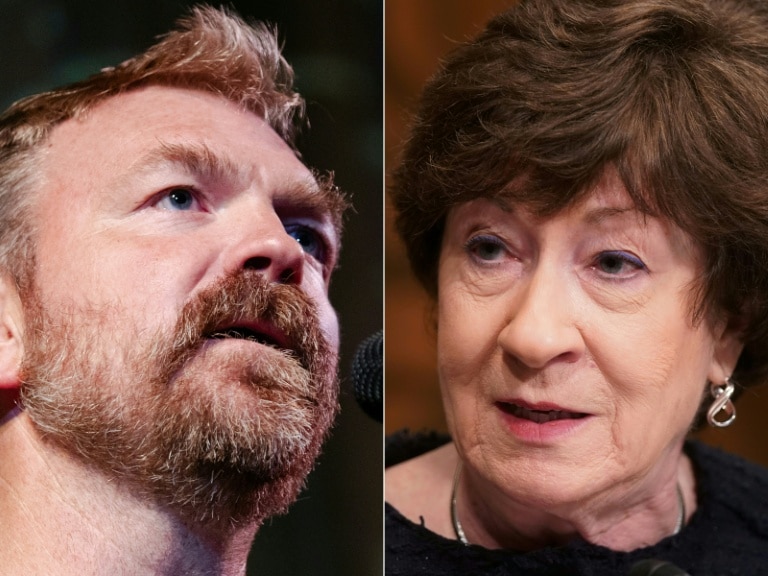
In a sudden development that upends one of the Democratic Party’s top pickup opportunities in this year’s midterm elections, Graham Platner, the scandal-plagued Democratic Senate nominee for Maine, announced Wednesday he is ending his campaign against incumbent Republican Senator Susan Collins.
Platner, a 41-year-old Marine veteran, commercial oysterman and first-time political candidate, shocked political observers last month when he won the state’s Democratic primary, propelled by a populist, anti-establishment message that won him a fervent grassroots following. His unapologetic, outsider style quickly drew comparisons to Donald Trump’s disruptive 2016 political rise, as he railed against corporate influence, big-money political donors, and Collins, whom he accused of prioritizing the interests of billionaires over working-class Mainers.
But his campaign began to unravel just days ago, after outlet Politico published a rape allegation from Jenny Racicot, a 41-year-old Maine resident and former romantic partner of Platner. Racicot accused Platner of forcing her to have non-consensual sex in late 2021, despite repeated protests from her. Platner has forcefully and categorically denied the claim, calling the accusation false, troubling, and unrelated to any actual misconduct.
“This is incredibly difficult, because I know that some will think it’s an admission of guilt, and it most certainly is not,” Platner said in a video statement posted to X Wednesday. He confirmed he would file formal paperwork to withdraw his candidacy, noting that his hand was forced after top national Democratic leaders pulled all financial and institutional support for his campaign. “We’re not doing it because of the allegations, we’re doing it because of the structures that are being taken away from us by those in power,” he added.
Even before the rape allegation emerged, Platner’s candidacy had been dogged by a series of personal controversies: inflammatory old social media posts, sexually explicit messages sent to women during the early years of his marriage, a tattoo that resembled a Nazi swastika (which he later covered up), and prior claims of mistreatment of women. Platner has acknowledged past struggles with undiagnosed post-traumatic stress disorder from his military service and alcohol abuse, but has repeatedly denied any physical harm to former partners.
Within 48 hours of the latest allegation becoming public, support for Platner collapsed across every wing of the Democratic Party. Senate Democratic Leader Chuck Schumer and Democratic Senatorial Campaign Committee chair Kirsten Gillibrand publicly called for his withdrawal, warning that the party’s national campaign infrastructure would not invest a single dollar in the Maine race if he remained on the ballot. Multiple sitting Democratic senators who had previously backed Platner joined the call for him to step aside, and the Maine Democratic Party issued a statement saying “principle does not bend based on party affiliation” while urging his exit.
Per Maine state election law, Platner’s withdrawal before the July 13 deadline allows state Democrats to select a replacement nominee to appear on the November general election ballot. The state party has until July 27 to name a new candidate, leaving party leaders just weeks to regroup for a high-stakes race that is central to Democrats’ goal of flipping control of the U.S. Senate from Republicans.
The sudden collapse of Platner’s campaign has exposed deep rifts within the Maine Democratic Party. Progressives are already pushing for a new nominee who will carry forward Platner’s populist policy agenda and grassroots movement, while centrist party leaders are under intense pressure to select a candidate who can appeal to moderate, independent and women voters — blocs that will be critical to unseating Collins. The five-term incumbent Republican, one of the last remaining moderate GOP members of Congress, has long proven resilient in tough Maine elections, and the turmoil surrounding Platner’s exit has handed her campaign an unexpected political reprieve.
For Democrats, the crisis in Maine comes as the party targets Collins’ seat as one of its most winnable pickup opportunities this cycle. To retake majority control of the Senate, Democrats need to flip multiple Republican-held seats, making the Maine race all the more critical. Platner closed his statement by calling on the Democratic establishment to honor the will and values of Maine’s rural, independent electorate as they move to select a new nominee.