Across China’s major urban centers, a growing cohort of overworked white-collar professionals is redefining the traditional midday break, fueling the rapid expansion of a new consumer segment dubbed the “lunch-break economy.” Stretched thin between packed work schedules and family responsibilities, these workers are turning their one-hour midday window into a precious, paid-for period of personal control and self-care that did not exist on this scale just a few years ago.
For Lin Yihan, a 43-year-old in-house legal counsel based in Dalian, Liaoning province, this new routine has become non-negotiable. Twice a week, she walks 10 minutes from her office to a local massage studio, pays 100 yuan ($14.7) for a 60-minute full-body relaxation session, and escapes the constant demands of her open-plan office. “Usually, my day is occupied by heavy work and taking care of my family,” Lin explained. “It’s the only time when no one is asking me for anything. No emails, no WeChat messages, no urgent requests. Just 60 minutes of being taken care of.”
Lin is far from an outlier. A wide range of service and product providers are reporting soaring demand for lunch-break-focused offerings, as young and mid-career professionals prioritize mental and physical recharge over casual post-meal chats with colleagues or quick office naps. What once was reserved for a quick bite and a casual stroll is now being repackaged as a discrete, consumable self-care experience, with options ranging from 30-minute power nap sessions, express facials and head spas to high-intensity interval training (HIIT) workouts, group meditation and even oxygen therapy.
Platform data highlights the rapid growth of this fragmented new market. On domestic local services platform Meituan, one massage studio similar to the one Lin visits sold more than 19,000 60-minute lunch-break relaxation packages over the past 12 months. Across 19 additional lunch-break-focused service offerings at the same establishment, total sales hit 45,000 orders, with prices ranging between 100 yuan and 250 yuan. While lunch-time orders make up less than 25% of the studio’s total business, the volume is already substantial enough to reshape its operating schedule.
Even physical goods tailored to office lunch breaks have seen explosive sales. On e-commerce giant JD.com, sales of office napping pillows, foldable camp beds for workplaces and portable sleeping chairs have all exceeded 1 million units each in recent months.
To meet this surging demand, service providers across multiple sectors are adjusting their business models to fit the tight 60-minute midday window. In Shanghai’s bustling Jing’an Temple central business district, lunch-time head spa slots have become such a hot commodity that customers must book by 10 a.m. to secure a spot, with the most popular venues requiring reservations a full day in advance. “I walked in at lunchtime wanting a quick head wash to relax, and they told me there were no slots left,” one regular customer told local Chinese media, describing the high demand.
Fitness facilities are also tapping into the trend. At a 24-hour gym in downtown Dalian that counts more than 400 annual members paying 4,000 yuan per person for membership, nearly one-fifth of all visits during weekdays fall during the lunch break. “Many white-collar workers who work nearby have signed up for our yoga class during the busiest time at noon,” said Zhang, the gym’s manager.
One regular lunch-time gym goer, Luo, shared that his routine now revolves around maximizing the midday hour: he eats a 15-minute bento at his desk, then spends 45 minutes on a HIIT workout before returning to work. “I used to drink two espressos to get through the afternoon,” he said. “Now I just move my body for 45 minutes. It’s more effective than any amount of caffeine.”
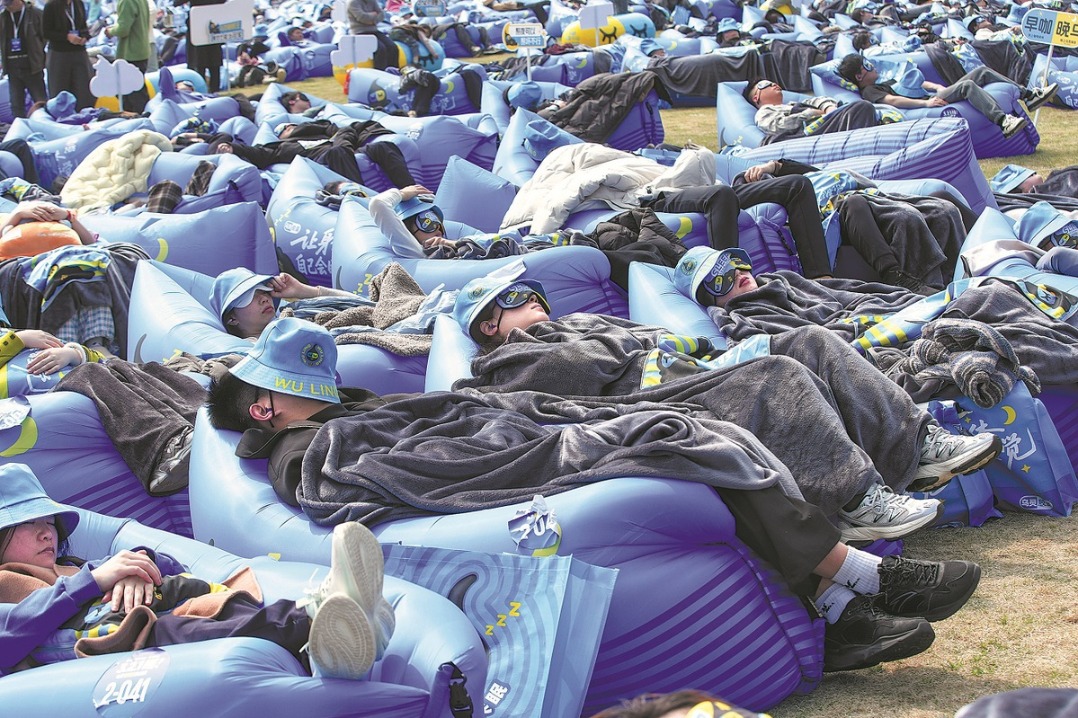
Public health events have also helped raise broader awareness of the importance of rest and stress management, with niche activities popping up to meet growing interest. Earlier this year in Huzhou, Zhejiang province, a public sleep competition invited 1,000 participants to set aside their smartphones, wear masks and earplugs, and focus on intentional rest, with the goal of raising public awareness of sleep health among overworked urban professionals.
Unlike mature, well-documented sectors such as e-commerce or ride-hailing, the lunch-break economy remains a fragmented phenomenon spanning wellness, beauty, fitness, hospitality, food service and furniture retail. But as urban work pressure continues to rise and professionals increasingly prioritize personal well-being alongside career advancement, industry observers expect the segment to continue its rapid expansion in coming years.