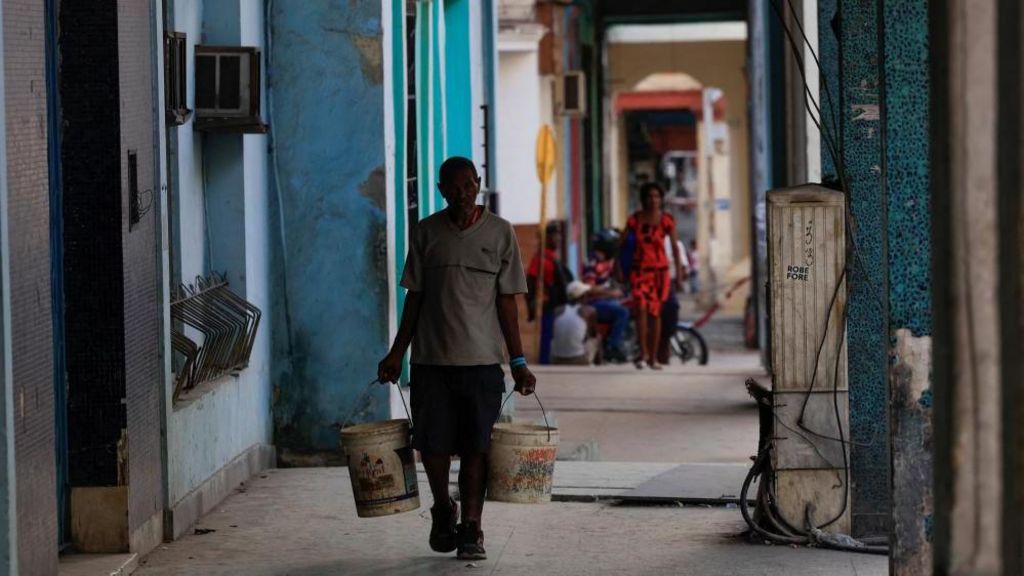
On Tuesday evening, spontaneous public demonstrations broke out across multiple Cuban communities, with furious residents banging pots and pans and lighting refuse ablaze to voice their frustration over a fresh nationwide power outage that has left large swathes of the island without electricity. This act of public dissent, rare in a country where open opposition to the ruling Communist government is commonly met with lengthy prison sentences, reflects the growing public anger over the island’s ongoing energy crisis that has dragged on for months.
The root of Cuba’s energy shortage traces back to long-standing fuel scarcity, a crisis that has been sharply worsened by stringent US sanctions and a de facto oil blockade on the island. Even residents who own backup generators are often left unable to operate them, as there is no fuel available to power the units amid ongoing shortages.
This latest unplanned outage, which occurred on Monday, marks the third nationwide blackout Cuba has experienced in 2026. It comes on top of pre-planned rolling blackouts that the Cuban government has implemented to conserve the country’s dwindling fuel supplies. In hard-hit rural regions, communities have been left without power for as long as 70 consecutive hours during scheduled outages, while urban centers face planned cuts that can stretch up to 30 hours at a time. As of Tuesday evening local time, the state-owned national electricity company had not released any explanation for what caused this latest unplanned full-grid outage. One of the hardest-hit areas that remained without power Tuesday was Santiago de Cuba, the country’s second-largest city. While Cuban officials announced that power service had been restored to most of the country by Tuesday, residents in still-dark neighborhoods took to the streets shouting demands to “turn on the lights!”
Cuban President Miguel Díaz-Canel has publicly acknowledged that discontent is spreading across the island. In an interview with Puerto Rico-based Spanish-language weekly Claridad, he admitted that the widespread hardships facing ordinary Cubans have fueled frustration. “There are shortages of transport, food, medicines, there are lengthy power cuts lasting more than 20 hours, that causes dissatisfaction, nobody can be happy, the people are suffering,” Díaz-Canel told reporters. However, the president placed full blame for the crisis on the United States, urging angry Cubans to direct their protest toward the US government instead of his own. “People bang pots, some with more anger than others. I say: direct your pot-banging towards our northern neighbours, who are the ones behind these power cuts,” he added.
The United States has rejected this blame, with US Ambassador to the United Nations Michael Waltz placing full responsibility for the outage and the broader crisis squarely on the Cuban government during a Tuesday address to the UN General Assembly. Waltz called on the Cuban government to “change your ways and turn the lights back on for your people,” and claimed that “there always seems to be enough power for the Cuban dictatorship.”
Cuba’s Foreign Minister Bruno Rodríguez countered by accusing the US of waging “multi-dimensional, non-conventional warfare” against the Cuban government and people, which he said has “become ever more cruel” over the past seven months.
Decades of already strained US-Cuba relations have deteriorated sharply since the start of 2026, after US President Donald Trump labeled the Cuban government a national security threat to the United States. Tensions spiked further in January, after US forces seized former Venezuelan President Nicolás Maduro — a close ally of Havana — leading Trump to publicly speculate that Cuba was “ready to fall.”
In the months following Maduro’s ousting, the Trump administration imposed sweeping new sanctions on Cuba, enacted the effective oil blockade that has crippled the country’s energy sector, and threatened to impose punitive tariffs on any third-party country that supplies fuel to Havana. The US also recently filed murder charges against former Cuban President Raúl Castro, who remains an influential political figure on the island at the age of 95.
Despite the very public exchange of accusations and escalating tensions, officials from both countries have confirmed that private negotiations have been ongoing in recent weeks. Rodríguez said Tuesday that the secret talks have so far “show no progress,” but confirmed that Cuba remains open “to dialogue based on mutual respect and non-interference in Cuba’s internal affairs.”